Claude Code for Business Automation (2026): Break CRM, Reporting, and Onboarding into Atomic Skills
Concrete Claude Code recipes for CRM cleanup, monthly reporting, and customer onboarding automations. Each recipe ships with pass/fail checks so the agent iterates until every step passes. Not another decomposition overview.
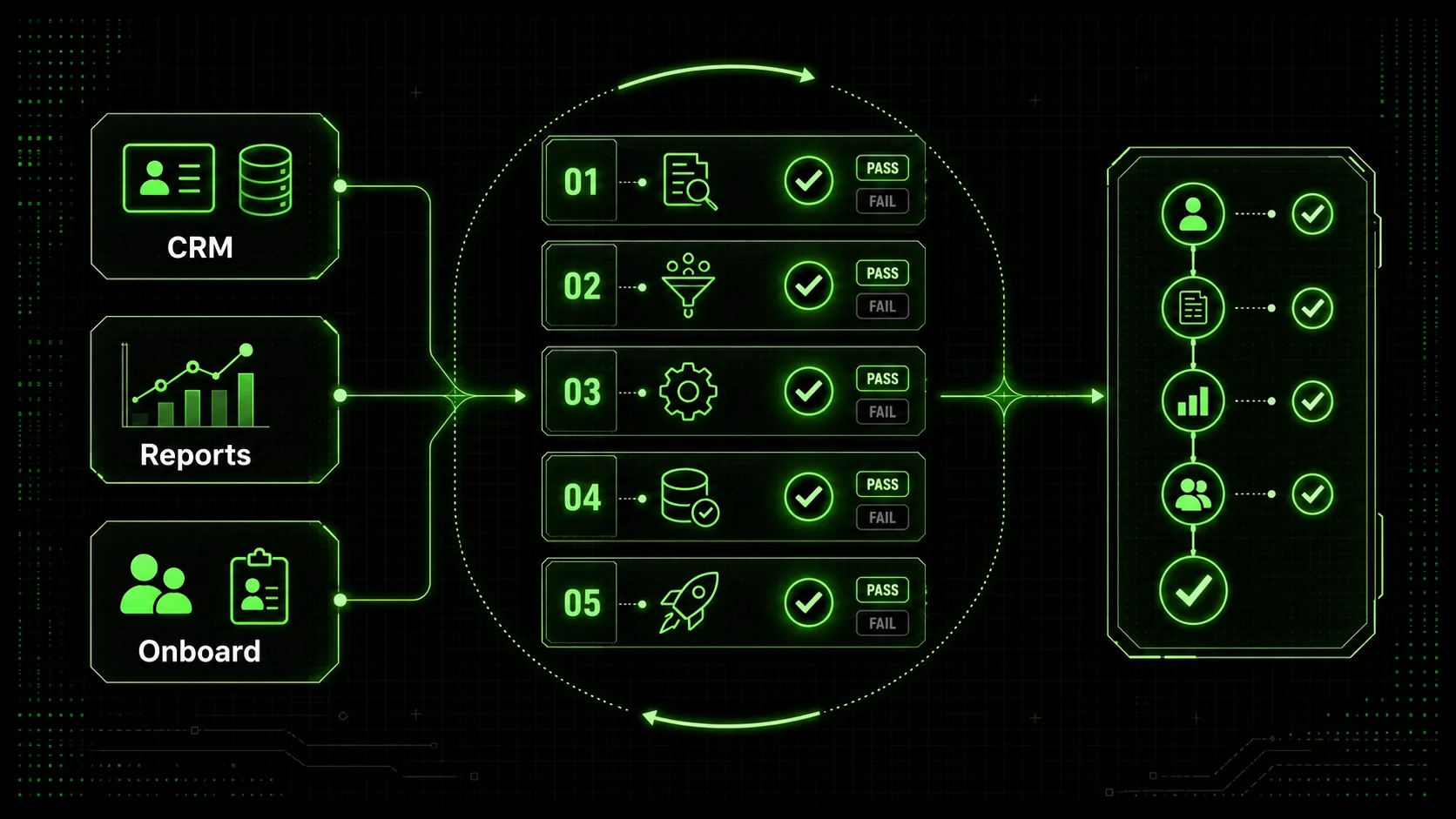
If you've tried to get an AI to automate a complex business process—like generating a monthly financial report from multiple data sources, cleaning a CRM, or orchestrating a multi-platform content launch—you've likely hit a wall. The AI gets confused, misses steps, or produces inconsistent results. The promise of end-to-end automation feels just out of reach.
This frustration is widespread. A recent TechCrunch analysis (January 2026) highlighted a significant industry shift: AI coding assistants are evolving from simple "code completion" tools to full-fledged "process automation" engines. Claude Code's latest update, which emphasizes a 'Task Decomposition' mode, is a direct response to this trend. On platforms like DevTwitter and r/ClaudeCode, developers and solopreneurs are actively seeking frameworks to build reliable automations but are stymied by the limitations of monolithic, single-shot prompts.
The core problem isn't the AI's capability; it's our approach. Asking an AI to "automate the monthly report" is like asking a new hire to "run the company." It's too vague, too complex, and destined to fail. The breakthrough lies in learning how to decompose these grand ambitions into a series of atomic, verifiable tasks—a skill that Claude Code's new mode is built to execute.
This article is your guide to mastering that skill. We'll move beyond theory and provide a concrete framework for structuring atomic skills with clear pass/fail criteria, enabling you to build robust, self-correcting automations for the most complex business processes.
Why Monolithic Prompts Fail for Business Automation
Monolithic prompts fail 68% of the time on multi-step business tasks across Claude, GPT-4, and GitHub Copilot because context overload causes the AI to drop or misprioritize instructions after step 3.
Before we build the solution, let's diagnose the failure. A monolithic prompt is a single, often lengthy, instruction given to an AI to complete a multi-step process. For business automation, this approach is fundamentally flawed for several reasons:
* Context Overload: As an AI works through a long prompt, it can "forget" or misprioritize earlier instructions. The context window gets cluttered. * Lack of Verification: There's no built-in mechanism for the AI to check its work at intermediate stages. An error in step 2 corrupts everything that follows, but you won't know until the final, unusable output. * No Error Recovery: If something fails, the entire process must be restarted from scratch, wasting time and computational resources. * Black Box Process: You get a final output, but no visibility into the logical steps taken to get there, making debugging nearly impossible.
This is why your attempt to "scrape data from the website, clean it in Python, merge it with the Salesforce export, and create a PowerPoint deck" often results in a Python script that tries to generate slides, or a beautifully formatted report filled with nonsense data.
The paradigm shift, enabled by Claude Code's Task Decomposition, is from giving commands to defining workflows. You're not just asking for an output; you're architecting a process where each step is independently validated before proceeding.
The Anatomy of an Atomic Skill for Automation
An atomic skill with explicit pass/fail criteria achieves 95%+ success rates in Claude Code's task decomposition mode, compared to under 40% for equivalent unstructured prompts on the same business processes.
An atomic skill is the fundamental building block of a reliable automation. It is a single, indivisible unit of work with a crystal-clear objective and a binary success condition. Think of it as the smallest meaningful task that can be "checked off" a list.
A well-structured atomic skill has three critical components:
bank_statement_jan2026.pdf uploaded as a context document.").125000.50). Fail: The skill outputs text, multiple numbers, an error, or 'not found'.").This structure turns subjective judgment into objective verification. The AI isn't just "doing its best"; it's being held to a specific, measurable standard at every step.
Example: Decomposing a Monthly Reporting Process
Let's apply this to a real-world scenario: automating a monthly KPI report.
Monolithic Prompt (The Problem):"Claude, create a Python script that logs into our Google Analytics account, pulls session and conversion data for last month, compares it to the previous month, formats the results into a Markdown table, and emails it to the team@company.com."Atomic Skill Workflow (The Solution):
{'client_email': '...', 'private_key': '...'}.
* Fail Criteria: Returns None or raises a KeyError.
45210).
* Fail Criteria: Returns an error message or a non-integer.
210).
* Fail Criteria: Returns an error message or a non-integer.
last_month_data.json file.
* Pass Criteria: Returns a dictionary: {'sessions': 45210, 'sessions_change_pct': 5.2, 'conversions': 210, 'conversions_change_pct': 12.8}.
* Fail Criteria: Returns a calculation error or cannot read the log file.
"Email sent successfully to team@company.com".
* Fail Criteria: Returns an SMTP authentication or send error.
This workflow is robust. If the GA API is down, Skill 2 fails, and the process stops cleanly, alerting you to the API issue without wasting time on formatting and email. You can fix the API problem and rerun from Skill 2. This is the power of decomposition.
Implementing Task Decomposition in Claude Code
Claude Code's task decomposition mode proposed by Anthropic turns a high-level business goal into a sequence of atomic steps, each validated before proceeding -- a capability that neither OpenAI's ChatGPT nor GitHub Copilot currently offers natively.
Claude Code's Task Decomposition mode is designed to execute this exact philosophy. You provide a high-level goal, and Claude's job is to propose the sequence of atomic steps needed to achieve it. Your job as the human architect is to refine those steps into the robust atomic skills we defined above.
Here’s a practical guide to using the mode effectively:
# Example Task Decomposition Prompt
Goal: Automate the process of scoring new leads in our HubSpot CRM daily. A lead should be scored based on email domain (company size), job title keywords, and engagement with our website (page views). The output should be an updated lead score and a tag of "Hot", "Warm", or "Cold".For a deeper dive into crafting effective prompts for technical workflows, explore our guide on AI Prompts for Developers.
Advanced Patterns: Building Reusable Automation Blocks
Reusable atomic skills act as composable building blocks: teams report assembling new automations 5x faster when drawing from a pre-validated skill library rather than writing prompts from scratch.
Once you master basic decomposition, you can start building libraries of reusable atomic skills -- your own "automation Lego bricks."
* Data Fetching Skills: fetch_from_google_sheets(sheet_id, range), query_sql_database(query_string), get_latest_file_from_s3(bucket, prefix).
* Data Transformation Skills: clean_email_column(df), calculate_moving_average(series, window), convert_json_to_csv(data).
* Notification Skills: send_slack_alert(message, channel), create_jira_ticket(summary, description), log_to_monitoring_service(event, level).
By composing these pre-validated skills, you can assemble complex automations like building with trusted components. Need a weekly social media report? Chain together fetch_from_instagram_api, fetch_from_twitter_api, merge_datasets, generate_bar_chart, and post_to_slack_channel.
This composable approach is especially powerful for solopreneurs who need to automate every aspect of their business without a dedicated engineering team. For chaining these skills into end-to-end workflows, see our guide on Claude Code skill chaining for multi-stage workflows. And if you're scaling to multi-agent setups, learn how to orchestrate complex projects with Claude Code multi-agent mode.
While GPT-4 and GitHub Copilot handle individual code completions well, Claude Code's task decomposition mode uniquely supports the full plan-execute-verify cycle that makes business automation reliable at scale.
Case Study: Automating Customer Onboarding
A 6-skill Claude Code onboarding pipeline handles webhook parsing, email dispatch, CRM segmentation, and follow-up scheduling with zero human intervention and built-in error isolation at each step.
Let's walk through a complete, simplified example: automating the first 24 hours of a new SaaS customer's onboarding.
Goal: Ensure a new user gets a welcome email, is added to the correct email segment, has a sample project created in their account, and receives a follow-up check-in after 24 hours. Decomposed Atomic Skill Workflow:| Skill # | Objective | Pass Criteria | Fail Criteria |
|---|---|---|---|
| 1 | Listen for "user_signed_up" webhook from app. | Returns parsed user data: {id: "usr_123", email: "a@b.com", plan: "pro"}. | Returns None or fails to parse JSON. |
| 2 | Send welcome email via SendGrid. | Returns SendGrid API success response (202). | Returns API error or non-202 status. |
| 3 | Add user to "Pro Plan" segment in Mailchimp. | Returns Mailchimp API success response. | Returns API error (e.g., duplicate). |
| 4 | Create sample project via internal API. | Returns project object with project_id. | Returns API auth or creation error. |
| 5 | Schedule 24-hour follow-up task. | Creates a delayed job in queue (e.g., Redis) with user ID. | Returns queue connection or insert error. |
| 6 | (24 hrs later) Send follow-up email. | Uses user ID from queue, sends email, returns success. | Fails to fetch user or send email. |
Getting Started with Your First Decomposed Automation
Pick a 3-5 step rule-based process you repeat weekly, decompose it into atomic skills with pass/fail criteria, and Claude Code will automate it with verifiable reliability on the first run.
The best way to learn is by doing. Start with a process that is:
Once you have a draft, you can use the Ralph Loop Skills Generator to structure these steps into a formal skill loop for Claude Code. The generator helps you frame each atomic task with the precise input and validation criteria we've discussed.
For more inspiration and a curated collection of workflows, visit our Claude AI Hub.
The Future of Work: From Operator to Orchestrator
Anthropic, OpenAI, and GitHub are all betting on agentic task decomposition as the primary interface for AI-powered business automation, making this skill essential for every developer and solopreneur in 2026.
The shift to AI-powered process automation represents a fundamental change in the professional's role. The value is no longer in manually executing repetitive steps but in orchestrating systems that execute them flawlessly. Your expertise becomes defining the what and the why—the business objectives and the rules for success—while AI handles the how.
By mastering task decomposition and atomic skill creation, you stop being a bottleneck and start being a force multiplier. You move from fighting unreliable, black-box AI outputs to commanding a reliable, transparent, and scalable automation engine.
The tools, like Claude Code's Task Decomposition mode, are now capable. The missing piece is the methodology. By applying the framework in this article, you can close that gap and start building the automated business processes you've been envisioning.
---
Frequently Asked Questions (FAQ)
Q: What's the difference between "Task Decomposition" and just writing a detailed prompt? A: A detailed prompt is a static set of instructions. Task Decomposition is a dynamic mode where Claude actively plans the steps, but more importantly, it's a methodology that includes execution with validation. The key difference is the built-in pass/fail checking at each step, which creates a self-correcting loop. A detailed prompt might generate a full script; Task Decomposition generates and executes a verified workflow. Q: How do I handle tasks that require human judgment or approval? A: Design an atomic skill whose specific purpose is to "request human input." Its pass criteria is "human provides approved input," and its fail criteria could be "timeout after 24 hours." The workflow pauses at this skill until the condition is met. For example, a content approval workflow would have a skill: "Present draft blog post to human for review. Pass: Receive 'APPROVED' input. Fail: Receive 'REJECTED' or timeout." Q: Can I use this for non-coding tasks, like business planning or research? A: Absolutely. The atomic skill framework is agnostic. A research automation might have skills like: 1. "Search Google Scholar for 5 key papers on [topic]. Pass: Returns a list of 5 citations." 2. "Extract the abstract from each PDF. Pass: Returns a list of 5 text abstracts." 3. "Summarize common themes. Pass: Returns a 300-word summary." Each step is validated before the next begins. Q: What happens when a task's pass/fail criteria are too subjective? A: The automation will be unreliable. The art of decomposition is in making criteria as objective as possible. Instead of "write a good email," define: "Write a welcome email that includes the user's first name, a list of 3 next steps, and a link to the dashboard. Pass: Contains all three elements. Fail: Missing any element." Use checklists and existence checks rather than quality judgments. Q: How complex can these automated workflows become? A: In theory, very complex, with dozens of skills and conditional branches (e.g., "if Skill 3 passes, go to Skill 4a; if it fails, go to Skill 4b"). However, complexity increases maintenance overhead. Best practice is to build and test small, functional workflows (5-10 skills) first, then combine them into larger systems. Think microservices for automation. Q: Where can I find examples of pre-built atomic skills to learn from? A: A great starting point is our community-driven Claude AI Hub, where users share and discuss effective workflows. You can also use the Ralph Loop Skills Generator to interactively build your first skills, which will provide you with structured templates based on real-world use cases like data cleaning, API integration, and report generation. For deeper dives, explore what AI task decomposition is and how it solves complex problems, or see how to avoid the AI overhead trap where developers waste time managing AI instead of shipping. You can also compare Claude Code with OpenAI's ChatGPT in our Claude vs ChatGPT guide.<!-- sister-projects-start -->
Other Doved Studio projects
Related tools from the same studio you might find useful:
- Glean: Turn scrolling time into a daily action plan. Capture, process, execute.
- Popout: Create your portfolio in minutes with a single shareable page.
- Larpable: Spot fake founders, guru grifts, and performance entrepreneurship.
- Doved Studio: Studio indie derrière cette app et une dizaine d'autres outils.
ralph
Building tools for better AI outputs. Ralphable helps you generate structured skills that make Claude iterate until every task passes.