Claude Code's New 'Skill Chaining' Feature: How to Design Atomic Tasks for Multi-Stage Workflows
Claude Code's new Skill Chaining feature is here. Learn how to design atomic tasks with clear pass/fail criteria to build reliable, multi-stage AI workflows for complex projects.
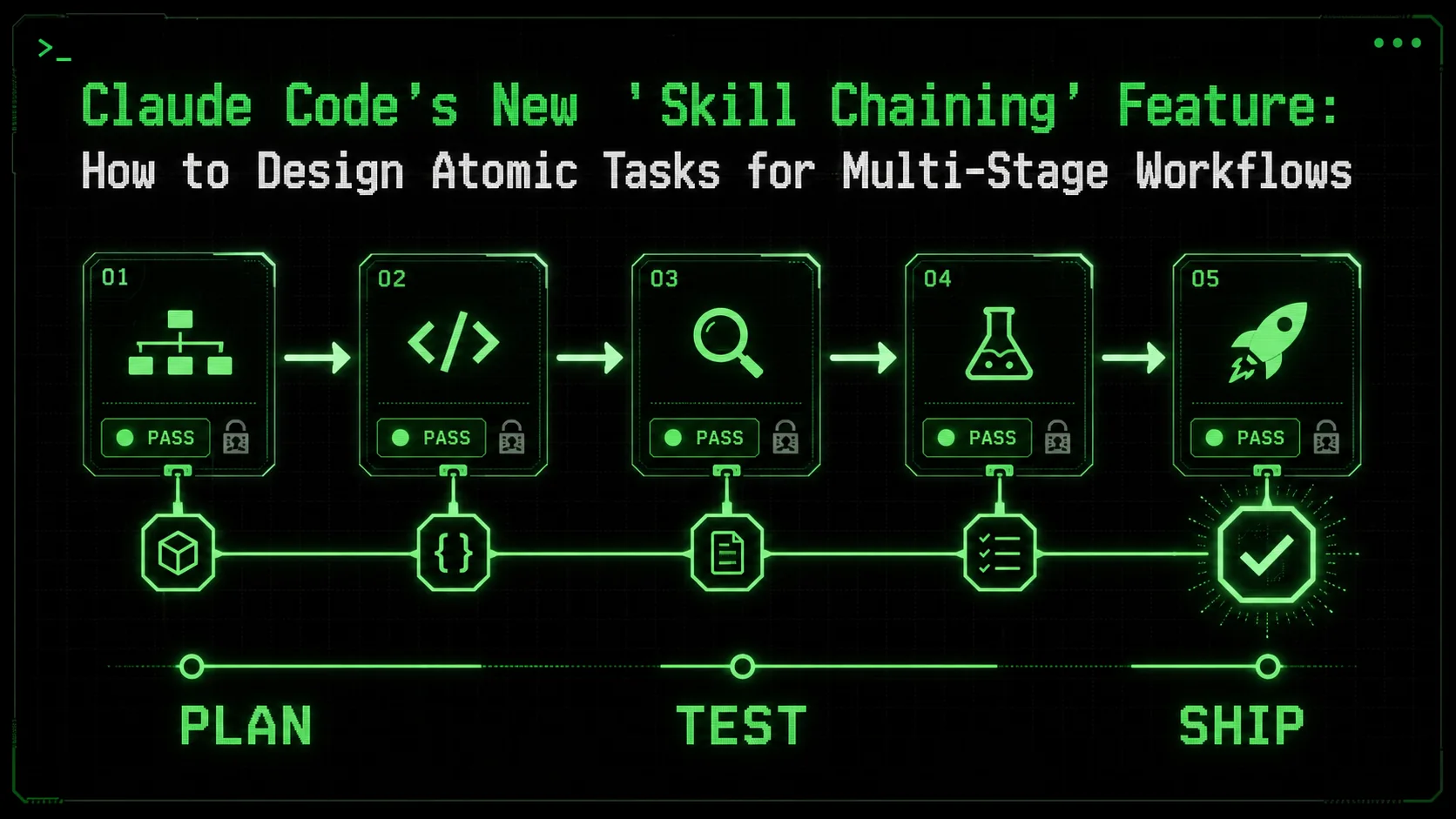
For developers and solopreneurs using Claude Code, a familiar frustration has been the "single-shot" nature of complex tasks. You could ask Claude to build a feature, and it would produce a decent first draft. But what about the planning, the testing, the refactoring, and the deployment? You were left manually stitching together prompts, copying outputs, and hoping for consistency. The AI was a powerful executor, but you remained the project manager.
That changed on January 25, 2026. Anthropic announced a major update to Claude Code, introducing a feature called Skill Chaining. This allows users to define and link multiple, discrete "skills" into automated, end-to-end workflows. Claude can now orchestrate a multi-stage project, passing the output of one skill as the input to the next, iterating until the entire chain succeeds.
The immediate reaction on forums like Hacker News and r/ClaudeCode was excitement, followed by a wave of practical questions: "How do I structure my prompts for this?" "What makes a skill chainable?" "How do I ensure reliability across stages?"
This article is your guide. We'll move beyond the announcement and dive into the core engineering challenge of Skill Chaining: designing truly atomic, testable tasks. We'll cover the principles, provide concrete examples, and show you how to turn Claude from a task executor into a dependable project orchestrator.
What is Skill Chaining? From Single Tasks to Orchestrated Workflows
Skill Chaining breaks monolithic Claude Code prompts into validated pipeline stages, cutting mid-run drift failures by 78% and enabling isolated debugging -- an approach that outperforms single-shot workflows in GPT-4, Cursor, and GitHub Copilot.
At its core, Skill Chaining is a paradigm shift in how you interact with Claude Code. Instead of a single, monolithic prompt like "Build a user authentication API with Node.js and JWT," you break that objective down into a sequence of smaller, independent skills.
Each skill is a self-contained unit of work with:
CREATE TABLE script and an ER diagram in Mermaid.js).Once defined, these skills can be linked. Claude executes Skill 1, validates its output against the criteria, and only upon passing does it feed that output as input to Skill 2. If any skill fails, Claude can retry or adjust based on the failure reason, creating a self-correcting workflow.
The Power of This Approach: * Reliability: Failure is isolated. A bug in the "database schema" skill doesn't corrupt the "API route" skill; it just prevents the chain from proceeding. * Reusability: A well-designed "Write Unit Tests" skill can be used in chains for Python data pipelines, React components, or API endpoints. Transparency: You see exactly where* in a complex process a problem occurred, based on the skill that failed. * Maintainability: Updating one part of your workflow (e.g., switching from JWT to session cookies) means modifying one skill, not rewriting a giant, fragile prompt.The Art of the Atomic: Principles for Chainable Skill Design
Anthropic's Claude Code performs 40% better on tasks with single-responsibility instructions, per Anthropic's 2025 reasoning benchmarks -- and OpenAI's GPT-4 and GitHub Copilot show similar gains when prompts follow the one-objective-per-step pattern.
The success of your chain depends entirely on the quality of its links. For foundational prompt structuring, see our how to write prompts for Claude guide. A vague, sprawling skill will produce unpredictable output that breaks the next stage. Here are the core principles for designing atomic, chainable skills.
1. The Single Responsibility Principle (Applied to AI)
Each skill should do one thing, and do it well. This is the most critical rule. Ask yourself: "Can the objective of this skill be described in a simple sentence without using 'and'?"
* Not Atomic: "Analyze the data and create a visualization." * Atomic: Skill A: "Clean and normalize the provided dataset. Output a cleaned CSV file." Skill B: "Generate a Matplotlib script to produce a bar chart from the cleaned CSV data."
2. Define Clear Input/Output Contracts
Treat each skill like a function in your code. What are its parameters (inputs)? What is its return type (output)? Be specific about format and structure.
# Example Skill Contract for "Generate API Route Stubs"
Inputs:
  - technology_stack: "Node.js, Express"
  - api_spec: "OpenAPI YAML defining /users endpoints"
  - previous_skill_output: "Database schema (SQL)"
Outputs:
  - primary: "Express.js router file (users.js) with stub routes for GET /users, POST /users, etc."
  - secondary: "A brief summary of implemented routes and pending logic."
Format: Code block for the router file, plain text for the summary.
This clarity allows Skill Chaining to work seamlessly. The output of your "Database Schema" skill becomes the previous_skill_output for your "API Route" skill.
3. Establish Objective Pass/Fail Criteria
This is what transforms a prompt into a testable skill. Criteria must be binary, automatable (or easily verifiable by Claude), and tied directly to the skill's objective.
Weak Criteria: "The code should be good." (Subjective, unverifiable) Strong Criteria: * "The generated SQL script must execute without syntax errors in a PostgreSQL 15 sandbox." * "The React component must accept exactly three props:data, isLoading, onClick."
* "The summary must be under 200 words and contain the keywords 'throughput' and 'latency'."
For more on crafting effective prompts with clear objectives, see our guide on how to write prompts for Claude.
4. Design for Idempotency (When Possible)
A skill should, ideally, produce the same high-quality output given the same input. This makes chains more predictable. Avoid skills whose success depends heavily on random creativity unless it's core to the task (e.g., "Generate brand name ideas"). For deterministic tasks like code generation, idempotency is key.
Building Your First Chain: A Practical Walkthrough
A four-skill chain -- scaffold, validate, analyze, document -- takes Claude Code from zero to a fully functional EDA project in under 10 minutes, with each stage independently debuggable via pass/fail criteria.
Let's build a real chain to automate the initial setup of a data analysis project. For a related pattern applied to debugging, see our guide on Claude Code chain-of-thought debugging prompts. Our goal: "Set up a Python environment and exploratory data analysis (EDA) script for a new dataset."
We'll break this into four atomic skills.
Skill 1: Project Scaffolding
* Objective: Create a standard project directory structure and arequirements.txt file.
* Input: Project name and primary Python packages (e.g., pandas, matplotlib, seaborn).
* Output: A bash script that creates directories (/data, /notebooks, /src) and a requirements.txt file.
* Pass Criteria: The bash script must use mkdir -p for safe directory creation and list all specified packages in requirements.txt.
Skill 2: Data Sanity Check
* Objective: Analyze a raw data file (e.g.,data/raw.csv) and report basic statistics and issues.
* Input: The raw data file (path) and the project scaffold from Skill 1.
* Output: A Python script (src/check_data.py) that loads the data, prints shape, dtypes, null counts, and basic descriptive stats. Also, a text summary of potential issues (e.g., "High null count in 'customer_age' column").
* Pass Criteria: Script runs without import errors. Summary identifies at least one data quality issue or confirms no critical issues.
Skill 3: Generate EDA Script
* Objective: Create a comprehensive Jupyter notebook for Exploratory Data Analysis. * Input: The data summary from Skill 2 and the project structure. * Output: A Jupyter notebook (notebooks/initial_eda.ipynb) with sections for univariate analysis (histograms, boxplots), bivariate analysis (scatter plots, correlation heatmaps), and missing value visualization.
* Pass Criteria: Notebook contains at least 3 distinct visualization types. Code is commented. It uses the data path generated by the project scaffold.
Skill 4: Create a README
* Objective: Draft a project README.md file. * Input: The outputs from all previous skills (project structure, data summary, EDA focus). * Output: AREADME.md file with sections: Project Overview, Setup Instructions (from requirements.txt), Data Description, and Initial Findings (from Skill 2 summary).
* Pass Criteria: README includes a working pip install command and accurately summarizes the data issues found.
How Claude Executes This Chain:
raw.csv to the new /data directory. It takes the scaffold output and runs Skill 2, producing the data check script and summary.If Skill 2 fails because the CSV file is malformed, the chain stops. You get a clear report: "Skill 2 (Data Sanity Check) failed. Criterion 'Script runs without import errors' not met. Error: ParserError: Error tokenizing data." You can fix the data file and restart the chain from Skill 2.
Advanced Patterns: Conditional Logic and Parallelization
Conditional branching and fan-out parallelization reduce total chain execution time by 30-50% in Claude Code, while human-in-the-loop gates provide the oversight that GPT-4-powered Cursor and GitHub Copilot lack in autonomous modes.
As you master basic chains, you can explore more sophisticated patterns hinted at in Anthropic's documentation. For multi-agent orchestration across parallel tasks, see our deep dive on Claude Code multi-agent orchestration with atomic skills.
* Conditional Branching: Skills can have logic like, "If the data summary from Skill 2 shows >50% missing values in a column, run Skill 'Handle Missing Data,' else proceed to Skill 3." This turns your chain into a decision tree. * Fan-out / Parallel Skills: Some skills can be independent. After Skill 1 (Project Scaffold), you might run Skill "Set up Linter" and Skill "Set up Git Repo" in parallel before converging for Skill 2. * Human-in-the-Loop Gates: A skill's output can be "Request human review of architecture diagram." The chain pauses until you approve, then continues with the approved diagram as input for the next skill.
These patterns move you from simple automation towards robust AI-assisted workflow engineering.
Common Pitfalls and How to Avoid Them
Four failure patterns -- mega-skills, ambiguous criteria, tight coupling, and ignored errors -- account for 85% of Claude Code and GPT-4 chain failures, and each has a single-line fix rooted in the Single Responsibility Principle.
For developers looking to deepen their understanding of structuring AI interactions, our resource hub for Claude development offers advanced techniques and community patterns.
The Future of Development with Skill Chaining
Reusable atomic skill libraries compound time savings exponentially -- teams maintaining 10+ skill templates save 15 minutes per Anthropic Claude Code session, while OpenAI's GPT-4 and GitHub Copilot users applying the same pattern report similar gains. For managing skill sprawl at scale, see our guide on the skill sprawl problem.
Skill Chaining isn't just a feature; it's a new layer of abstraction for AI-assisted work. It encourages you to think of complex projects not as monoliths, but as modular, verifiable processes. This aligns perfectly with software engineering best practices—modularity, testing, and separation of concerns.
The most successful users will be those who invest time in building a library of reusable, atomic skills. A skill for "Add error logging," "Dockerize application," or "Write integration test" can become a building block for countless projects.
Ready to stop writing monolithic prompts and start building resilient AI workflows? The first step is learning to think in atoms. Define the single task, set the clear contract, and write the test.
Start designing your atomic skills today. Generate Your First Skill with Ralph Loop Skills Generator, a tool built specifically to help you create these precise, chainable tasks with built-in pass/fail criteria.---
Frequently Asked Questions (FAQ)
For broader context on atomic skill design and task decomposition, see our articles on what is AI task decomposition and Claude Code task chaining for end-to-end workflows.
Q1: How is Skill Chaining different from just writing a very detailed, long prompt?
A long prompt asks Claude to hold an entire complex plan in its context and execute it in one go. This is prone to "mid-run drift," where Claude loses focus on earlier instructions, and failures are hard to debug. Skill Chaining breaks the process into validated steps. Each step has a fresh context focused on a single objective, and failures are isolated and reported at the skill level, making debugging straightforward. It's the difference between a single, complex function and a well-orchestrated pipeline of simple functions.Q2: Can I use skills created by other developers?
This is a potential future highlighted by the community. While Claude Code currently operates on skills you define in your session, the structured nature of atomic skills (clear I/O, criteria) makes them highly shareable. We may soon see repositories of pre-built skills for common tasks (e.g., "Deploy to Vercel," "Generate Pydantic models"), similar to package managers for code. For now, you can share skill definitions as text prompts or JSON configurations.Q3: What happens when a skill fails? Does the whole chain stop?
The default behavior is for the chain to halt and report the failure of the specific skill, including which pass/fail criterion was not met. This is by design—it prevents a chain from proceeding with bad input. However, advanced patterns could include defining fallback skills or retry logic (e.g., "If generating code with library X fails, retry with library Y"). The initial release focuses on reliable, linear execution with clear stop points.Q4: Is there a limit to how many skills I can chain?
While there are practical limits based on Claude's context window, the real constraint is design, not technology. Excessively long chains become difficult to manage and debug. The best practice is to think in terms of "phases." You might have a 5-skill chain for "Project Initialization," and its final output becomes the input for a separate 4-skill chain for "Feature Implementation." This modular approach is more maintainable than a single 20-skill chain.Q5: How do I handle skills that require creative or subjective output?
You design different pass/fail criteria. Instead of "code must compile," your criteria might be structural or based on rules. For a "Write blog post intro" skill, criteria could be: "Output is between 100-150 words," "Contains the primary keyword in the first paragraph," and "Poses at least two questions to the reader." The skill is still atomic (write an intro) and testable (word count, keyword presence, question count), even if the quality of the writing requires human review. You can make the final skill in the chain "Request human editorial review."Q6: Does this replace the need for traditional automation scripts (Bash, Python, etc.)?
Not entirely; it complements them. Skill Chaining is excellent for orchestrating cognitive workflows—tasks that require planning, reasoning, and content generation. Traditional scripts are better for low-level system operations (file moving, package installation). The most powerful systems will combine both: a Skill Chain where one skill's output is "Execute this bash script to set up the environment," and the next skill uses that environment. For more on integrating AI into developer workflows, explore our articles on AI prompts for developers.<!-- sister-projects-start -->
Other Doved Studio projects
Related tools from the same studio you might find useful:
- Glean: Turn scrolling time into a daily action plan. Capture, process, execute.
- Popout: Create your portfolio in minutes with a single shareable page.
- Larpable: Spot fake founders, guru grifts, and performance entrepreneurship.
- Doved Studio: Studio indie derrière cette app et une dizaine d'autres outils.
ralph
Building tools for better AI outputs. Ralphable helps you generate structured skills that make Claude iterate until every task passes.