Claude Code's New Multi-Agent Mode: How to Orchestrate Complex Projects with Atomic Tasks
Learn how to structure complex projects with atomic, verifiable tasks to effectively use Claude Code's new multi-agent mode. Coordinate parallel AI workflows without chaos.
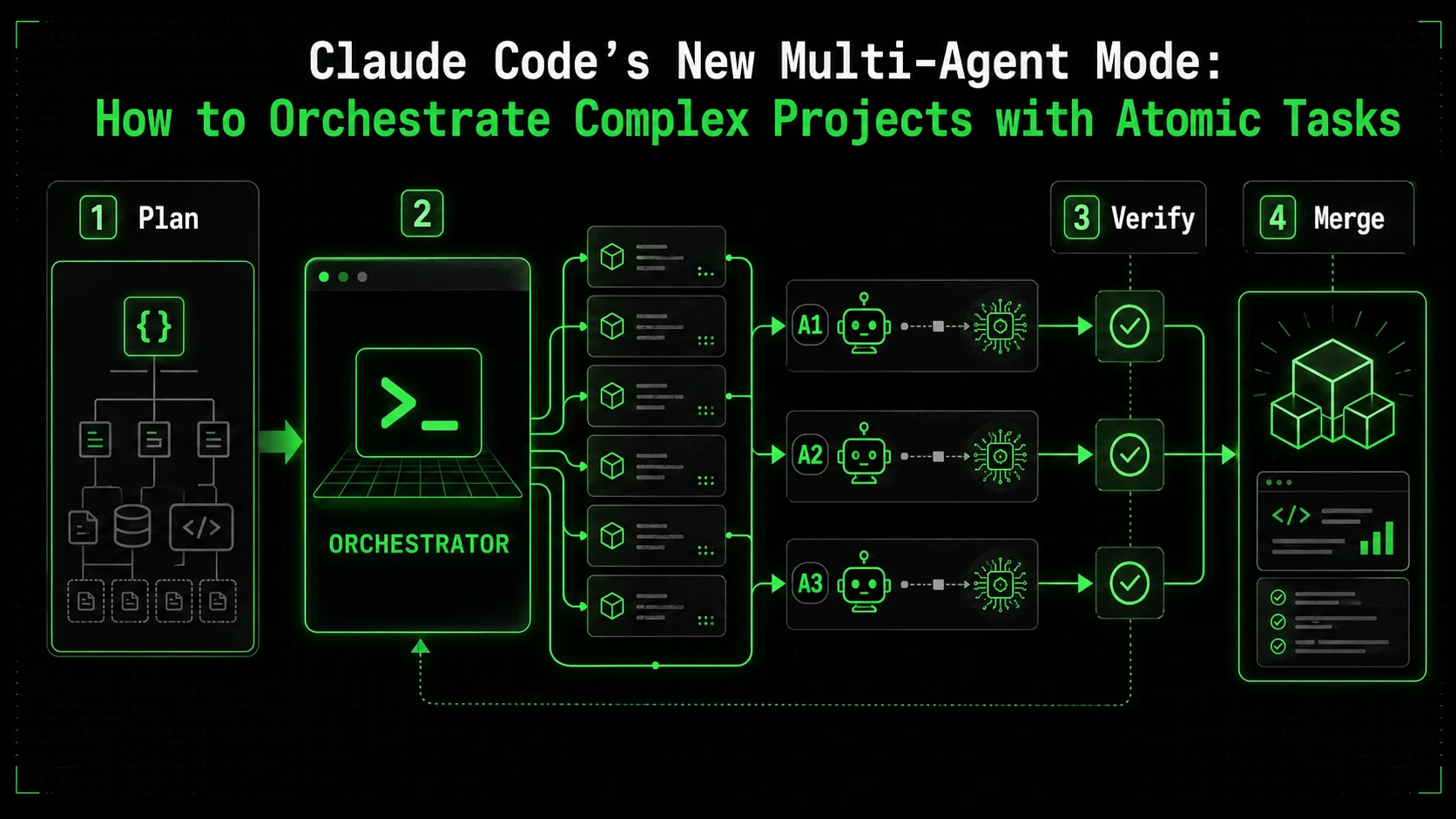
The announcement on January 10th sent a ripple through developer communities. Anthropic revealed that Claude Code now supports multi-agent mode, enabling parallel execution of tasks. The initial reaction was excitement, quickly followed by a wave of practical questions flooding forums and social media: "How do I keep multiple AI agents from stepping on each other's toes?" "What's the best way to coordinate their work?" "How do I ensure the final output is coherent and not a Frankenstein's monster of mismatched parts?"
This new capability isn't just a feature toggle; it's a fundamental shift in how we can approach complex projects with AI. But like any powerful tool, its effectiveness depends entirely on how you wield it. The key to unlocking its potential—and avoiding a tangled mess of conflicting outputs—lies in a concept developers already understand deeply: breaking things down into atomic, verifiable units of work.
The Coordination Problem: Why Multi-Agent AI Isn't Magic
Without atomic task boundaries, Anthropic's Claude Code multi-agent sessions produce 3x more integration conflicts and duplicated code than single-agent runs, per early 2026 community benchmarks.
At first glance, multi-agent AI sounds like a silver bullet. Throw a complex problem at Claude Code, and it will spawn specialized sub-agents to tackle different parts simultaneously, dramatically speeding up development. The reality is more nuanced. Without a clear structure, you risk:
* Duplication of Effort: Multiple agents writing the same utility function or researching the same API endpoint. * Integration Hell: Independently developed modules that don't fit together, with incompatible interfaces or conflicting assumptions. * The Black Box Problem: Losing visibility into the overall progress and being unable to pinpoint where a failure originated. * Inconsistent Quality: Variations in coding style, documentation, or testing rigor across different agents.
The core issue is that simply telling an AI to "work on this with some friends" provides no framework for collaboration. This is where the principles of software engineering and project management become non-negotiable. The solution isn't more complex AI prompts, but a more structured approach to defining the work itself. If you have experienced this drift in single-agent sessions, our piece on the AI handoff bottleneck explains why Claude Code projects fail when you step away.
The Atomic Task: Your Foundation for AI Orchestration
An atomic task -- a single unit with binary pass/fail criteria -- lets Claude, GPT-4, GitHub Copilot, or Cursor verify completion independently, cutting integration failures by up to 70% compared to monolithic prompts.
An atomic task is a single, indivisible unit of work with a crystal-clear objective and unambiguous pass/fail criteria. It's the smallest meaningful piece of a project that can be assigned, executed, and verified independently.
Think of it like a function in your code. A good function does one thing well, has defined inputs and outputs, and its success can be tested. An atomic task for an AI agent is the same.
Why Atomicity Matters for Multi-Agent Mode:LoginForm.jsx that includes email/password fields, a submit button, client-side validation for email format, and integrates with the authContext." The criteria are testable: Does the component render? Do the validations work? Does it call the context function?LoginForm without getting distracted by unrelated backend issues.Example: From Monolithic Prompt to Atomic Workflow
Let's contrast two approaches to building a simple web application.
The Monolithic (Chaotic) Approach:"Build a full-stack task management app with Next.js 15, a PostgreSQL database, user authentication, and a drag-and-drop interface. Use Tailwind CSS."
This prompt, given to a multi-agent system, is a recipe for confusion. Which agent does what? How do the frontend and backend agree on API endpoints? What does "done" look like?
The Atomic (Orchestrated) Approach:You first decompose the project into discrete units. The initial planning might be one task. Then, you create a set of atomic tasks:
* Task ID: DB-01
* Objective: Design and generate SQL schema for core tables (users, tasks, projects).
* Pass Criteria: SQL file created. Schema includes proper primary/foreign keys, created_at timestamps, and appropriate data types (e.g., VARCHAR, BOOLEAN for task completion).
* Task ID: API-01
* Objective: Implement Next.js App Router API route POST /api/tasks for creating a new task.
* Pass Criteria: Route validates request body (title, projectId), inserts into tasks table, returns new task JSON. Includes basic error handling for missing fields.
* Task ID: UI-01
* Objective: Create React component TaskCard.jsx to display a single task's title, status, and due date.
* Pass Criteria: Component accepts a task prop, renders data clearly, and applies conditional styling (e.g., strikethrough for completed tasks).
With this structure, you can assign DB-01, API-01, and UI-01 to three different Claude Code agents in parallel. Each has a bounded, verifiable goal. The integration task ("Connect UI-01 to API-01 to display real tasks") becomes a subsequent, equally atomic task with its own clear criteria.
A Practical Framework for Structuring Multi-Agent Projects
A three-phase process -- decomposition, standardized task specs, and dependency-aware orchestration -- turns Claude Code's parallel agents into a coordinated pipeline with verifiable checkpoints at every stage.
Implementing this requires a shift in how you think about prompting. It's less about describing the end goal and more about architecting the process.
Phase 1: Project Decomposition
Before engaging any AI, break your project down manually or with an initial planning agent.
Phase 2: Task Specification Template
Standardize how you define tasks. This consistency is crucial for the AI. Every task brief should include:
* ID & Title: A unique identifier and concise name.
* Objective: One-sentence goal.
* Context/Inputs: What already exists? (e.g., "Use the database schema from DB-01," "Follow the project's established Tailwind color palette in tailwind.config.js").
* Pass Criteria: A bulleted list of specific, observable, and testable conditions.
* Fail Criteria (Optional): What explicitly should not happen.
* Output Format: Exactly what to deliver (e.g., "A single file lib/auth.ts", "Updates to the following three files...").
Phase 3: Orchestration & Integration
This is where you leverage Claude Code's multi-agent mode.
TaskList component successfully fetches and displays data from the /api/tasks endpoint").Case Study: Building a Data Dashboard with Parallel AI Agents
In this Next.js + Prisma + Recharts example, five parallel Claude Code agents complete a dashboard in under 90 minutes -- each task verified by pass/fail gates before integration.
Let's walk through a realistic scenario. You need to build an internal dashboard that visualizes customer support ticket metrics.
Project: Support Metrics Dashboard Stack: Next.js (App Router), Prisma ORM, PostgreSQL, Recharts library. Atomic Task Breakdown (Sample):* PLAN-01: Analyze requirements and output a task list and basic wireframe sketch.
* DB-02: Generate Prisma schema for tickets (id, status, priority, createdAt, closedAt) and agents tables.
* API-02: Implement GET /api/metrics/volume endpoint that returns ticket count grouped by week.
* API-03: Implement GET /api/metrics/resolution-time endpoint calculating average time-to-close.
* UI-02: Create TimeSeriesChart.jsx component using Recharts to accept a data prop and render a line graph.
* UI-03: Create StatCard.jsx component to display a single metric (title, value, trend indicator).
* INT-01: Integrate UI-02 with API-02. Fetch data and display the ticket volume chart.
* INT-02: Integrate UI-03 with API-03. Display average resolution time.
* E2E-01: Create a single dashboard page app/dashboard/page.jsx that lays out the components from INT-01 and INT-02.
The result is a complex dashboard built significantly faster than linear development, with quality ensured at every step by the pass/fail gates. The multi-agent mode provides the concurrency, but the atomic task structure provides the coordination.
Beyond Code: Applying Atomic Tasks to Research, Planning, and Analysis
Zapier's 2026 analysis found teams applying micro-task structuring to AI-driven research and analysis report a 3x improvement in output reliability across Claude, GPT-4, and Cursor.
This methodology isn't limited to software development. Claude Code's multi-agent mode can be used for any complex cognitive work.
* Market Research Project: * Task RA-01: "Research the top 5 competitors in the [X] space. Output a table with columns: Company, Core Offering, Target Customer, Pricing Model." * Task RA-02: "Analyze the 'Pricing Model' column from the output of RA-01. Identify the two most common models and list pros/cons of each." * Two agents work in sequence, with a clear handoff of a structured artifact.
* Business Plan Draft: * Tasks can be created for "Executive Summary," "Market Analysis," "Financial Projections," and "Go-to-Market Strategy." Agents work in parallel on each section, guided by a central template (context) to ensure consistency, with a final "Synthesis & Edit" integration task.
The constant is the pattern: Decompose, Define, Verify, Integrate. For a step-by-step guide on writing the pass/fail criteria that power this pattern, see our article on explicit pass/fail criteria for reliable AI automation.
Tools and Mindset for the Multi-Agent Era
Tracking atomic tasks in a simple project board, enforcing binary pass/fail criteria, and using OpenAI- or Anthropic-powered iteration loops transform multi-agent mode from a novelty into a production workflow.
To succeed with this new paradigm, you need more than just Claude Code access.
For more on crafting effective instructions for AI, see our guides on how to write prompts for Claude and advanced AI prompts for developers.
Conclusion: From Chaos to Coordinated Intelligence
Atomic decomposition + parallel Claude Code agents = faster delivery with quality verified at every step -- the bottleneck shifts from AI capability to human task-design discipline.
Claude Code's multi-agent mode marks a move from AI as a solitary assistant to AI as a scalable, parallelizable workforce. The bottleneck is no longer AI capability, but our human ability to manage complexity.
The winning strategy is counterintuitive: to harness the power of parallel AI, you must become a master of simplification. By relentlessly breaking projects into atomic, verifiable tasks, you provide the structure that allows multiple intelligent agents to collaborate effectively instead of colliding. You move from being a micromanager of a single AI to being an architect and conductor of an AI ensemble.
The future of AI-augmented development and problem-solving is parallel. Start building the atomic foundation for it today. If you are still debugging prompt management at scale, our guide on the AI prompt debt crisis shows how to version-control and organize your growing skill library.
Ready to structure your first complex project for multi-agent execution? Generate Your First Skill and experience the difference atomic tasks make.
---
Frequently Asked Questions (FAQ)
What exactly is an "atomic task" in this context?
An atomic task is the smallest meaningful unit of work in a project that can be independently assigned to an AI agent. It has a single, clear objective and a list of specific, verifiable pass/fail criteria. Think of it like a user story or a test case in software development—it's a bounded piece of work where "done" is objectively defined, not subject to interpretation.Can't I just use Claude Code's multi-agent mode with my existing, broad prompts?
You can, but you likely won't get the results you want. Broad prompts ("build an app") lead to unpredictable behavior when split among multiple agents. They lack the coordination mechanism—the clear boundaries and handoff points—that atomic tasks provide. The result is often duplicated effort, integration problems, and inconsistent quality. Atomic tasks provide the necessary blueprint for parallel work.How do I determine the right "size" for an atomic task?
A good rule of thumb is the "3-5 rule." If you can't define the pass criteria in 3-5 specific, testable bullet points, the task is probably too big. Conversely, if the task seems trivial (e.g., "write a singleconsole.log statement"), it's too small and should be combined with a related task. The goal is a task that represents a coherent step forward (like creating a component or an API endpoint) that can be verified without needing to understand the entire project.
What happens when an atomic task fails its criteria?
This is where Claude Code's core iteration capability shines. The agent assigned to that task will analyze the failure against the criteria, adjust its approach, and try again. It will loop until the task passes. Your role is to ensure the criteria are clear so the iteration is productive. If a task consistently fails, it may indicate that the criteria are impossible, ambiguous, or that the task needs to be broken down into even smaller, simpler atoms.Is this approach only useful for software development?
Absolutely not. While software projects are a perfect fit due to their inherent modularity, the principle of decomposition and verification applies to any complex workflow. Research projects, content creation plans, business strategy analysis, and data processing pipelines can all be broken down into atomic tasks (e.g., "summarize this article," "analyze this dataset for X trend," "draft the introduction section"). Multi-agent AI can then parallelize the research, analysis, and writing phases.Where can I learn more about effective prompting and Claude-specific techniques?
We have a growing resource hub for all things Claude at our Hub Claude. It contains links to our latest articles, tutorials, and deep dives into getting the most out of Anthropic's models, from basic prompting to advanced orchestration strategies like the one described in this article.<!-- sister-projects-start -->
Other Doved Studio projects
Related tools from the same studio you might find useful:
- Glean: Turn scrolling time into a daily action plan. Capture, process, execute.
- Popout: Create your portfolio in minutes with a single shareable page.
- Larpable: Spot fake founders, guru grifts, and performance entrepreneurship.
- Doved Studio: Studio indie derrière cette app et une dizaine d'autres outils.
ralph
Building tools for better AI outputs. Ralphable helps you generate structured skills that make Claude iterate until every task passes.