AI Prompts for Solopreneurs: Run Your Business with AI
50+ AI prompts for solopreneurs. Automate tasks, make better decisions, and scale your one-person business with tested templates.
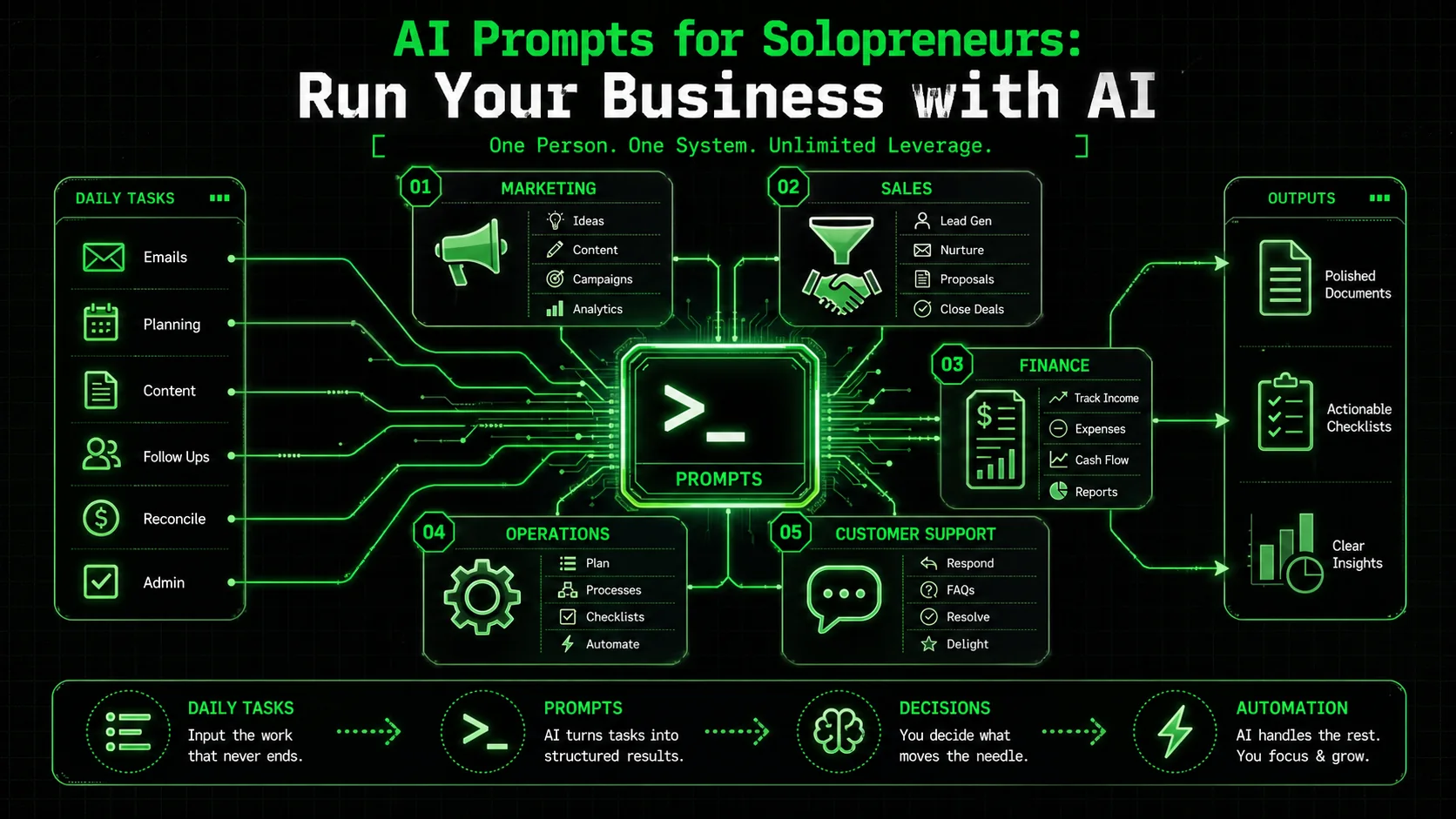
Running a business alone means you do everything. Marketing, sales, finance, operations, customer service, product development—all of it.
There is never enough time. Important tasks slip through cracks. Strategic thinking gets buried under daily fires.
AI changes the equation.With the right prompts, you can compress hours of work into minutes. Get strategic advice without expensive consultants. Create professional content without agencies. Make better decisions with structured analysis.
This guide provides 50+ AI prompts specifically designed for solopreneurs. Not generic templates—practical prompts for the real challenges of running a one-person business.
Each prompt is tested and ready to use with ChatGPT, Claude, or other AI assistants. For more templates across professions, see our complete AI prompts collection.
---
How to Use These Prompts
Copy each prompt into Claude, GPT-4, or any major AI assistant, replace bracketed placeholders with your business details, and iterate on the response until it meets your quality bar.
For each prompt:
---
Business Strategy Prompts
Claude and GPT-4 excel at structured strategic analysis -- solopreneurs using weekly AI reviews report saving 3-5 hours per week on planning tasks according to a 2026 Indie Hackers survey.
1. Weekly Business Review
I run a [type of business] as a solopreneur. Here is my week:
Revenue this week: [amount]
New customers/clients: [number]
Key activities completed: [list]
Challenges faced: [list]
Time spent on different areas: [breakdown]
Act as my strategic advisor. Analyze my week and provide:
What is working well that I should double down on
What is not working that I should stop or change
One specific action for next week that will have the highest impact
Warning signs I might be missing
Be direct and practical. I do not need motivation—I need clarity.
2. Quarterly Planning Session
I need to plan next quarter for my [type of business].
Current situation:
- Monthly revenue: [amount]
- Main revenue streams: [list]
- Biggest challenges: [list]
- Available time per week for business: [hours]
Goals I am considering:
[List your potential goals]
Help me create a focused quarterly plan:
Analyze my goals—which are realistic given my constraints?
Recommend the ONE primary goal that will have the most impact
Break that goal into monthly milestones
Identify the 3-5 key activities I need to focus on
What should I explicitly NOT do this quarter to stay focused?
Keep the plan simple. As a solopreneur, I cannot execute complex strategies.
3. Business Model Evaluation
Evaluate my business model as a solopreneur:
Business: [description]
How I make money: [revenue model]
How I get customers: [acquisition channels]
What I spend time on: [activities breakdown]
What I spend money on: [expenses]
Current monthly revenue: [amount]
Current monthly profit: [amount]
Analyze my business model like a seasoned business advisor:
Is this model scalable for a one-person business?
Where are the biggest inefficiencies?
What is my true hourly rate when I account for all time spent?
What would you change first to improve profitability?
What risks should I be aware of?
Be brutally honest. I would rather hear hard truths now than fail later.
4. Competitive Analysis
I run a [type of business] targeting [audience].
My main competitors are:
[List 3-5 competitors with brief descriptions]
Analyze my competitive landscape:
What are each competitor's apparent strengths and weaknesses?
Where are the gaps none of them are filling?
How can I differentiate as a solopreneur (turning small size into advantage)?
What are competitors doing that I should NOT copy?
What is one positioning angle that could set me apart?
Focus on actionable insights, not generic advice.
5. Revenue Diversification Assessment
My solopreneur business currently makes money through:
[List your revenue streams with approximate percentages]
Total monthly revenue: [amount]
Available time per week: [hours]
Skills I have: [list]
Skills I enjoy using: [list]
Evaluate my revenue situation:
How risky is my current revenue concentration?
What additional revenue streams could fit my skills and time?
Which potential stream would be easiest to add?
Which would have the highest long-term potential?
What is a realistic timeline to add a new revenue stream?
I need practical options, not a list of 20 ideas I will never implement.
---
Marketing and Sales Prompts
Anthropic's Claude and OpenAI's ChatGPT can draft full sales pages, email sequences, and outreach scripts in minutes -- solo founders report 60-80% less time on first-draft marketing copy.
6. Customer Avatar Deep Dive
Help me understand my ideal customer deeply.
My business: [description]
What I sell: [product/service]
Current customers (brief descriptions): [list a few]
Ask me 10 probing questions about my ideal customer. After I answer, synthesize a detailed customer avatar including:
- Demographics and situation
- Their main problems and frustrations
- What they have tried before
- What they really want (not just what they say they want)
- Where they spend time online and offline
- What would make them trust me
- What would make them buy immediately
This needs to be specific enough to guide my marketing decisions.7. Content Strategy for Solopreneurs
I need a content strategy I can actually execute as a solopreneur.
My business: [description]
Target audience: [who]
Time available for content: [hours per week]
Platforms I am on: [list]
Content I have created before: [examples]
What worked: [if known]
What I enjoy creating: [types]
Create a sustainable content strategy:
Which ONE platform should I focus on primarily?
What content format fits my time and skills?
A realistic posting schedule I can maintain
10 content ideas based on what my audience needs
How to repurpose content to maximize reach with minimal effort
What metrics to track (keep it simple)
The strategy must be doable by one person without burning out.
8. Sales Page Copy
Write sales copy for my [product/service].
Product/Service: [name and description]
Price: [amount]
Target customer: [description]
Main problem it solves: [problem]
Key benefits: [list]
What makes it different: [differentiators]
Social proof available: [testimonials, numbers, etc.]
Write a complete sales page including:
Attention-grabbing headline
Opening that connects with the reader's pain
Clear explanation of what they get
Benefits (not just features)
Objection handling
Social proof section
Clear call to action
FAQ section (suggest 5 questions and answers)
Write in a conversational, authentic tone. Avoid hype and manipulation. I want to attract the right customers, not just any customers.
9. Email Sequence for New Subscribers
Write an email welcome sequence for my newsletter subscribers.
My business: [description]
Newsletter focus: [topics]
My voice/personality: [description]
Free resource they signed up for: [if applicable]
What I want them to eventually buy: [product/service]
Write a 5-email welcome sequence:
Email 1: Welcome and deliver value immediately
Email 2: Build credibility and connection
Email 3: Provide useful content related to their problem
Email 4: Share a story or lesson learned
Email 5: Soft introduction to how I can help further
For each email provide:
- Subject line (and one alternative)
- Full email body
- Call to action
Keep emails concise. Busy people do not read long emails.10. Lead Magnet Ideas
I need lead magnet ideas for my solopreneur business.
My business: [description]
Target audience: [who]
Main problems they have: [list]
What I sell: [product/service]
Time I can spend creating it: [hours]
Generate 10 lead magnet ideas that:
Solve a real, immediate problem
Can be created quickly
Naturally lead to my paid offering
Position me as an expert
Will not attract the wrong audience
For each idea, provide:
- Title
- Brief description
- Why it works for my audience
- Estimated creation time
- How it connects to my paid offer
Prioritize ideas by impact vs. effort.11. Social Media Bio Optimization
Help me optimize my social media bios.
My business: [description]
Target audience: [who]
What I want them to do: [goal]
Platforms: [list]
Current bios: [paste current bios]
For each platform, write an optimized bio that:
Clearly states who I help
Shows what transformation/result I provide
Has a clear call to action
Fits the platform's character limits and culture
Sounds human, not like corporate marketing
Also suggest:
- Best profile photo approach
- Link strategy (what to link to)
- Any platform-specific optimizations
12. Cold Outreach Templates
I need to reach potential clients through cold outreach.
My service: [description]
Ideal client: [description]
Value I provide: [what they get]
Social proof: [credentials, results, etc.]
Outreach channel: [email/LinkedIn/etc.]
Write 3 different cold outreach templates:
Direct approach (straightforward offer)
Value-first approach (give before asking)
Curiosity approach (spark interest)
For each template:
- Subject line (for email)
- Message body (under 150 words)
- Suggested follow-up if no response
Make them personal and authentic. No salesy language or manipulation tactics.---
Productivity and Operations Prompts
Use Claude or GPT-4 to build SOPs, prioritize tasks, and identify automation opportunities -- structured prompts reduce context-switching overhead by up to 40% for one-person teams.
13. Weekly Planning Session
Help me plan my week as a solopreneur.
Ongoing commitments:
[List regular meetings, tasks, etc.]
Projects in progress:
[List with status]
This week's priorities (what I think):
[Your initial list]
Time available: [hours]
Energy patterns: [when I am most/least productive]
Upcoming deadlines: [if any]
Create my weekly plan:
Evaluate my priorities—am I focusing on the right things?
Schedule my tasks accounting for energy levels
Identify what I should delegate or eliminate
Build in buffer time for unexpected issues
Suggest time blocks for deep work vs. admin
What should I say no to this week?
Keep it realistic. I would rather complete 5 things well than start 10.
14. Process Documentation
Help me document a process so I can eventually delegate it.
Process: [name/description]
Steps I currently take: [list what you do]
Tools I use: [list]
Common problems: [what goes wrong]
Time it takes: [estimate]
Create a standard operating procedure (SOP) that includes:
Overview and purpose
Step-by-step instructions (detailed enough for someone new)
Screenshots or descriptions of what they should see
Common mistakes and how to avoid them
Quality checklist
Troubleshooting guide
Write it so someone with basic skills could follow it without asking me questions.
15. Task Prioritization Matrix
I have too many tasks and need help prioritizing.
Here are my current tasks:
[List all your tasks]
For context:
My main business goal right now: [goal]
My biggest constraint: [time/money/energy/etc.]
Tasks only I can do: [list]
Deadlines: [any hard deadlines]
Create a prioritization matrix:
Categorize tasks by urgency and importance
Identify which tasks directly move my main goal forward
What can be eliminated entirely?
What can be delegated (even if I do not have help yet)?
What can be automated?
Provide a recommended order of execution
Help me focus on what matters, not just what is urgent.
16. Automation Opportunities
Help me identify automation opportunities in my business.
Current manual tasks I do regularly:
[List tasks with frequency and time spent]
Tools I already use:
[List software/apps]
Technical skill level: [basic/intermediate/advanced]
Budget for new tools: [range]
Identify automation opportunities:
Which tasks are best candidates for automation?
What tools could help (include free options)?
Estimate time saved per week for each
Provide step-by-step setup for the highest-impact automation
What should NOT be automated (where human touch matters)?
Focus on quick wins I can implement this week.
17. Client Onboarding Process
Create a client onboarding process for my service business.
My service: [description]
Typical client: [description]
What I need from clients to start: [information/materials]
Project duration: [typical timeline]
Common client mistakes: [things they do that cause problems]
Design a client onboarding system that:
Welcomes clients professionally
Sets clear expectations
Collects necessary information efficiently
Prevents common problems before they happen
Makes clients feel confident they made the right choice
Include:
- Welcome email template
- Onboarding questionnaire
- Timeline communication
- What to do in first 48 hours
- Red flags to watch for
Financial Management Prompts
Claude and ChatGPT can model pricing scenarios, project cash flow, and stress-test business assumptions -- replacing hours of spreadsheet work with a single well-structured prompt.
18. Pricing Strategy Analysis
Help me analyze and optimize my pricing.
My offering: [product/service description]
Current price: [amount]
How I determined this price: [your reasoning]
Competitor prices: [range if known]
What customers have said about price: [feedback]
My costs: [rough breakdown]
Current sales volume: [units/clients per month]
Analyze my pricing:
Is my price positioned correctly for my target market?
Am I leaving money on the table?
What pricing model might work better?
Should I have different tiers?
How would I test a price increase?
What value am I not communicating that justifies higher prices?
I want to maximize profit while serving the right customers.
19. Cash Flow Projection
Help me project my cash flow for the next 3 months.
Current situation:
- Cash on hand: [amount]
- Monthly recurring revenue: [amount]
- Expected one-time revenue: [amount and timing]
- Fixed monthly expenses: [list with amounts]
- Variable expenses: [estimates]
- Known upcoming expenses: [list]
Create a cash flow projection:
Month-by-month forecast
Identify potential cash crunches
Suggest buffer I should maintain
Strategies to improve cash flow
Warning signs to watch for
Decisions I should make now to avoid problems later
Be conservative in projections. I would rather be pleasantly surprised than caught short.
20. Tax Planning Basics
Help me think through tax planning for my solopreneur business.
Business structure: [LLC/Sole Prop/etc.]
Country/State: [location]
Estimated annual revenue: [amount]
Main expense categories: [list]
Current tax approach: [what you do now]
Note: I understand you cannot provide tax advice and I should consult a professional.
Help me:
What questions should I ask my accountant?
What records should I be keeping?
What deductions do solopreneurs commonly miss?
When should I be setting aside money for taxes?
What financial organization would make tax time easier?
Warning signs I need professional help
Focus on helping me be organized and prepared.
21. Investment Decisions
I am considering a business investment and need to think it through.
The investment: [description]
Cost: [amount]
Expected benefit: [what I hope to gain]
Timeline to see results: [estimate]
Risk if it does not work: [what I lose]
My current financial situation: [relevant context]
Alternative uses for this money: [options]
Help me analyze this decision:
Is this investment aligned with my current business priorities?
What is the realistic ROI scenario?
What is the worst-case scenario?
What would need to be true for this to be a great investment?
What am I not considering?
What is your recommendation and why?
Be the skeptical friend I need, not the cheerleader.
---
Customer Service and Relationships
Anthropic's Claude produces empathetic, context-aware client communications, while OpenAI's GPT-4 excels at structured templates -- both cut response drafting time from 20 minutes to under 3.
22. Client Communication Templates
Create professional client communication templates for my service business.
My service: [description]
My communication style: [formal/casual/etc.]
Common situations I need to communicate about: [list]
Create templates for:
Initial inquiry response
Project kickoff confirmation
Progress update
Asking for feedback
Handling a delayed deliverable
Requesting payment
Project completion and offboarding
Asking for referral
Handling unhappy client
Declining a project politely
Each template should:
- Sound like me (not corporate)
- Be easy to customize
- Maintain professionalism while being warm
- Include relevant next steps or CTAs
23. Difficult Client Situation
I have a challenging client situation and need advice.
The situation: [describe what happened]
Client background: [relevant context]
What they are asking for: [their request/complaint]
What I have already tried: [your attempts to resolve]
What I want to happen: [ideal outcome]
What I am afraid of: [concerns]
Contract/agreement situation: [relevant terms]
Help me navigate this:
Am I looking at this situation objectively?
What might the client's perspective be?
What are my options?
What should I say to them? (Draft a message)
How do I prevent this situation in the future?
When should I fire a client vs. try to save the relationship?
I want to handle this professionally while protecting my business.
24. Referral Program Design
Help me create a simple referral program for my business.
My business: [description]
Average client value: [amount]
Current referral situation: [how referrals happen now]
What I can afford to give as incentive: [budget]
What my clients would value: [if known]
Design a referral program that:
Is simple enough for me to manage alone
Motivates referrals without being awkward
Works for my type of business
Can be tracked easily
Include:
- Program structure and incentives
- How to ask for referrals naturally
- Email template to introduce the program
- How to thank referrers
- Simple tracking method
25. Customer Feedback Collection
Create a system for collecting and using customer feedback.
My business: [description]
Current feedback collection: [what you do now]
Types of customers: [segments if relevant]
What I want to learn: [specific questions]
How I will use feedback: [intended use]
Design a feedback system including:
What questions to ask (and when)
Best format for collecting feedback
How to encourage honest responses
Template survey or interview questions
How to analyze and act on feedback
How to close the loop with customers
Keep it simple. I will not maintain a complex system.
---
Personal Effectiveness
AI assistants like Claude and GPT-4 serve as on-demand coaches for energy management, decision frameworks, and burnout prevention -- areas where solopreneurs typically lack external support.
26. Energy Management Assessment
Help me optimize my energy as a solopreneur.
Current situation:
- Typical wake time: [time]
- Typical sleep time: [time]
- When I feel most productive: [time of day]
- When I feel least productive: [time of day]
- Main energy drains: [activities/situations]
- Main energy boosters: [activities/situations]
- Current exercise: [routine]
- Current breaks: [what I do]
- Work environment: [description]
Analyze my energy patterns and suggest:
How to restructure my day around energy levels
What tasks to do during peak vs. low energy
Breaks and recovery strategies
Environmental changes that might help
Warning signs of burnout to watch for
One high-impact change to try this week
As a solopreneur, my energy IS my business capacity.
27. Decision Making Framework
I am facing a business decision and need a framework to think it through.
The decision: [describe the choice]
Options I see: [list options]
Timeline: [when I need to decide]
Stakes: [what is at risk]
My gut feeling: [initial instinct]
What is holding me back: [concerns]
Walk me through a decision-making process:
Am I framing this decision correctly?
What additional options am I not seeing?
For each option, what are the likely outcomes?
What would I need to believe for each option to be best?
What is reversible vs. irreversible?
What would I advise a friend in this situation?
What is the cost of not deciding?
Help me get unstuck and make a confident choice.
28. Skill Gap Analysis
Help me identify skill gaps holding my business back.
My business: [description]
Current skills: [list your relevant skills]
Skills I enjoy using: [list]
Current bottlenecks: [where things get stuck]
Tasks I avoid: [things you procrastinate]
Tasks I do poorly: [honest assessment]
Time I have for learning: [hours per week]
Budget for learning: [range]
Analyze my skill situation:
What skills are most critical for my business's success?
Which gaps are hurting me most right now?
What should I learn vs. delegate vs. eliminate?
Best resources to close priority skill gaps
Realistic timeline to develop each skill
How to learn while still running my business
I cannot learn everything. Help me prioritize ruthlessly.
29. Motivation Recovery
I am struggling with motivation in my business and need help getting unstuck.
Context:
- How long I have run this business: [time]
- What sparked this feeling: [recent events]
- What I used to enjoy: [aspects you liked]
- What I dread now: [aspects you dislike]
- External pressures: [financial, family, etc.]
- What I have tried: [to get motivated again]
Help me:
Diagnose what is really going on (burnout? Wrong business? Temporary slump?)
Separate solvable problems from unsolvable ones
Identify quick wins to rebuild momentum
Determine if this is a business problem or personal problem
Create a 2-week recovery plan
Decide if I should consider bigger changes
Be honest. Sometimes the right answer is not "push through."
30. Work-Life Integration
Help me design better work-life integration as a solopreneur.
Current situation:
- Work hours typical: [schedule]
- Personal commitments: [family, health, etc.]
- Current boundaries: [what you have in place]
- Main conflicts: [where work and life clash]
- What you want more of: [personal priorities]
- What is non-negotiable: [boundaries you need]
Design an integrated schedule that:
Protects personal priorities
Maintains business productivity
Creates clear boundaries
Allows for flexibility when needed
Prevents creeping scope of work time
Include:
- Recommended weekly structure
- Communication boundaries with clients
- How to handle urgent issues
- Recovery and rest protocols
- Check-in questions to assess balance
Growth and Scaling
Claude and GPT-4 can pressure-test scaling decisions, model hire costs, and evaluate partnership risks before you commit resources -- a virtual advisory board for solo founders.
31. First Hire Evaluation
Help me evaluate whether to make my first hire.
Current situation:
- Monthly revenue: [amount]
- Monthly profit: [amount]
- Hours I work weekly: [number]
- Tasks I could delegate: [list]
- What is limiting growth: [bottlenecks]
Position I am considering:
- Role: [description]
- Full-time or part-time: [preference]
- Estimated cost: [salary/rate]
- Tasks they would do: [list]
Analyze this decision:
Am I ready for a hire financially?
What would I do with freed-up time?
What is the true cost of this hire?
What would I need to put in place first?
Alternatives to hiring (contractor, automation)?
What are the risks if it does not work out?
Should I hire, and if so, what role first?
I am nervous about losing my lean operation. Help me think clearly.
32. Scaling Assessment
Help me evaluate if I should scale my solopreneur business.
Current state:
- Revenue: [amount]
- Profit margin: [percentage]
- Time investment: [hours/week]
- What I love about solopreneurship: [aspects]
- What is frustrating me: [challenges]
Potential paths:
Stay solo, optimize current model
Add contractors/freelancers
Build a small team
Productize services
Create passive income streams
For each path, analyze:
What would my business look like?
What would I need to change?
What new skills/capabilities would I need?
What would I give up?
Realistic timeline and cost
Help me decide: Is scaling right for me, or should I optimize my solo operation?
33. Product Creation from Service
I provide a service and want to explore creating a product.
My service: [description]
What clients always ask for: [common needs]
Patterns I see: [recurring problems/solutions]
Knowledge I have: [expertise]
Time I can invest: [hours/week for product]
Budget: [range]
Help me identify product opportunities:
What could I package into a product?
Which format makes sense (course, template, software, etc.)?
How does this fit with my service business?
Realistic revenue expectations
MVP version I could launch quickly
How to validate before building
Pricing strategy
I do not want to stop services entirely—I want to add leverage.
34. Partnership Evaluation
I am considering a business partnership and need to evaluate it.
The potential partner: [description, background]
What they bring: [skills, resources, network]
What I bring: [my contributions]
Proposed arrangement: [how we would work together]
What I hope to gain: [benefits]
My concerns: [worries]
Help me evaluate this partnership:
Does this partnership solve a real problem I have?
What could go wrong?
How would we handle disagreements?
Exit strategy if it does not work?
What should be in a formal agreement?
Questions I should ask before committing
Red flags to watch for
I have heard partnerships often fail. Help me do this right if I proceed.
---
Content and Thought Leadership
Use Claude or ChatGPT to generate blog ideas, draft LinkedIn posts, and build a thought leadership pipeline -- solopreneurs using AI content workflows publish 3x more consistently.
35. Thought Leadership Strategy
Help me develop thought leadership in my field.
My expertise: [description]
Target audience: [who I want to reach]
Current presence: [platforms, following]
Unique perspective I have: [what sets my view apart]
Topics I can speak to: [areas of knowledge]
Time available: [hours/week]
Goal: [what I want thought leadership to achieve]
Create a thought leadership strategy:
What specific niche should I own?
Core message/thesis I should be known for
Content themes and topics
Best platforms for my audience
Realistic path from unknown to recognized expert
Milestones to track progress
What thought leadership looks like for a solopreneur (realistic scale)
This needs to fit my capacity. I cannot compete with full content teams.
36. Blog Post Ideas Generator
Generate blog post ideas for my solopreneur business.
My business: [description]
Target audience: [who]
Problems they have: [list]
Questions they ask: [common questions]
Content I have already created: [topics covered]
My unique perspective: [what I bring]
Goal for content: [traffic, leads, authority, etc.]
Generate 20 blog post ideas:
- 5 beginner/awareness stage topics
- 5 intermediate/consideration stage topics
- 5 advanced/decision stage topics
- 5 controversial or unique angle topics
For each idea provide:
- Working title
- Brief outline (3-5 main points)
- Target keyword (if relevant)
- Why this topic works for my audience
37. LinkedIn Content Strategy
Create a LinkedIn content strategy for my solopreneur business.
My business: [description]
Target audience on LinkedIn: [who]
Goal for LinkedIn: [leads, authority, network]
Time available: [hours/week]
My personality/voice: [description]
Current LinkedIn presence: [followers, engagement]
Design a LinkedIn strategy:
Optimal posting frequency for my time
Content mix (what types of posts)
Best practices for my goals
10 specific post ideas to start
How to engage with others efficiently
Metrics to track
What to avoid
Include 3 sample posts in my voice that I could adapt.
---
Crisis and Problem Solving
Claude and GPT-4 act as rapid-response advisors during revenue drops, client losses, and burnout -- providing structured frameworks within minutes instead of waiting days for a consultant.
38. Revenue Emergency Response
My revenue has dropped significantly and I need to respond.
Situation:
- Previous monthly revenue: [amount]
- Current monthly revenue: [amount]
- Drop started: [when]
- Suspected causes: [what you think happened]
- Cash runway: [months of expenses covered]
- Current expenses: [key costs]
Help me respond:
Immediate actions (this week)
Short-term actions (this month)
Analysis of what might have caused this
Expenses to cut vs. preserve
Quick revenue opportunities
When to worry vs. when to stay calm
How to prevent this in the future
I need practical actions, not general advice.
39. Client Loss Analysis
I just lost an important client and need to learn from it.
The client: [brief description]
Revenue from them: [amount/percentage of business]
Relationship length: [time]
What happened: [how/why they left]
Warning signs (in retrospect): [any signals you missed]
What they said: [their stated reasons]
Help me:
Analyze what really went wrong
Separate what I could control from what I could not
Identify patterns if this has happened before
Determine changes to prevent future losses
Create a client retention checklist
Decide if I should try to win them back
How to reduce concentration risk
Be objective. I need truth, not comfort.
40. Burnout Recovery Plan
I am experiencing burnout and need a recovery plan.
Symptoms I am experiencing: [list]
How long this has been going on: [time]
What I think caused it: [triggers]
Current work situation: [hours, stress level]
Financial flexibility: [can I take time off?]
Support available: [people who can help]
Responsibilities I cannot drop: [non-negotiables]
Create a burnout recovery plan:
Immediate relief actions (today/this week)
Short-term adjustments (this month)
Long-term changes needed
What to communicate to clients
Minimum viable business operation during recovery
Warning signs to watch for in future
How to rebuild sustainably
I cannot just stop working. Give me a practical path forward.
---
Specialized Prompts
Whether you freelance, build SaaS, or create courses, Claude and GPT-4 can prepare negotiation scripts, productization plans, and positioning statements tailored to your niche.
41. Freelancer Rate Negotiation
Help me prepare for a rate negotiation with a client.
Current situation:
- Current rate: [amount]
- Target rate: [desired amount]
- Client relationship: [history, satisfaction]
- Market rates: [if known]
- My leverage: [what makes me valuable]
- My concerns: [what I am worried about]
Prepare me for negotiation:
Is my target rate realistic?
How to frame the rate increase
Script for the conversation
How to handle common objections
Walk-away point and alternatives
Best timing and approach
If they say no, what then?
I am not comfortable with negotiation. Make this as painless as possible.
42. Service Productization
Help me productize my service offering.
Current service: [description]
Typical client: [who]
Typical project: [what you do]
Variations: [how projects differ]
Average project value: [amount]
Time per project: [hours]
What clients always need: [common elements]
Help me productize:
What could become a standard package?
Tiers or options to offer
What to include vs. make add-ons
How to price packages
What to stop offering
How to handle custom requests
Sales page outline for productized offer
I want to simplify my business while serving clients well.
43. Solo Consultant Positioning
Help me position myself as a consultant in my field.
My expertise: [description]
Years of experience: [number]
Notable achievements: [relevant accomplishments]
Target clients: [who I want to work with]
Problems I solve: [client challenges]
Current positioning: [how I describe myself]
Competition: [others in my space]
Develop my positioning:
What specific problem should I be known for solving?
Unique value proposition
Elevator pitch (under 30 seconds)
Full positioning statement
Bio for different contexts (short, medium, long)
Proof points to emphasize
What to stop saying
Make me memorable and differentiated.
44. SaaS Founder Decisions
I am building a SaaS product as a solopreneur and need guidance.
Product: [description]
Stage: [idea/MVP/launched]
Current MRR: [if launched]
Target market: [who]
My technical capability: [developer/non-technical]
Runway: [time/money available]
Current challenge: [specific issue]
Help me with:
Prioritization framework for my stage
Analysis of my current challenge
What to focus on vs. ignore right now
Common mistakes at my stage
Key metrics I should track
Realistic timeline expectations
When to persist vs. pivot
Solo SaaS is hard. Help me make smart decisions.
45. Course Creator Planning
I want to create an online course based on my expertise.
My expertise: [topic]
Target audience: [who]
Problem the course solves: [what students will achieve]
My platform presence: [audience size, where]
Time to create: [hours available]
Experience teaching: [past experience]
Budget: [for tools, production]
Help me plan:
Is a course the right product for me?
Course topic and scope
Module outline (high level)
Pricing strategy
Minimum viable course approach
Launch strategy for a small audience
Realistic revenue expectations
Platform recommendation
I do not have a huge audience. Give me a realistic path.
---
Decision-Making and Analysis
Use Claude or GPT-4 to run structured opportunity evaluations, failure post-mortems, and direction-setting exercises -- replacing gut-feel decisions with data-driven frameworks.
46. Should I Pursue This Opportunity?
I have an opportunity and need to evaluate whether to pursue it.
The opportunity: [description]
How it came to me: [context]
Potential upside: [benefits]
Investment required: [time, money, effort]
Timeline: [when I need to decide, when it plays out]
What I would give up: [opportunity cost]
My gut feeling: [instinct]
Concerns: [worries]
Analyze this opportunity:
Does this align with my business goals?
What is the realistic expected value?
What am I not seeing or considering?
What questions should I ask before deciding?
Red flags to watch for
What would make this a definite yes or no?
Your recommendation
Help me make a clear-headed decision.
47. Failure Analysis
Something did not work in my business and I want to learn from it.
What failed: [description]
What I expected: [anticipated outcome]
What actually happened: [actual outcome]
Time/money invested: [resources spent]
Warning signs I might have missed: [in hindsight]
External factors: [things outside my control]
Help me conduct a failure analysis:
Root cause analysis - what really went wrong?
What was within my control vs. not?
What assumptions were wrong?
What would I do differently?
What should I take forward?
Is there anything to salvage?
How do I prevent this pattern?
I want to fail forward. Help me extract the lessons.
48. Business Direction Clarity
I am at a crossroads with my business and need clarity on direction.
Current situation: [describe your business]
Time in business: [years]
What is working: [successful elements]
What is not working: [struggling elements]
What I enjoy: [aspects you like]
What I dislike: [aspects draining you]
Options I see: [possible directions]
What is holding me back from deciding: [obstacles]
Help me gain clarity:
What patterns do you see in my situation?
What is my business trying to tell me?
Analysis of each direction option
What would I need to believe for each path to be right?
Questions to help me clarify values and priorities
Framework for making this decision
First step once I decide
I have been stuck here too long. Help me move forward.
---
Quick-Use Templates
These 2-minute Claude or ChatGPT prompts bookend your day with structured reflection and planning -- solopreneurs who use daily AI check-ins report 25% fewer missed priorities.
49. Daily Startup Prompt
Quick daily planning for my solopreneur day.
Yesterday I completed: [brief list]
Today I have: [hours available]
Most important outcome for today: [one thing]
Meetings/commitments: [scheduled items]
Energy level: [high/medium/low]
Give me:
Three priorities for today (specific and achievable)
One thing to avoid today
A question to reflect on tonight
50. End of Day Reflection
Quick end-of-day reflection.
What I planned to do: [morning priorities]
What I actually did: [what happened]
Wins: [what went well]
Frustrations: [what was difficult]
Tomorrow looks like: [upcoming day]
Help me:
What should I celebrate today?
What do I need to adjust?
One thing to do first tomorrow
---
Making These Prompts Work for You
Iterate on responses, save winning prompts, and build a personal library -- the difference between average and exceptional AI output is prompt refinement, not the model itself.
Customization Is Key
These prompts are starting points. Customize them by:
- Adding your specific business context
- Adjusting the tone to match your preferences
- Including relevant history and background
- Specifying the level of detail you want
Building Your Prompt Library
Save prompts that work well. Over time, build a personal library organized by:
- Use case (marketing, finance, planning, etc.)
- Frequency (daily, weekly, occasionally)
- Priority (essential vs. nice to have)
Iteration Produces Better Results
First responses are often good but not great. Iterate by:
- Asking follow-up questions
- Requesting specific changes
- Providing feedback on what works and what does not
- Trying different phrasings
Tools That Help
[Ralphable](/) provides iterative prompts specifically designed for professional use. The methodology builds on these principles—prompts that keep improving until they meet quality criteria.
---
Frequently Asked Questions
Yes, Claude and GPT-4 help solopreneurs with content, decisions, and operations, but they augment human judgment rather than replace it -- the right prompts are the differentiator.
Can AI really help run a one-person business?
Yes, within limits. AI excels at drafting content, analyzing decisions, creating structures, and providing perspectives. It cannot replace human judgment, relationship building, or creative vision. Use it as a capable assistant, not a replacement for thinking.
Which AI should solopreneurs use?
Claude and ChatGPT both work well. Anthropic's Claude typically produces better long-form content and follows complex instructions more reliably. OpenAI's GPT-4 offers more integrations and plugins. Many solopreneurs use both strategically. For a detailed comparison, see Claude vs ChatGPT.
How do I keep AI outputs sounding like me?
Include examples of your writing in prompts. Describe your voice explicitly. Edit outputs to match your style. Over time, build prompts that consistently produce your voice. Our how to get better AI responses guide covers tone calibration in depth.
Will AI replace solopreneurs?
AI augments solopreneurs, making them more capable. The businesses most at risk are those competing purely on commodity services that AI can replicate. Solopreneurs who combine AI capabilities with unique expertise, relationships, and judgment will thrive.
How much time can AI actually save?
Variable, but significant. Tasks that took hours (research, drafting, analysis) can often be completed in minutes. The key is identifying high-leverage applications and building efficient workflows.
---
Conclusion
Start with 2-3 prompts from this guide, customize them for your business, and iterate weekly -- structured AI prompting with Claude or GPT-4 compounds into hours saved per month.
Running a business alone is hard. AI does not make it easy, but it makes it more possible.
The prompts in this guide address the real challenges of solopreneurship: strategic thinking, marketing without a team, financial decisions, customer relationships, and personal sustainability.
Start small:Running a one-person business means you need every advantage. These prompts give you leverage. Use them.
---
Last updated: March 2026<!-- sister-projects-start -->
Other Doved Studio projects
Related tools from the same studio you might find useful:
- Glean: Turn scrolling time into a daily action plan. Capture, process, execute.
- Popout: Create your portfolio in minutes with a single shareable page.
- Larpable: Spot fake founders, guru grifts, and performance entrepreneurship.
- Doved Studio: Studio indie derrière cette app et une dizaine d'autres outils.