Claude Code's 'Autonomous Research' Mode: How to Structure Atomic Skills for Market Analysis & Competitor Intelligence
Learn how to structure atomic research skills for Claude Code's autonomous mode. Turn complex market analysis into verifiable tasks for reliable, actionable competitor intelligence.
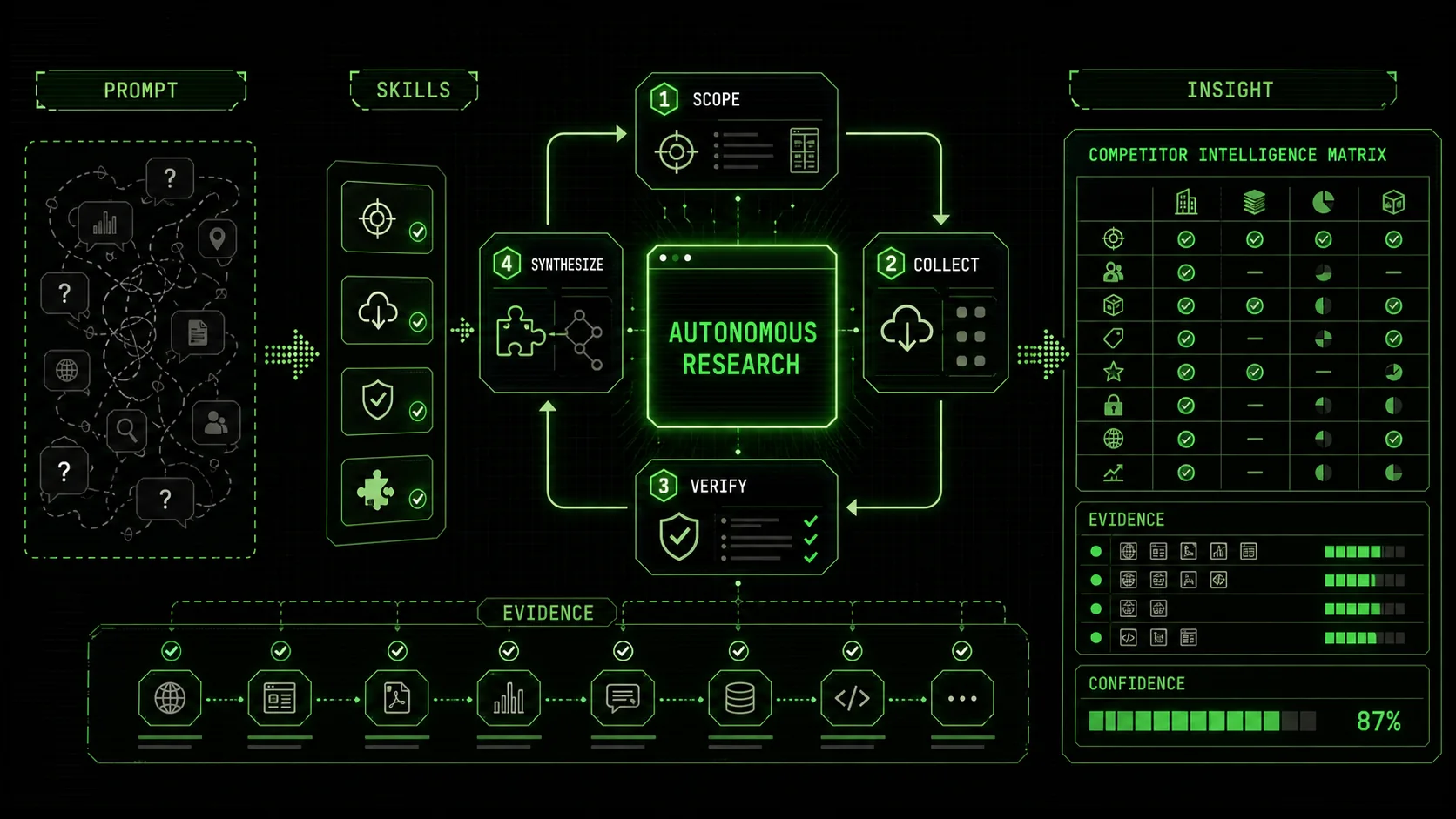
A recent TechCrunch analysis highlighted a quiet but significant shift: developers and solopreneurs are increasingly using AI coding assistants like Claude Code for tasks far beyond their original purpose. They're not just generating functions; they're conducting market research, analyzing competitors, and building business plans. The reason? Tools from Anthropic (Claude), OpenAI (GPT-4), and GitHub (Copilot) have evolved from simple code completers into agents with advanced reasoning and web search capabilities.
Yet, there's a catch. Ask Claude to "research my competitors," and you might get a broad, generic overview. Ask it a week later, and you might get a different answer. The output is often a one-shot, non-verifiable summary—great for brainstorming, but risky for making strategic decisions. The industry is saturated with content on code generation, but there's a glaring gap in structured methodologies for turning these powerful agents into reliable, autonomous research partners.
This article is for you if you've ever needed to: * Systematically track a competitor's feature launches. * Validate the size and sentiment of a new market. * Gather pricing intelligence without manual, error-prone spreadsheet work. * Get a consistent, auditable report that you can trust and act upon.
We'll move beyond one-off prompts and dive into how to structure atomic research skills—self-contained, verifiable tasks with clear pass/fail criteria—that allow Claude Code to operate in a true "autonomous research" mode, iterating until it produces accurate, actionable intelligence.
Why Traditional AI Prompts Fail for Complex Research
One-shot research prompts lack verifiability, produce inconsistent results across runs, and have no objective completion criteria -- atomic skills with JSON output schemas solve all three problems.
Most attempts at AI-driven research follow a familiar, flawed pattern. This is true whether you're using Claude from Anthropic, GPT-4 from OpenAI, or any other AI assistant. You write a prompt like: "Act as a market research analyst. Find the top 5 competitors in the project management SaaS space and summarize their key features and pricing."
What happens next?
The problems with this approach are fundamental to making business decisions:
* Lack of Verifiability: How do you know the information is current or complete? There's no built-in mechanism for Claude to validate its sources or cross-check data. * The "Black Box" Problem: The reasoning process is opaque. You see the output, not the steps, making it impossible to audit or correct the methodology. * Inconsistency: Run the same prompt twice, and minor variations in search results can lead to different answers. This is unacceptable for tracking metrics over time. * No Clear Success Criteria: When is the task actually "done"? When the summary looks good? This subjective endpoint leads to vague and potentially incomplete work.
This is where the paradigm of atomic skills changes the game. Instead of one monolithic research task, you break it down into a sequence of smaller, independent tasks, each with a crystal-clear objective and a binary pass/fail condition.
The Atomic Research Skill Framework
Each atomic research skill has three components: a specific task instruction, binary pass/fail validation criteria, and a strict output schema (JSON/CSV) -- this structure makes Claude Code's research repeatable and auditable.
An atomic skill is a single, well-defined unit of work that an AI agent can execute, evaluate, and, if necessary, re-execute. For research, this transforms a fuzzy goal into a reliable pipeline. The same framework applies to task decomposition for business automation and data analysis workflows.
A robust atomic research skill has three core components:
plan_name, monthly_price, and annual_price. All prices include the currency symbol. FAIL: Output is not valid JSON, is missing required keys, or prices are not found.").This framework forces precision. Claude isn't just "researching"; it's executing a specific data-gathering operation with a built-in quality check. If the output doesn't meet the validation criteria, the task fails, and Claude can try a different approach, refine its search, or flag the issue for human review.
From Monolithic Prompt to Atomic Workflow
Let's deconstruct the flawed, monolithic competitor research prompt into an atomic workflow.
Monolithic Prompt (Problematic):"Research the project management tool 'FlowZen'. List its main features, pricing, and two positive and two negative user reviews from the last 6 months."Atomic Workflow (Reliable): Skill 1: Feature Extraction * Task: "Navigate to the 'Features' page on the FlowZen website. List all features mentioned, categorizing them as 'Core' (task management, timelines) or 'Advanced' (AI suggestions, advanced integrations)." * Validation: "PASS: Output is a markdown table with columns
Feature_Name, Category, Description. At least 5 features are listed. FAIL: Table structure is incorrect or fewer than 5 features found."
Skill 2: Pricing Data Scraping
* Task: "Locate the FlowZen pricing page. Extract all pricing plans into a JSON object."
* Validation: "PASS: JSON is valid and contains an array of plans. Each plan object has name, price_per_month, price_per_year, feature_highlights. FAIL: JSON invalid or key fields are null."
Skill 3: Recent Review Sentiment Analysis
* Task: "Search for 'FlowZen reviews 2025' on a trusted software review site (e.g., G2, Capterra). Extract the 4 most recent relevant reviews. For each, determine sentiment (Positive/Negative/Neutral) and note the primary reason."
* Validation: "PASS: Output is a list of 4 reviews. Each has date, source, sentiment, summary. Sentiment is correctly assigned based on review text. FAIL: Fewer than 4 reviews found, or sentiment is incorrectly assigned for a clearly positive/negative review."
This workflow yields structured, verifiable data instead of a loose paragraph. You can run Skill 2 (pricing) weekly to monitor changes, or run the entire workflow monthly for a consistent competitor dashboard.
Building Your First Autonomous Market Analysis Skill
Chain three atomic skills -- community identification, pain point extraction, and keyword validation -- to build a structured market demand assessment that Claude Code can run autonomously with verifiable results.
Let's build a practical example: a skill to assess market demand for a hypothetical new product--an "AI-Powered Personal Finance Coach for Freelancers."
Skill: Validate Problem-Solution Fit via Online Discourse * Goal: Determine if freelancers are actively discussing the specific financial pains our product aims to solve. Atomic Task 1: Identify Relevant Communities# Task Instruction for Claude
Search for the top 3 most active online communities (subreddits, forums, Discord servers) where freelancers discuss business and finance. Prioritize communities with high post frequency in the last 30 days.community_name, platform, url, and estimated_active_users. FAIL: Returns generic results (e.g., "Twitter") without specific communities or lacks required data points.
Atomic Task 2: Extract & Categorize Pain Points
# Task Instruction for Claude
Analyze the 50 most recent discussion threads from the first community on the list (/r/freelance). For each thread, categorize it if it relates to: 1) Irregular income management, 2) Tax estimation/payment, 3) Client invoicing/payment delays, 4) Retirement saving for self-employed. Provide a count for each category.# Task Instruction for Claude
Using a hypothetical search volume tool (or noting its absence), state the relative monthly search volume for the phrases "freelancer tax calculator," "irregular income budget," and "self-employed retirement account."By chaining these skills in Claude Code, you get a composite report: where your audience congregates, what they're complaining about, and the search landscape. Each step is validated. If Task 2 fails because it can't access 50 threads, Claude will know and can adjust or alert you.
Advanced Pattern: Multi-Source Competitor Intelligence
Triangulate competitor data across four sources -- website positioning, review sentiment, news/funding, and product activity -- using separate atomic skills with structured validation at each stage.
For robust competitor analysis, you must triangulate data from multiple sources. A single source (their website) is often marketing; you need the full picture. This multi-source approach is what separates Claude Code's structured research from the hallucination-prone outputs you get with GPT-4 or Cursor when using unstructured prompts.
Workflow: Comprehensive Competitor Profile| Skill | Data Source | Atomic Task Goal | Validation & Output |
|---|---|---|---|
| Official Positioning | Competitor Website | Extract stated value prop, core features, and pricing. | PASS: Data populates a structured template. FAIL: Key pages (Home, Pricing) not found or unparsable. |
| User Perception | Review Sites (G2, Trustpilot) | Scrape recent reviews (last 90 days). Calculate average rating and common praise/complaint themes. | PASS: Sentiment analysis performed on >10 reviews. Themes are extracted. FAIL: Insufficient reviews found or sentiment logic error. |
| Market Presence | News & Crunchbase | Find latest funding round, key partnerships, or leadership changes in the last 12 months. | PASS: Events are listed with date and source. FAIL: Returns "no news found" without attempting a search. |
| Product Activity | GitHub / Changelog | (For tech products) List recent major version updates or feature commits. | PASS: Lists up to 5 most recent items with dates. FAIL: Cannot locate public changelog or repo. |
Integrating Atomic Research into Your Business Workflow
Schedule pricing skills weekly, market scans monthly, and full competitor deep dives quarterly -- this cadence turns Claude Code from a reactive tool into a proactive intelligence system.
The power of this methodology is its integration into regular operations. Anthropic's Claude excels here because its context window handles complex multi-step research better than GPT-4 for extended workflows, though OpenAI's tool calling is catching up fast.
* Weekly: Run pricing tracking skills for your top 5 competitors. Data appends to a shared spreadsheet or dashboard. * Monthly: Execute a "Market News Scan" skill for your industry keywords, feeding a curated digest to your team. * Quarterly: Launch the full "Competitor Deep Dive" workflow to update strategic profiles. * Ad-Hoc: Use a "Validate Assumption" skill to quickly gather data on a new customer segment or product idea before a meeting.
This turns Claude Code from a reactive coding tool into a proactive research assistant, executing a defined intelligence-gathering protocol. For more on integrating AI into business operations, see our guide on AI Prompts for Solopreneurs.
Getting Started: From Concept to Autonomous Agent
Start with one atomic skill that saves 30 minutes of manual research this week, test it in isolation, then chain it with related skills -- small wins compound into a full autonomous research pipeline.
The key is to start small. Build one atomic skill that saves you 30 minutes of manual work this week. For foundational prompt engineering techniques that make this process smoother, check out our article on How to Write Prompts for Claude.
Conclusion: The Strategic Research Partner
Atomic research skills transform AI from a brainstorming toy into a systematic intelligence engine -- structured tasks with validation criteria guarantee useful outputs that you can act on with confidence.
The shift from using Claude Code as a coder to a researcher isn't about asking different questions; it's about architecting the process differently. For more on building structured AI workflows, explore our guides on prompt engineering and AI prompts for product managers. By adopting an atomic skill framework, you inject reliability, verifiability, and consistency into AI-powered business intelligence.
You move from hoping for a good answer to engineering a system that guarantees a useful one. This is how solopreneurs and developers can leverage AI not just for tactical tasks, but for strategic advantage—making informed decisions based on systematic, automated analysis.
Ready to structure your first autonomous research skill? Generate Your First Skill with the Ralph Loop Skills Generator and turn your next complex market question into a series of solvable, verifiable tasks.
---
FAQ
Can Claude Code actually browse the web and get real-time data for these skills?
Claude Code can utilize web search capabilities when they are enabled in the environment it's running in (like the Claude desktop app or certain API configurations). However, it's crucial to structure your atomic tasks with this in mind. A skill's validation should account for potential search limitations. For truly live data (like stock prices), you would need to integrate an API call as a separate atomic task. The skill framework is about the structure; the data source is a variable you control.
How is this different from using a dedicated market research AI tool?
Dedicated tools (like certain GPTs from OpenAI, SaaS platforms, or GitHub Copilot extensions) are often pre-packaged for specific use cases. The atomic skill approach is a methodology you own and customize. It's more flexible (you can research anything you can define) and transparent (you see and control each step). It's also potentially more cost-effective for solopreneurs and developers who already have access to Claude Code from Anthropic, Cursor, or similar tools. For a comparison of AI capabilities, you might find our analysis of Claude vs. ChatGPT useful.
What happens when a skill consistently fails its validation?
A consistent failure is a feature, not a bug. It's a clear signal that either:
This forces you to refine your research protocol, leading to more robust skills over time. It prevents you from acting on bad data.
Is this only useful for software/tech markets?
Not at all. The atomic skill framework is domain-agnostic. You could build skills to: * Analyze real estate listing descriptions in a target neighborhood. * Track ingredient trends from top food blogs for a restaurant. * Monitor regulatory announcement summaries from government websites. * Gather patient sentiment on new treatment options from moderated health forums (while respecting privacy).
Any field where information is published online can be researched with this structured approach.
How do I manage the output from dozens of these skills over time?
This is where the enforced output format (JSON, CSV, structured tables) pays off. You should design your skills to write their outputs to a centralized data store—a simple Google Sheet, an Airtable base, or a database. Each successful skill execution appends a new, structured row of data. This creates a time-series database of your market intelligence that you can easily visualize and analyze.
Where can I find examples and templates for atomic research skills?
A great starting point is our Claude Hub, where we share community-driven examples and templates. The Ralph Loop Skills Generator also provides a framework to quickly build these skills by defining the task, validation, and output format. Start with a template and adapt it to your specific research question.
<!-- sister-projects-start -->
Other Doved Studio projects
Related tools from the same studio you might find useful:
- Glean: Turn scrolling time into a daily action plan. Capture, process, execute.
- Popout: Create your portfolio in minutes with a single shareable page.
- Larpable: Spot fake founders, guru grifts, and performance entrepreneurship.
- Doved Studio: Studio indie derrière cette app et une dizaine d'autres outils.
ralph
Building tools for better AI outputs. Ralphable helps you generate structured skills that make Claude iterate until every task passes.