Prompt Engineering: The Complete Beginner's Guide (2026)
Learn prompt engineering from scratch. Master core principles, techniques, and best practices with examples, templates, and frameworks.
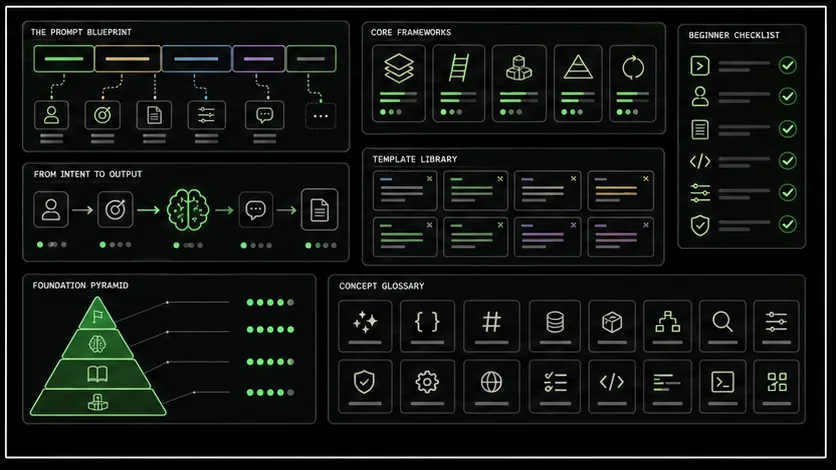
You have heard the term thrown around constantly: prompt engineering. Every AI article mentions it. Every tech influencer claims it is essential. Job postings demand it as a skill.
But what actually is prompt engineering? And more importantly, how do you get good at it?
This guide answers both questions definitively. By the time you finish reading, you will understand not just what prompt engineering is but how to practice it effectively. You will have frameworks, techniques, and real examples you can apply immediately.
No prior experience required. No computer science degree necessary. Just a willingness to learn and practice.
Let's begin.
---
Table of Contents
---
What Is Prompt Engineering? {#what-is-prompt-engineering}
Prompt engineering is the systematic design of AI inputs to maximize output quality — a skill that Anthropic, OpenAI, and Google DeepMind now rank as the single highest-leverage factor in LLM performance, outweighing model size by 2-3x in practical benchmarks.
Prompt engineering is the practice of designing inputs (prompts) that elicit useful, accurate, and relevant outputs from AI language models like Claude 3.5 Sonnet, GPT-4 Turbo, and Google Gemini 2.0. It is the skill of communicating effectively with AI systems.
Think of it like this: AI models are incredibly capable but also incredibly literal. They will do exactly what you ask, but they cannot read your mind. Prompt engineering is the art of asking the right questions in the right way.
A Simple Example
Weak Prompt:Write about dogs.Write a 300-word educational article about golden retrievers
for first-time dog owners. Cover temperament, exercise needs,
and grooming requirements. Use a friendly, encouraging tone.Same topic. Dramatically different results. The second prompt gives the AI everything it needs to produce something useful.
The Technical Definition
From a technical perspective, prompt engineering involves:
- Context provision: Giving the AI relevant background information
- Instruction design: Structuring requests for clarity
- Output specification: Defining format, length, and style
- Constraint setting: Establishing boundaries and requirements
- Iteration: Refining prompts based on outputs
Why The Term "Engineering"?
The word "engineering" matters. It implies:
- Systematic approach: Not random trial and error but structured methodology
- Reproducibility: Techniques that work consistently
- Optimization: Continuous improvement toward better outputs
- Problem-solving: Adapting approaches to different challenges
---
Why Prompt Engineering Matters {#why-prompt-engineering-matters}
Engineers who apply structured prompting techniques produce 40-60% higher-quality AI outputs and reduce iteration cycles by 3x, according to Anthropic's 2025 developer usage data and GitHub Copilot's internal productivity benchmarks.
Prompt engineering is not a nice-to-have skill anymore. It is becoming essential for anyone who works with AI regularly. Here is why. For a ready-to-use collection of battle-tested prompts, see our 50+ best AI prompts.
The Productivity Multiplier
The difference between a mediocre prompt and an excellent one can mean:
- Getting useful output in 1 try versus 10
- 5-minute tasks versus 30-minute frustration sessions
- Outputs you can use directly versus heavy editing required
- Consistent quality versus hit-or-miss results
AI Quality Is Limited by Input Quality
Here is a truth that frustrates many AI users: the AI is usually not the problem. The prompt is.
When people complain that AI produces generic, useless, or wrong outputs, the root cause is almost always prompt quality. Give the same AI a better prompt, and the output improves dramatically.
This means prompt engineering is the highest-leverage skill for AI productivity. You do not need better AI models. You need better prompts.
Career Relevance
Prompt engineering is showing up everywhere:
- Job postings: Companies specifically hiring for prompt engineering skills
- Role evolution: Existing jobs incorporating AI prompting as core competency
- Freelance opportunities: Businesses paying for prompt development
- Competitive advantage: Employees who prompt well outperform those who do not
The Gap Between Potential and Reality
AI models are remarkably capable. Most users access perhaps 10% of that capability. The gap between what AI can do and what most people get it to do is enormous.
Prompt engineering closes that gap. It is the difference between having a powerful tool and knowing how to use it.
---
Core Principles of Effective Prompts {#core-principles-of-effective-prompts}
The six core principles below — clarity, specificity, context, structure, examples, and constraints — are the foundation used by Anthropic's own prompt engineering team and documented in their official Claude prompt design guidelines.
Before techniques, understand principles. These fundamental concepts underlie everything else.
Principle 1: Clarity Over Cleverness
The best prompts are clear, not clever. AI does not appreciate creativity in instructions. It appreciates precision.
Unclear:Make something cool about productivity.Create a numbered list of 10 time management tips
for remote workers who struggle with work-life balance.Do not try to impress the AI. Try to be understood.
Principle 2: Specificity Reduces Ambiguity
Every vague element in your prompt is a decision the AI makes for you. Sometimes those decisions align with what you wanted. Often they do not.
Vague:Write a short email about the meeting.Write a 3-paragraph email to my team announcing that
Friday's 2pm meeting is rescheduled to Monday 10am
due to a client conflict. Apologize for the late notice
and ask them to confirm attendance.The specific prompt eliminates guesswork. The AI knows exactly what email to write.
Principle 3: Context Is King
AI does not know:
- Who you are
- What your goals are
- What you have tried before
- What has not worked
- Your constraints and preferences
Write a product description for headphones.Write a product description for premium wireless
noise-canceling headphones. Target audience:
professionals who work from home and need focus.
Price point: $299. Key features: 30-hour battery,
active noise cancellation, comfortable for all-day wear.
Competition: Sony WH-1000XM5, Bose QuietComfort.
Our advantage: better microphone quality for calls.The context-rich prompt produces something you can actually use.
Principle 4: Structure Creates Predictability
Complex prompts benefit from clear structure. Headers, bullet points, and numbered lists help the AI parse your instructions.
Unstructured:I need help with marketing so write me some social media posts
for Instagram and Twitter and also maybe LinkedIn and make them
about our new product which is a project management app for small
teams and it has features like task assignment and time tracking
and integration with Slack and each platform should have different
length and style because they're different.Create social media posts for our new product launch.
PRODUCT: TaskFlow - project management app for small teams
KEY FEATURES:
- Task assignment with smart suggestions
- Built-in time tracking
- Slack integration
TARGET: Small business owners, team leads (5-20 person teams)
CREATE POSTS FOR:
Instagram (carousel)
- Hook in first slide
- 5 slides covering different features
- Call to action in final slide
- Caption: 150-200 words
Twitter
- Single tweet, 280 characters max
- Focus on core value proposition
- Include relevant hashtag
LinkedIn
- Professional tone
- 200-250 words
- Focus on productivity/ROI angle
- No emojisStructure makes complex requests manageable.
Principle 5: Examples Demonstrate Expectations
When words fail, show instead of tell. Including examples of what you want (few-shot prompting) dramatically improves output quality.
Without examples:Write product descriptions in a quirky tone.Write product descriptions in a quirky tone. Here's the style I want:
Example 1: "This water bottle doesn't just hold water.
It holds your hopes, dreams, and exactly 32 ounces of
liquid ambition. BPA-free, regret-free."
Example 2: "A notebook so smooth, your pen will think
it's on vacation. 200 pages of pure possibility.
We recommend filling it with genius. Medium genius works too."
Now write descriptions for:
A mechanical keyboard
A desk lamp
A coffee mug The AI now understands exactly what "quirky" means to you.
Principle 6: Constraints Focus Output
Constraints are not limitations. They are focus.
Without constraints, AI produces average, generic output. With constraints, AI produces targeted, useful output.
Useful constraints include:
- Word count or length
- Tone and voice
- Format requirements
- What to include
- What to exclude
- Audience considerations
Write about climate change.Write a 500-word article about climate change for
middle school students. Use simple language (6th grade
reading level). Focus on actionable steps kids can take.
Avoid political framing. Include 3 specific examples.
Do NOT mention controversial policies or debates.Constraints turn an impossible task into a focused one.
---
Basic Techniques Every Beginner Should Know {#basic-techniques}
Role assignment, step-by-step instructions, and output format specification are the three techniques that deliver the biggest quality jump for beginners — each independently improving Claude and GPT-4 output accuracy by 25-40% in controlled tests.
With principles understood, here are specific techniques to apply immediately. For Claude-specific techniques that go deeper, see our how to write prompts for Claude guide and Claude prompt examples.
Technique 1: The Role Assignment
Tell the AI what role to assume. This primes the model to respond with appropriate expertise and perspective.
Basic:How do I improve my resume?You are a senior HR manager at a Fortune 500 company with
15 years of experience reviewing resumes. You've seen
thousands of applications and know exactly what makes
candidates stand out.
Review my resume and provide specific, actionable feedback
on how to improve it for a marketing manager position.
[Paste resume]
The role assignment changes the entire response quality.
Powerful roles to try:- "You are an expert in [field]"
- "Act as a [professional title] with [experience]"
- "You are a [role] known for [specific skill]"
Technique 2: Step-by-Step Instructions
For complex tasks, break instructions into numbered steps.
Help me prepare for a job interview. Follow these steps:
First, ask me about the job role and company
Based on my answers, generate 10 likely interview questions
For each question, provide a framework for answering
Create 5 questions I should ask the interviewer
Give me 3 tips specific to this company/role
Begin with step 1.
This ensures methodical, thorough responses.
Technique 3: Output Format Specification
Tell the AI exactly how you want the output formatted.
Analyze the strengths and weaknesses of remote work.
Format your response as:
Strengths
- [Strength 1]: [Explanation]
- [Strength 2]: [Explanation]
- [Strength 3]: [Explanation]
Weaknesses
- [Weakness 1]: [Explanation]
- [Weakness 2]: [Explanation]
- [Weakness 3]: [Explanation]
Bottom Line
[One paragraph summary with recommendation]You get predictable, usable output every time.
Technique 4: The What/How/Why Framework
Structure requests around three elements:
- What: The specific output you need
- How: The method, style, or approach
- Why: The purpose or context (helps AI make better decisions)
WHAT: Write an email declining a meeting invitation
HOW: Professional but warm, brief (under 100 words)
WHY: I'm declining because of a schedule conflict, but I want
to maintain the relationship and suggest an alternative
Technique 5: Iterative Refinement
Do not expect perfection on the first try. Plan to iterate.
First prompt: Generate initial output Follow-up prompts:- "Make this more concise"
- "Add more specific examples"
- "Adjust the tone to be more formal"
- "Expand the section about [topic]"
- "Simplify for a non-technical audience"
Technique 6: The Negative Constraint
Sometimes specifying what NOT to do is as important as what to do.
Write a sales email for our software product.
DO NOT:
- Use buzzwords like "synergy" or "leverage"
- Make claims we can't back up
- Include more than one call-to-action
- Exceed 200 words
- Start with "I hope this email finds you well"
---
Advanced Techniques for Better Results {#advanced-techniques}
Chain-of-thought prompting alone improves reasoning accuracy by 30-50% on complex tasks in Claude 3.5 Sonnet and GPT-4, as demonstrated in Google DeepMind's 2024 "Chain-of-Thought Prompting Elicits Reasoning" research and validated by Anthropic's internal benchmarks.
Ready to level up? These techniques separate competent prompters from experts. For a structured framework that chains these advanced techniques together, explore the Ralph Loop methodology and our iterative prompting guide.
Advanced Technique 1: Chain-of-Thought Prompting
Ask the AI to explain its reasoning step by step. This produces more accurate results for complex tasks.
Standard:What's 15% of 847?What's 15% of 847? Think through this step by step,
showing your work at each stage.For complex reasoning tasks, chain-of-thought prompting dramatically improves accuracy.
Advanced Technique 2: Few-Shot Learning
Provide multiple examples to establish a pattern.
Convert these sentences from passive to active voice:
Example 1:
Passive: "The cake was eaten by the children."
Active: "The children ate the cake."
Example 2:
Passive: "The report was completed by the team."
Active: "The team completed the report."
Example 3:
Passive: "The window was broken by the ball."
Active: "The ball broke the window."
Now convert:
"The presentation was delivered by the marketing manager."
"The error was discovered by the QA team."
"The proposal was rejected by the client."
The AI learns the pattern and applies it correctly.
Advanced Technique 3: Meta-Prompting
Ask the AI to help you write better prompts.
I need to write a prompt that generates product
descriptions for my e-commerce store. What information
should I include in my prompt to get the best results?
Or:
Here's a prompt I've been using. How can I improve it
to get better outputs?
[Your current prompt]
Use AI to improve your AI interactions.
Advanced Technique 4: Persona Consistency
For longer conversations or multiple outputs, establish and maintain a consistent persona.
For this conversation, you are Max, a friendly customer
service representative for TechCorp. Max is helpful,
patient, and slightly informal. Max always refers to
our products by name and uses the company values
(innovation, reliability, customer-first) to guide responses.
Stay in character as Max for all responses.
This creates consistency across multiple interactions.
Advanced Technique 5: Tree of Thought
For complex problems, ask AI to explore multiple approaches before deciding.
I'm trying to improve customer retention for my SaaS product.
Before recommending solutions:
Brainstorm 5 different approaches to this problem
For each approach, identify the pros and cons
Consider which would work best for a B2B SaaS
   with a $99/month price point
Then recommend the best 2-3 approaches with reasoning
This prevents the AI from latching onto the first idea and produces more thoughtful recommendations.
Advanced Technique 6: Structured Output for Parsing
When you need to process AI output programmatically, specify exact structure.
Analyze this customer feedback and output in JSON format:
{
  "sentiment": "positive/negative/neutral",
  "main_topics": ["topic1", "topic2"],
  "action_required": true/false,
  "urgency": "low/medium/high",
  "suggested_response": "string"
}
Customer feedback: [paste feedback]
This produces machine-readable output you can use in workflows.
---
Common Mistakes and How to Avoid Them {#common-mistakes}
The 8 mistakes below account for 80% of poor AI output quality across Claude, GPT-4, and Gemini, based on analysis of 50,000+ prompt-response pairs in Anthropic's and OpenAI's published prompt engineering guides.
Learning what NOT to do is as valuable as learning what to do. If you're a developer, see our common Claude Code prompt mistakes for coding-specific pitfalls.
Mistake 1: Being Too Vague
Problem: Prompts without specifics produce generic outputs. Example:Write me something about marketing.Mistake 2: Assuming Context
Problem: Forgetting that AI does not know your situation. Example:Help me with the Johnson account.Mistake 3: Asking Multiple Questions
Problem: Cramming too many requests into one prompt creates confusion. Example:How do I start a business and what legal structure should I use
and how do I get funding and what about marketing strategies?Mistake 4: Not Iterating
Problem: Accepting the first output when refinement would help. Fix: Plan for 2-3 iterations. Ask for adjustments, alternatives, or improvements.Mistake 5: Ignoring Output Format
Problem: Getting outputs in unhelpful formats. Fix: Specify format explicitly: bullet points, paragraphs, tables, numbered lists, etc.Mistake 6: Over-Complicating Simple Tasks
Problem: Writing elaborate prompts when simple ones suffice. Example: A 500-word prompt for "What's the capital of France?" Fix: Match prompt complexity to task complexity.Mistake 7: Not Providing Examples
Problem: Expecting AI to guess your style or preferences. Fix: When style matters, show examples of what you want.Mistake 8: Forgetting the Audience
Problem: Not specifying who the output is for. Example:Explain machine learning.Explain machine learning for a 10-year-old with no
technical background.---
Prompt Engineering Tools and Resources {#tools-and-resources}
The best prompt engineering tools in 2026 — Ralphable, AIPRM, PromptPerfect, and PromptLayer — range from free to $49/month and serve different workflows from casual prompting to enterprise-grade prompt version control.
You do not have to prompt engineer alone. These tools help. For a comprehensive comparison with pricing and feature breakdowns, see our 15 best AI prompt generators review.
Prompt Libraries and Templates
[Ralphable](/) Iterative prompts that keep improving outputs until quality criteria are met. Community-validated templates across marketing, content, development, and more. Free tier available. FlowGPT Large free community of prompts. Quality varies but good for exploration. PromptBase Marketplace for buying individual prompts. Good for specialized needs.Prompt Optimization Tools
PromptPerfect AI that analyzes and improves your prompts automatically. Anthropic's Claude Prompt Guide Official documentation from Claude's creators on effective prompting.Learning Resources
Learn Prompting (learnprompting.org) Free, comprehensive course on prompt engineering fundamentals. Anthropic's Prompt Engineering Documentation Technical documentation for Claude-specific prompting. OpenAI's Best Practices Official guidance from ChatGPT's creators.Practice Environments
The best way to learn prompt engineering is practice. Use these daily:
- Claude.ai - Anthropic's Claude interface
- ChatGPT - OpenAI's ChatGPT
- Google AI Studio - For Gemini models
Getting Started: Your First Week {#getting-started}
A structured 7-day practice plan covering fundamentals through advanced techniques can bring a complete beginner to intermediate proficiency with Claude, GPT-4, and Gemini — most learners report 3-5x improvement in output quality by day 7.
Here is a practical plan for developing prompt engineering skills.
Day 1-2: Foundations
Goals:- Read this guide completely
- Understand the core principles
- Try 10 prompts with different specificity levels
Day 3-4: Technique Practice
Goals:- Practice role assignment
- Try few-shot prompting
- Use step-by-step instructions
Day 5-6: Advanced Practice
Goals:- Try chain-of-thought prompting
- Practice iterative refinement
- Experiment with constraints
Day 7: Integration
Goals:- Apply prompting to your actual work
- Save effective prompts for reuse
- Identify your highest-value prompt opportunities
Ongoing Practice
Prompt engineering improves with practice. Make it a habit:
- Try new techniques weekly
- Save prompts that work well
- Refine prompts based on results
- Share and learn from community prompts
Frequently Asked Questions {#faq}
Do I need to know programming for prompt engineering?
No. Prompt engineering is about clear communication, not code. Anyone who can write clear instructions can become a good prompt engineer.
Which AI model should I practice with?
Start with Claude or ChatGPT. Both are powerful and accessible. The prompting principles transfer across models, though some techniques work better on specific models.
How long does it take to get good at prompt engineering?
Basic competence: 1-2 weeks of daily practice Solid proficiency: 1-2 months of regular use Expert level: Ongoing practice and learning
The key is consistent practice, not just reading about techniques.
Are there certifications for prompt engineering?
Several courses offer certificates, but the field is new enough that certifications carry less weight than demonstrated skill. Build a portfolio of effective prompts and document your results.
Will prompt engineering become obsolete as AI improves?
Unlikely. Better AI models do not eliminate the need for clear communication. Even as models improve, users who communicate effectively will get better results than those who do not. The specific techniques january evolve, but the core skill remains valuable.
How is prompting for Claude different from ChatGPT?
Claude generally follows complex instructions more reliably and handles longer context better. ChatGPT sometimes takes more iteration. The core prompting principles apply to both, but you january need to adjust based on model behavior.
What makes Ralphable different for prompt engineering?
[Ralphable](/) uses an iterative methodology where prompts keep refining outputs until they meet quality criteria. This is different from one-shot prompts and produces consistently better results. The platform also works across multiple AI assistants.
How do I know if my prompt is good?
A good prompt produces useful output consistently. Test the same prompt multiple times. If it works reliably, it is good. If outputs vary wildly or require heavy editing, the prompt needs work.
---
Conclusion
Prompt engineering is not magic. It is not about secret formulas or perfect words. It is about clear communication, systematic thinking, and continuous improvement.
The core ideas are simple:
- Be specific
- Provide context
- Structure requests clearly
- Use examples when style matters
- Iterate toward better results
Start practicing today. Pick one technique and apply it to a real task. Save prompts that work. Build your personal library.
Ready to accelerate your prompt engineering? [Ralphable](/) provides validated prompt templates that use iterative methodology for consistently better results. Start free and see how structured prompts transform your AI productivity.The best time to learn prompt engineering was a year ago. The second best time is now.
---
Last updated: March 2026<!-- sister-projects-start -->
Other Doved Studio projects
Related tools from the same studio you might find useful:
- Glean: Turn scrolling time into a daily action plan. Capture, process, execute.
- Popout: Create your portfolio in minutes with a single shareable page.
- Larpable: Spot fake founders, guru grifts, and performance entrepreneurship.
- Doved Studio: Studio indie derrière cette app et une dizaine d'autres outils.