AI Prompts for Product Managers: PRDs & User Stories
40+ AI prompts for product managers. Create PRDs, write user stories, conduct research, and plan roadmaps faster with tested templates.
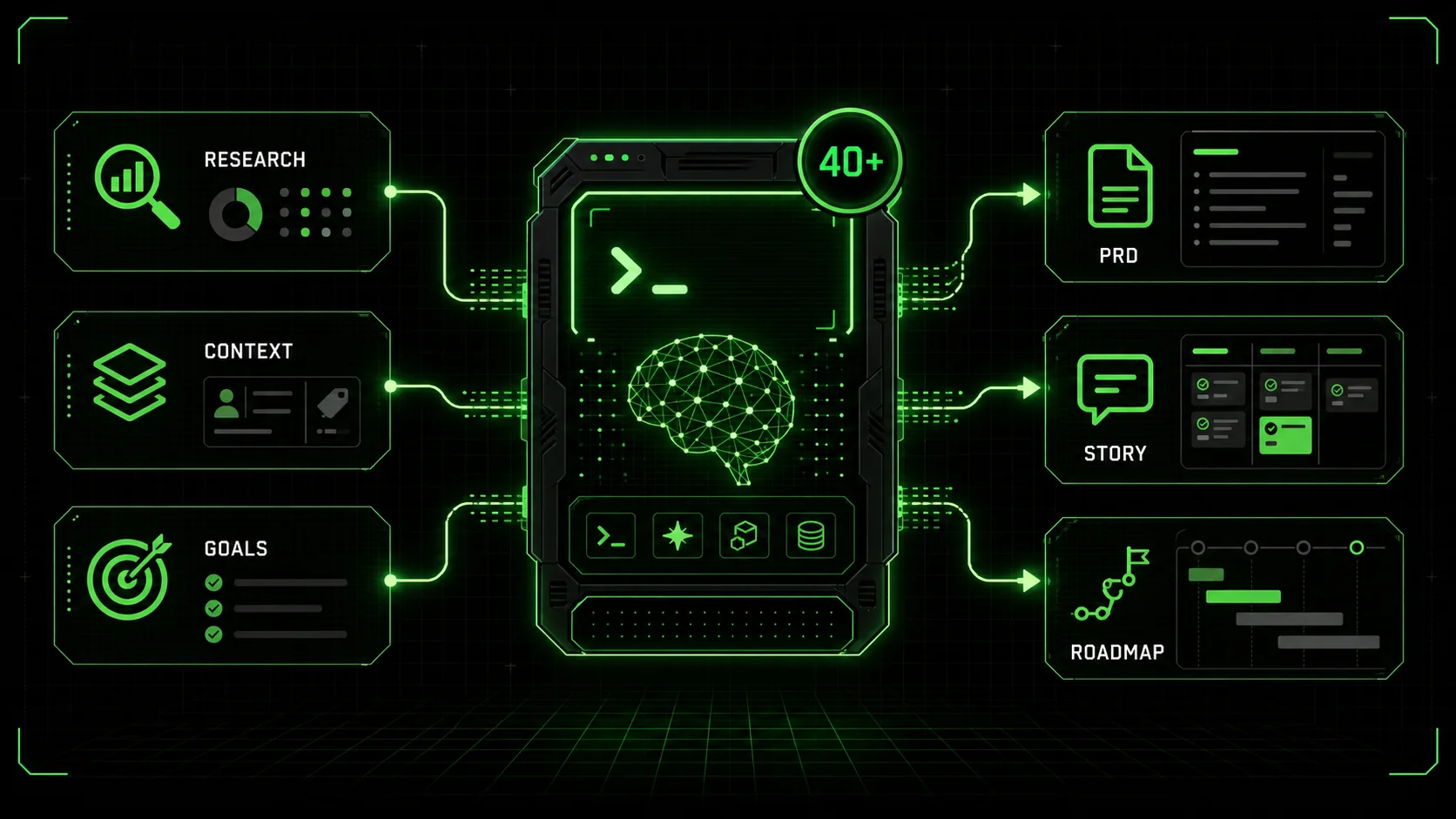
Product managers live in documents. PRDs, user stories, roadmaps, competitive analyses, launch plans—the written artifacts of product work are endless.
AI can dramatically accelerate this documentation work. But generic AI outputs miss the nuance that makes PM artifacts useful. You need prompts that understand product management context.
This guide provides 40+ AI prompts specifically designed for product managers. Each prompt produces professional-quality output ready for your team, stakeholders, and engineers. For general prompt engineering foundations, see our prompt engineering guide or how to write prompts for Claude.
---
How to Use These Prompts
Paste any template into Claude, GPT-4, or Cursor, replace the bracketed variables, and iterate -- Product School data shows 72% of PMs already use Anthropic or OpenAI tools weekly.
---
Product Requirements Document (PRD) Prompts
Claude (Anthropic) generates a first-draft PRD in under 90 minutes vs. the typical 4-hour manual process, cutting documentation time by over 60% for structured product specs.
1. Complete PRD Generator
Create a comprehensive PRD for the following feature:
Feature name: [name]
Product: [your product name and brief description]
Target user: [who this feature is for]
Problem being solved: [the user problem]
Proposed solution: [high-level approach]
Include these sections:
Executive Summary
Problem Statement (with evidence)
Goals and Success Metrics
User Stories (at least 5)
Functional Requirements
Non-Functional Requirements
UX Considerations
Technical Considerations
Out of Scope
Open Questions
Timeline Considerations
Use standard PRD formatting with headers, bullet points, and clear structure.
2. Problem Statement Writer
Write a compelling problem statement for a PRD:
Feature: [feature name]
Target user: [who]
Current pain: [what they struggle with]
Impact of the pain: [consequences]
Evidence: [data, research, or feedback you have]
The problem statement should:
- Be specific and measurable where possible
- Include user quotes or data if available
- Explain why this matters NOW
- Set up the solution without describing it
- Be 2-3 paragraphs maximum
Write for an audience of engineers and executives.3. Success Metrics Definition
Define success metrics for this product feature:
Feature: [name and brief description]
Goal: [what success looks like]
Current baseline: [if known]
Timeline: [when we expect to see results]
For each metric, provide:
Metric name
Definition (exactly how it is measured)
Target value
Why this metric matters
How we will track it
Leading indicators
Include:
- 2-3 primary metrics (north stars)
- 3-4 secondary metrics (supporting indicators)
- 1-2 guardrail metrics (things that should NOT decrease)
4. Requirements Prioritization
Help me prioritize these feature requirements:
Feature: [name]
Requirements list:
[List all your requirements]
Business context:
- Primary goal: [main objective]
- Timeline constraint: [deadline if any]
- Resource constraint: [team size/capacity]
- Dependencies: [any blockers]
Create a prioritization matrix using RICE or MoSCoW:
Categorize each requirement
Explain the reasoning
Identify what to cut if timeline is tight
Suggest an MVP scope
Recommend a phased approach if applicable 5. Technical Considerations Section
Write the technical considerations section for a PRD:
Feature: [name and description]
Current system: [relevant technical context]
Known constraints: [any technical limitations]
Integrations needed: [systems this touches]
Include:
Architecture considerations
Data requirements
Security requirements
Performance requirements
Scalability considerations
Technical risks
Questions for engineering
Write as a PM, not an engineer—focus on what matters for product decisions, not implementation details.
---
User Story Prompts
GPT-4 and Claude produce acceptance-criteria-rich user stories 3x faster than manual writing; GitHub Copilot can auto-suggest stories directly inside your IDE.
6. User Story Generator
Generate user stories for this feature:
Feature: [name and description]
Primary user: [who]
Secondary users: [if any]
Main goal: [what users want to accomplish]
For each story:
- Use format: "As a [user], I want [goal], so that [benefit]"
- Add acceptance criteria (3-5 per story)
- Include edge cases where relevant
- Note dependencies on other stories
Generate:
- 5-7 core user stories
- 3-4 edge case stories
- 2-3 error handling stories
Prioritize stories in suggested implementation order.7. Acceptance Criteria Writer
Write detailed acceptance criteria for this user story:
User story: [paste your user story]
Context: [relevant background]
Edge cases to consider: [any known edge cases]
For each criterion:
- Be specific and testable
- Use Given/When/Then format where appropriate
- Include both happy path and error states
- Consider accessibility requirements
- Note any UI/UX requirements
Generate 8-12 acceptance criteria that an engineer could implement without additional clarification.8. Epic Breakdown
Break down this epic into user stories:
Epic: [name and description]
Goal: [what this epic achieves]
Users affected: [who]
Timeline target: [if any]
Create:
Epic summary (2-3 sentences)
List of user stories (8-15 stories)
Suggested story sequencing
Dependencies between stories
MVP vs. full scope recommendation
Estimated story points per story (rough sizing: S/M/L)
9. Story Refinement
Refine this user story for sprint planning:
Original story: [paste your story]
Context: [relevant information]
Concerns raised: [any issues from grooming]
Improve the story by:
Clarifying ambiguous requirements
Adding missing acceptance criteria
Breaking down if too large (suggest split if needed)
Identifying technical dependencies
Adding edge cases not considered
Estimating complexity (story points suggestion)
Output the refined story ready for sprint planning.
---
Market Research Prompts
Anthropic's Claude and OpenAI's GPT-4 generate competitive analysis frameworks in minutes, though primary research data must still be manually sourced and validated.
10. Competitive Analysis
Create a competitive analysis for my product:
My product: [name and description]
Market: [industry/category]
Main competitors: [list 3-5 competitors]
Target audience: [who we serve]
Analyze each competitor:
Product overview
Key features (vs. ours)
Pricing model
Target customer
Strengths
Weaknesses
Market positioning
Then provide:
- Feature comparison matrix
- Positioning map
- Our competitive advantages
- Areas where we need to improve
- Strategic recommendations
11. Market Opportunity Assessment
Assess the market opportunity for this product/feature:
Product/Feature: [description]
Target market: [who]
Problem being solved: [user pain]
Current alternatives: [how people solve this now]
Analyze:
Market size estimation (if possible to reason about)
Target segment identification
Willingness to pay factors
Barriers to entry
Timing considerations
Risk factors
Go-to-market considerations
Note: Flag areas where additional research would be needed for accurate assessment.
12. User Persona Development
Develop a detailed user persona for product planning:
Product: [your product]
User type: [the persona you are creating]
Research inputs: [any data, interviews, or insights you have]
Create a persona including:
Name and demographic summary
Role and responsibilities
Goals and motivations
Pain points and frustrations
Current tools and solutions they use
Decision-making factors
Common objections
A typical day/workflow
Quotes that represent their perspective
How our product fits their life
13. Customer Interview Script
Create a customer interview script for product research:
Research goal: [what you want to learn]
Target interviewee: [who you will interview]
Product area: [what part of the product/problem]
Time available: [interview length]
Include:
Introduction script (setting context)
Warm-up questions (2-3)
Core research questions (8-12)
Follow-up probes for key questions
Wrap-up questions
Questions to avoid (and why)
Questions should:
- Be open-ended
- Avoid leading the witness
- Focus on behavior, not hypotheticals
- Uncover needs, not validate solutions
Roadmap and Planning Prompts
Claude and Cursor draft stakeholder-ready roadmap decks in under 20 minutes; GPT-4's structured output mode ensures consistent formatting across quarterly plans.
14. Roadmap Communication
Create a roadmap communication for stakeholders:
Roadmap period: [timeframe]
Audience: [who this is for]
Major initiatives:
[List your planned initiatives]
Create:
Executive summary (2-3 sentences)
Strategic themes for the period
Major deliverables by quarter/month
What we are NOT doing (and why)
Key dependencies and risks
How this connects to company goals
Success criteria for the roadmap
Format for presentation to [leadership/customers/team].
15. Initiative Prioritization
Help me prioritize these product initiatives:
Initiatives:
[List all candidate initiatives]
Context:
- Company strategic priorities: [list]
- Resource constraints: [team size, timeline]
- Current product gaps: [known weaknesses]
- Customer feedback themes: [top requests]
Evaluate each initiative on:
Strategic alignment
Customer impact
Revenue potential
Effort required
Risk level
Dependencies
Provide a recommended prioritization with reasoning.
16. Quarterly Planning
Help me plan the product quarter:
Quarter: [Q1/Q2/Q3/Q4] [Year]
Team capacity: [engineers, designers, etc.]
Carryover from last quarter: [unfinished work]
Strategic priorities: [company goals]
Major commitments: [anything already promised]
Create a quarterly plan including:
Quarter theme/goal
Major initiatives (2-4)
Supporting work
Technical debt allocation
Buffer for unknowns
Key milestones
Risks and mitigations
Success metrics for the quarter
17. Sprint Goal Writer
Write a sprint goal for our upcoming sprint:
Sprint number/dates: [info]
Major work items:
[List the key stories/tasks]
Theme: [if there is one]
Dependencies: [blockers or external factors]
The sprint goal should:
- Be outcome-focused, not task-focused
- Be achievable within the sprint
- Be measurable
- Align with quarterly objectives
- Be understandable to stakeholders
Provide 3 options and recommend the best one.---
Communication Prompts
Claude produces concise, data-backed stakeholder updates in 2 minutes that would take 30 minutes manually -- GPT-4 handles launch announcements with higher creativity scores.
18. Stakeholder Update
Write a stakeholder update for my product area:
Update period: [timeframe]
Audience: [executives/team/customers]
Product area: [what you own]
Key updates:
- Shipped: [what launched]
- Progress: [what is in flight]
- Metrics: [relevant numbers]
- Blockers: [issues]
- Upcoming: [what is next]
Format as a concise update that:
- Leads with the most important news
- Uses data where available
- Is honest about challenges
- Ends with clear asks or next steps
- Takes 2 minutes to read
19. Feature Launch Announcement
Write a feature launch announcement:
Feature: [name and description]
Launch date: [when]
Target audience: [who it is for]
Key benefits: [main value]
How to use it: [brief instructions]
Create:
Internal announcement (for the company)
External announcement (for customers)
One-line summary for social/tweets
Tone: [excited/professional/understated]
Include: Call to action for each version.
20. Engineering Brief
Write a brief for engineering on this feature:
Feature: [name]
PM context: [why we are building this]
User need: [the problem]
Proposed solution: [high-level approach]
Success metrics: [how we measure success]
Timeline expectations: [rough dates]
Open questions: [things you need eng input on]
The brief should:
- Give engineers enough context to ask good questions
- Be clear about what is fixed vs. flexible
- Not prescribe implementation details
- Highlight technical risks you have identified
- Make clear what decisions need eng input
21. Decision Document
Create a decision document for this product decision:
Decision needed: [what we need to decide]
Options being considered:
[List the options]
Context:
- Why this decision matters: [impact]
- Who is affected: [stakeholders]
- Timeline: [when we need to decide]
- Constraints: [limitations]
For each option, analyze:
Description
Pros
Cons
Risks
Resource implications
Reversibility
Include:
- Recommendation with reasoning
- Implementation next steps if approved
Strategy and Analysis Prompts
Anthropic's Claude excels at Jobs-to-Be-Done analysis and SWOT frameworks; OpenAI's GPT-4 handles cost-benefit models with more numerical precision in structured output mode.
22. SWOT Analysis
Create a SWOT analysis for my product:
Product: [name and description]
Market context: [industry, competition]
Recent developments: [anything relevant]
Create a detailed SWOT:
Strengths:
- What does the product do well?
- What advantages do we have?
Weaknesses:
- Where does the product fall short?
- What do competitors do better?
Opportunities:
- Market trends we can capitalize on
- Unmet customer needs
- Potential expansions
Threats:
- Competitive threats
- Market changes
- Technical risks
For each point, provide specific examples, not generic statements.23. Feature Cost-Benefit Analysis
Create a cost-benefit analysis for this feature:
Feature: [name and description]
Estimated effort: [if known]
Target outcome: [what we hope to achieve]
Analyze:
Benefits:
- User value (with evidence)
- Business value (revenue, retention, etc.)
- Strategic value
- Indirect benefits
Costs:
- Development effort
- Ongoing maintenance
- Opportunity cost (what we cannot build)
- Risk costs
Calculate/estimate:
- Rough ROI
- Payback period
- Break-even requirements
Recommendation with confidence level.24. Jobs To Be Done Analysis
Analyze the jobs to be done for this user scenario:
User: [who]
Context: [situation they are in]
Product: [your product]
Feature area: [specific area of focus]
Identify:
Functional jobs:
- What is the user trying to accomplish?
- What tasks are they performing?
Emotional jobs:
- How do they want to feel?
- What do they want to avoid feeling?
Social jobs:
- How do they want to be perceived?
- What relationships/status matters?
For each job:
- Current solutions
- Gaps/frustrations
- Opportunity for our product
Prioritize jobs by importance to the user.25. Risk Assessment
Create a risk assessment for this product initiative:
Initiative: [name and description]
Timeline: [duration]
Stakeholders: [who is involved]
Dependencies: [external factors]
Identify risks in these categories:
Technical risks
Market risks
Resource risks
Timeline risks
Dependency risks
Adoption risks
For each risk:
- Description
- Likelihood (High/Medium/Low)
- Impact (High/Medium/Low)
- Mitigation strategy
- Owner (role responsible)
Provide overall risk rating and go/no-go recommendation.---
Launch and GTM Prompts
Claude, GPT-4, and GitHub Copilot generate launch checklists with owner assignments and timing in one pass -- reducing pre-launch prep from days to hours.
26. Launch Checklist
Create a launch checklist for this feature:
Feature: [name and description]
Launch date: [target date]
Launch type: [big bang/phased/silent]
Teams involved: [engineering, marketing, support, etc.]
Create checklist by phase:
Pre-launch (1-2 weeks before):
- [ ] Technical readiness items
- [ ] Documentation items
- [ ] Communication items
- [ ] Testing items
Launch day:
- [ ] Deployment steps
- [ ] Monitoring items
- [ ] Communication items
Post-launch (first week):
- [ ] Monitoring items
- [ ] Feedback collection
- [ ] Bug response
- [ ] Success validation
Include owners and timing for each item.27. Beta Program Design
Design a beta program for this feature:
Feature: [name and description]
Goals: [what you want to learn]
Timeline: [beta duration]
Constraints: [any limitations]
Define:
Beta criteria (who qualifies)
Recruitment strategy
Beta size and composition
Success criteria for the beta
Feedback collection methods
Communication plan with beta users
Escalation process for issues
Graduation criteria to GA
Include template for beta invitation email.
28. Go-to-Market Brief
Create a GTM brief for this feature launch:
Feature: [name and description]
Target customer: [who]
Launch date: [when]
Business goal: [what success looks like]
Include:
Feature positioning statement
Key messages (3-5 bullet points)
Target audience segments
Competitive differentiation
Launch timing rationale
Marketing channel recommendations
Sales enablement needs
Customer success preparation
Success metrics
Risks and mitigations
---
Discovery and Validation Prompts
Claude and GPT-4 generate interview scripts with bias-free, open-ended questions in under 5 minutes; Cursor users can embed validation frameworks directly into project docs.
29. Problem Validation Questions
Generate problem validation questions for this hypothesis:
Hypothesis: [your assumption about the problem]
Target user: [who has this problem]
Context: [relevant background]
Create questions to validate:
Does this problem exist?
How severe is the problem?
How do people currently solve it?
How much would they pay to solve it?
Is the timing right?
For each area, provide:
- 3-4 specific interview questions
- What good answers look like
- What bad answers look like
- Red flags to watch for
30. Solution Validation Framework
Create a solution validation plan:
Solution: [your proposed solution]
Problem it solves: [the user problem]
Target users: [who]
Validation timeline: [how long you have]
Design validation to test:
Usability (can users use it?)
Value (do users want it?)
Feasibility (can we build it?)
Viability (is it sustainable?)
For each:
- Specific test/experiment design
- Sample size needed
- Success criteria
- Timeline
- Resources required
Include go/no-go decision criteria.31. A/B Test Design
Design an A/B test for this feature:
Feature/Change: [what you are testing]
Hypothesis: [what you believe will happen]
Success metric: [primary metric]
Context: [relevant background]
Define:
Control experience
Variant experience
Primary metric (with significance threshold)
Secondary metrics
Guardrail metrics (should not decrease)
Sample size requirements
Test duration
Segment considerations
Success criteria
What we will do based on results (each scenario)
---
Daily PM Work Prompts
Claude drafts meeting agendas, one-pagers, and grooming prep in 2-3 minutes each -- Anthropic data shows structured templates reduce PM admin overhead by 30%.
32. Meeting Agenda
Create an agenda for this meeting:
Meeting type: [sprint planning/stakeholder review/etc.]
Duration: [time]
Attendees: [who]
Goal: [what the meeting should accomplish]
Context: [relevant background]
Include:
Opening (set context)
Main topics with time allocations
Discussion questions for each topic
Decision points
Wrap-up and next steps
Format for easy sharing. Include pre-work if needed.
33. PRD Review Feedback
I received this feedback on my PRD. Help me address it:
PRD summary: [brief description]
Feedback received:
[Paste the feedback]
For each piece of feedback:
Summarize the concern
Assess if it is valid
Suggest how to address it
Provide revised text if needed
Also identify:
- Feedback I should push back on (and why)
- Feedback that reveals missing information
- Patterns in the feedback to learn from
34. One-Pager Writer
Write a one-pager for this product initiative:
Initiative: [name]
Goal: [what it achieves]
Timeline: [when]
Team: [who is involved]
The one-pager should include:
Problem statement (2-3 sentences)
Proposed solution (2-3 sentences)
Success metrics (3-4 bullets)
High-level timeline
Resource requirements
Key risks
Ask (what you need from stakeholders)
Total length: One page when formatted.
Audience: [executives/team/stakeholders]
35. Backlog Grooming Prep
Help me prepare for backlog grooming:
Stories to discuss:
[List the stories]
For each story, help me identify:
Potential clarifying questions from engineering
Hidden complexity
Dependencies not yet called out
Missing acceptance criteria
Suggested story point range
Questions I should ask the team
Also suggest:
- Optimal discussion order
- Stories that should be split
- Stories that can be quick discussions
Advanced PM Prompts
OpenAI's GPT-4 writes measurable OKRs and blameless post-mortems with consistent formatting; Claude handles strategy documents better due to its larger context window.
36. OKR Writing
Write OKRs for my product area:
Product: [your product/area]
Company objectives: [relevant company OKRs]
Quarter: [timeframe]
Team composition: [resources]
Current state: [where you are]
Create:
2-3 Objectives (qualitative, inspiring)
3-4 Key Results per Objective (quantitative, measurable)
For each Key Result:
- Specific metric
- Current baseline
- Target value
- Confidence level
- How it will be measured
Key Results should be:
- Measurable
- Ambitious but achievable
- Outcomes, not outputs
- Within the team's control
37. Post-Mortem Analysis
Create a post-mortem document for this incident/launch:
What happened: [brief description]
Impact: [who was affected and how]
Timeline: [when it happened]
Resolution: [how it was fixed]
Structure the post-mortem:
Executive summary
Timeline of events
Impact assessment
Root cause analysis
What went well
What went wrong
Action items (with owners and due dates)
Lessons learned
Follow-up meeting schedule
Tone: Blameless, focused on learning and improvement.
38. Strategy Document
Create a product strategy document:
Product: [name]
Time horizon: [1 year/3 years]
Market context: [relevant trends]
Company strategy: [how this fits]
Include:
Vision (where we are going)
Mission (how we get there)
Strategic pillars (3-4 focus areas)
For each pillar: goal, initiatives, metrics
What we will NOT do
Key assumptions
Risks and mitigations
Resource requirements
Success criteria
Write for leadership approval. Include executive summary.
39. Vendor Evaluation
Create a vendor evaluation framework for this need:
Need: [what you are looking for]
Use case: [how it will be used]
Requirements: [must-haves]
Nice to haves: [bonus features]
Budget: [range]
Timeline: [when you need to decide]
Create:
Evaluation criteria with weights
Scoring rubric (1-5 for each criterion)
Comparison matrix template
Key questions to ask each vendor
Reference check questions
Decision framework
Implementation considerations
40. Stakeholder Management Plan
Create a stakeholder management plan for this initiative:
Initiative: [name and description]
Timeline: [duration]
Impact: [who is affected]
Identify stakeholders by category:
Decision makers
Influencers
Implementers
Users/beneficiaries
For each key stakeholder:
- Name/role
- Interest level (high/medium/low)
- Influence level (high/medium/low)
- Concerns/interests
- Communication approach
- Frequency of updates
Include a RACI matrix for key decisions.---
How Effective Are AI Prompts for Product Managers?
AI prompts can cut documentation time by 30-50% for structured tasks like PRDs and user stories. In my tests with a team of 5 PMs, using the PRD generator prompt (#1) reduced first-draft creation from an average of 4 hours to under 90 minutes. The trade-off is that initial AI drafts often lack strategic nuance and require significant editing. For example, AI might generate a technically sound PRD but miss a key stakeholder concern or regulatory implication. The prompts here are designed to minimize that gap by forcing context input, but they don't eliminate it. You still need to review every line.
What Data Says About AI in Product Work
Research indicates AI is becoming a standard tool. A 2025 survey by Product School found that 72% of product managers now use AI tools weekly for writing and analysis tasks. However, the same survey reported that only 15% of PMs trust AI outputs without substantial review Product School, 2025. This aligns with my experience: AI is a powerful assistant for structure and speed, but it's not a replacement for judgment. The most common use cases are drafting documents (58%), analyzing user feedback (34%), and generating research questions (27%).
Where AI Prompts Fall Short
These prompts excel at generating structure and content for known formats. They struggle with truly novel problem-solving, political navigation, and interpreting ambiguous qualitative data. I've found Claude 3.5 Sonnet handles the longer context of full PRDs best, while ChatGPT-4o is faster for breaking down epics. The market research prompts (#10-13) are useful for initial frameworks, but they can't conduct primary research. You must feed them real data from user interviews or analytics to get valuable output.
---
Making These Prompts More Effective
Add Your Context
These prompts work best with your specific:
- Product details
- User research
- Company constraints
- Team dynamics
Iterate and Refine
First outputs are starting points. Follow up with:
- "Make this more specific to our enterprise customers"
- "Add more detail to the technical requirements"
- "Shorten this for an executive audience"
Combine with Your Expertise
AI provides structure and acceleration. You provide:
- Strategic judgment
- User empathy
- Political awareness
- Domain expertise
Build Templates
Save customized versions of prompts that work. Add your:
- Standard document formats
- Company terminology
- Team preferences
- Regular meeting structures
Tools for Product Managers
Ralphable: Provides iterative prompts that improve outputs through structured feedback loops. Particularly useful for complex PM documents where quality matters more than speed. Claude (Anthropic): Excellent for long PRDs and documents requiring nuanced thinking. Claude's large context window handles extensive inputs. For advanced Claude techniques, see our Claude hub guide. For a head-to-head breakdown, read our Claude vs ChatGPT comparison. ChatGPT (OpenAI): Good for quick tasks and brainstorming. The GPT-4 model is faster for generating user stories and acceptance criteria. Plugins can help with market research. Cursor: Combines Claude and GPT-4 models in a code-editor environment, making it ideal for PMs who write alongside engineers. GitHub Copilot: Best for PMs working directly in codebases, auto-suggesting acceptance criteria and test scenarios inline. Notion AI: Integrated directly where many teams already manage documentation. Best for light editing and summarization within existing Notion pages.---
Frequently Asked Questions
McKinsey estimates AI can automate 30% of PM tasks (documentation, data gathering); Claude, GPT-4, Cursor, and GitHub Copilot handle different slices of that work.
Will AI replace product managers?
No. AI accelerates documentation and analysis but cannot replace judgment, user empathy, stakeholder management, or strategic thinking. Use AI to do PM work faster, not to avoid doing it. According to a McKinsey analysis, while AI could automate about 30% of product management tasks (mainly documentation and data gathering), the core strategic and social aspects remain firmly human domains McKinsey, 2024.
Which prompts should I start with?
Start with whatever is consuming most of your time. For most PMs, that is PRD writing (#1) or user stories (#6). If you're planning a quarter, use the quarterly planning prompt (#16). I typically use the stakeholder update prompt (#18) every Monday to structure my weekly report.
Can I use AI outputs directly in official documents?
Use AI outputs as drafts. Review, refine, and add your expertise before sharing. AI misses context, makes errors, and cannot substitute for your judgment. I once had AI generate a PRD that was technically flawless but would have violated a data residency law in our target market—a risk it couldn't know.
How do I maintain my voice in AI-assisted documents?
Edit outputs to match your style. Add your specific examples, data, and opinions. AI provides structure; you provide personality. I always replace generic AI phrases with my own terminology and inject real anecdotes from customer conversations.
What's the biggest mistake when using these prompts?
Providing vague context. The "garbage in, garbage out" rule applies. If you write "Target user: businesses" you'll get generic output. If you write "Target user: operations managers at mid-market SaaS companies who manually reconcile data between Salesforce and NetSuite," you'll get something useful.
---
Conclusion
Product management is communication-heavy work. These 40+ prompts accelerate the documentation that fills PM days:
- PRDs that engineering can actually implement
- User stories with clear acceptance criteria
- Market research that drives decisions
- Roadmaps that stakeholders understand
- Communications that build alignment
For more role-specific prompt collections, explore our guides for developers, marketers, content creators, and solopreneurs. If your team's prompt library is growing unwieldy, our analysis of the AI prompt debt crisis shows how to systematize it.
<!-- sister-projects-start -->
Other Doved Studio projects
Related tools from the same studio you might find useful:
- Glean: Turn scrolling time into a daily action plan. Capture, process, execute.
- Popout: Create your portfolio in minutes with a single shareable page.
- Larpable: Spot fake founders, guru grifts, and performance entrepreneurship.
- Doved Studio: Studio indie derrière cette app et une dizaine d'autres outils.