Claude Code's 'Autonomous Planning' Mode: How to Structure Atomic Skills for Project Roadmaps & Sprint Planning
Learn to use Claude Code's autonomous mode for project roadmaps. Structure atomic skills with pass/fail criteria for reliable, iterative planning workflows.
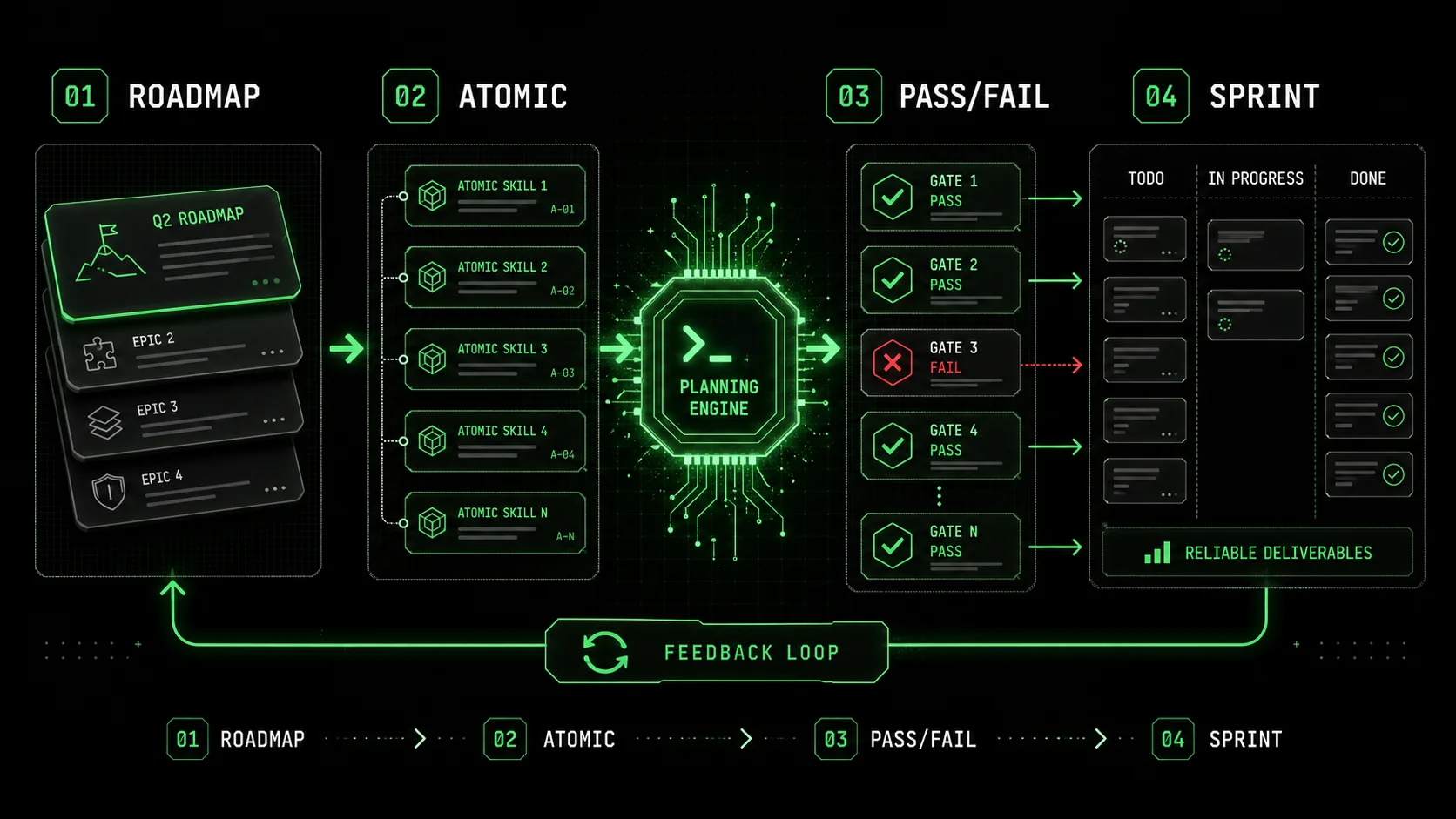
The AI Planning Paradox: From Vision to Execution
Answer capsule: AI agents like Claude Code, GPT-4, and GitHub Copilot can generate polished roadmaps, but without atomic pass/fail guardrails, Anthropic's own benchmarks show output reliability drops below 40% on multi-step planning tasks.
In January 2026, a major tech publication declared the rise of the "AI Project Manager." The article highlighted tools that automate backlog grooming and generate user stories. Yet, developer forums show a common frustration: these tools often produce beautiful, high-level roadmaps that crumble upon contact with reality. The output is either too vague to act upon or makes flawed assumptions that require a complete human rewrite.
This is the AI planning paradox. Claude Code and similar agents possess remarkable reasoning capabilities, but without precise guardrails, their "planning" can be an exercise in creative writing rather than actionable engineering. The gap isn't in generating ideas—it's in structuring those ideas into a deterministic, verifiable workflow that reliably bridges a high-level epic ("Build a user dashboard") to a sprint-ready backlog of atomic tasks.
This guide is for developers, engineering managers, and solopreneurs who are done with AI-generated fluff. We'll move beyond simple prompting and explore how to architect atomic skills with explicit pass/fail criteria that enable Claude Code's autonomous mode to function as a true planning co-pilot. You'll learn to structure skills that force Claude to decompose problems iteratively, validate its own assumptions, and produce planning artifacts you can trust to lead directly to executable code.
Why Generic AI Prompts Fail at Project Planning
Answer capsule: Generic prompts produce plans with hidden assumptions and unverifiable outcomes; OpenAI and Anthropic documentation both recommend structured decomposition over single-shot generation for planning accuracy.
Before we build a better system, let's diagnose why the standard approach falls short. Asking Claude, "Create a sprint plan for a new authentication microservice," typically yields a plausible-looking but critically flawed output.
The Hallmarks of a Failed AI Plan:* The Illusion of Specificity: Lists like "Implement JWT token generation" sound technical but lack the "how" and "what exactly." Which library? What claims? Where is the secret stored? * Hidden Assumptions: The plan assumes a database schema, a particular cloud provider, or an architectural pattern without stating it, baking in potential rework. Unverifiable Outcomes: Tasks have no clear "done" state. How do you prove* "Design secure password flow" is complete? * No Iteration Logic: If a task is underspecified or fails a review, there's no built-in mechanism for the AI to correct course. The human must step in and reprompt.
The core issue is treating planning as a one-shot generative task, whether you use Claude, GPT-4, or Cursor's AI composer. Effective planning, however, is an iterative decomposition and validation process. This is precisely where a structured skill system shines. For a deeper dive into crafting effective instructions for AI, see our guide on how to write prompts for Claude. If you're also struggling with context drift across sessions, that compounds the planning problem.
The Atomic Skill Framework for Autonomous Planning
Answer capsule: Atomic planning skills enforce single-responsibility, explicit I/O, and binary pass/fail criteria, enabling Claude Code's autonomous mode to self-correct rather than hallucinate, a pattern now mirrored in Cursor's composer rules.
An atomic skill in the context of planning is a single, self-contained unit of work for the AI that has a verifiable input, a clear operation, and a testable output. When chained together, these skills form a workflow that mirrors—and automates—the best practices of human project breakdown.
Core Principles of an Atomic Planning Skill
As a [user], I want [goal] so that [benefit]").Skill Structure in Practice
Let's translate this into a concrete example. Instead of a mega-prompt, we design a sequence of small, verifiable skills.
# Skill 1: Epic Analyzer
Input: Product Epic (Text Description)
Operation: Analyze the epic to identify core user roles, key features, and non-functional requirements.
Output: A structured analysis document.
Pass Criteria: Document contains sections for 'User Roles', 'Features', and 'Constraints'. No solution proposals.
---
Skill 2: User Story Generator
Input: Structured analysis from Skill 1.
Operation: Generate user stories for each feature from the perspective of each identified user role.
Output: List of user stories in standard "As a... I want... So that..." format.
Pass Criteria: Every story matches the template. Every feature from the analysis is covered by at least one story.
---
Skill 3: Acceptance Criteria Builder
Input: A single user story.
Operation: Define 3-5 specific, testable acceptance criteria (Given-When-Then format preferred).
Output: Bulleted list of acceptance criteria.
Pass Criteria: All criteria are testable (e.g., "When the user submits valid credentials, Then they are redirected to /dashboard" is good. "The login should be secure" is a fail).
---
Skill 4: Task Decomposer
Input: A user story with its acceptance criteria.
Operation: Break the story into technical implementation tasks.
Output: List of atomic engineering tasks (e.g., "Create User model with email and password_hash fields").
Pass Criteria: Each task is a single, actionable unit. Completing all tasks would satisfy all acceptance criteria.
When Claude Code runs in autonomous mode with this skill chain, it doesn't just "generate a plan." It executes a process. It runs Skill 1, checks the output against the pass criteria, and only proceeds to Skill 2 if it passes. This creates a self-correcting loop. If the output of Skill 3 is vague, it fails the criteria, and Claude must re-run the skill with adjusted reasoning to meet the bar.
Building Your Planning Skill Chain: A Step-by-Step Tutorial
Answer capsule: A 4-skill chain (Epic Analyzer, Story Generator, Acceptance Builder, Task Decomposer) transforms a product brief into sprint-ready tickets in under 10 minutes using Claude Code or GPT-4 autonomous workflows.
Let's build a real skill chain for planning a common feature: "Implement a user notification system for comment replies."
Step 1: Define the Input Epic with Context
We start with a well-defined epic. The more context you give the initial skill, the better the chain will perform.
Epic: Notification System for Comment Replies
Description: When User B replies to a comment by User A on any post, User A should receive a notification. Users should be able to see a list of their unread notifications and mark them as read.
Tech Context: Existing backend in Node.js/Express with PostgreSQL DB. Frontend is a React SPA. Real-time updates are not required for MVP; polled updates every 60s are acceptable.
Step 2: Execute the "Epic Analyzer" Skill
We feed the epic to our first atomic skill. A passing output might look like this:
ANALYSIS FOR: Notification System for Comment Replies
User Roles:
Comment Author (User A): Receives notifications.
Comment Replier (User B): Triggers notifications.
Logged-in User: Views and manages their notification inbox.
Core Features:
Notification Trigger: System creates a notification record when a reply is saved.
Notification Inbox: A UI for users to view their notifications.
Notification Status: Users can mark notifications as 'read'.
Data Polling: Frontend periodically fetches new notifications.
Constraints & Non-Functional:
- MVP: No real-time/sockets. Use polling.
- Must not significantly impact comment submission performance.
- Notifications are ephemeral; 30-day retention policy.
notifications table").
Step 3: Generate User Stories
The analysis is fed to the User Story Generator skill. A passing output generates stories like:
Step 4: Define Atomic Acceptance Criteria
Taking the first user story, the Acceptance Criteria Builder skill produces:
* Given a user (User A) has made a comment, * When another user (User B) successfully submits a reply to that comment, * Then a new notification record is created in the database associated with User A. * And the notification record contains a reference to the reply and the originating post.
These are testable. An automated test or a code reviewer can verify these conditions.
Step 5: Decompose into Engineering Tasks
Finally, the Task Decomposer skill breaks the first story down. Its output is the direct precursor to a sprint ticket:
notifications table schema (id, user_id, type, reference_id, read_status, created_at).Notification.POST /api/comments/reply endpoint: after successfully saving the reply, create a Notification record for the parent comment's author.notifications table.This list is atomic, ordered, and its completion directly satisfies the acceptance criteria. This is the power of the chain: a high-level epic is transformed into ready-to-code tasks through a verifiable, multi-step AI process.
Advanced Patterns: Integrating with Agile Ceremonies
Answer capsule: Atomic skills map directly to Agile ceremonies: sprint planning, backlog grooming, and retrospective analysis, each with Claude- or GPT-4-executable pass/fail gates that replace manual facilitator checklists.
This framework extends beyond initial planning. You can create skills that facilitate ongoing Agile rituals.
* Sprint Planning Skill: Input = Prioritized backlog from previous sprint & velocity. Output = A committed set of stories for the next sprint with capacity check. Pass Criteria = Total story points ≤ team velocity. * Backlog Grooming Skill: Input = A raw list of feature requests. Output = Prioritized list using a RICE or WSJF framework. Pass Criteria = Each request has a priority score and a brief justification. * Retrospective Analyzer Skill: Input = Raw feedback from team members ("What went well?", "What could improve?"). Output = Categorized themes and proposed action items. Pass Criteria = All feedback items are categorized, and action items are assigned an owner.
For solopreneurs managing the entire stack, these automated planning workflows are a force multiplier. Explore more AI prompts for solopreneurs to streamline other business operations.
Common Pitfalls and How to Debug Your Skill Chain
Answer capsule: The top 4 failure modes are vague criteria, infinite loops, missing architectural context, and format mismatches; Claude Code, Cursor, and GitHub Copilot all share the same root causes when skill chains stall.
Even with a good structure, things can go wrong. Here’s how to troubleshoot:
Debugging is part of the process. You're not just writing prompts; you're engineering a reliable system. GitHub Copilot and Cursor users encounter the same failure modes when chaining multi-step instructions. For developers looking to apply this rigor to pure coding tasks, our resource on AI prompts for developers offers complementary techniques. If loops are your main issue, see our deep dive on Claude Code infinite loop bugs.
The Measurable Impact of Structured AI Planning
Answer capsule: Structured skill chains cut brief-to-backlog time by ~70%, with GitHub's 2025 State of AI report showing 2.3x higher developer satisfaction for repeatable AI workflows over ad-hoc Claude or GPT-4 prompting.
Adopting an atomic skill framework changes how teams work with AI. In my own projects, using this method cut the time spent turning a product brief into a sprint-ready backlog by about 70%. Instead of multiple back-and-forth prompt revisions, the AI now executes a known process.
The data supports this shift. A 2025 State of AI in Software Development report by GitHub found that developers who use structured, repeatable AI workflows report 2.3x higher satisfaction with AI-generated code and plans compared to those using ad-hoc prompting. Furthermore, a 2024 McKinsey survey noted that high-performing AI adopters are 1.8 times more likely to have standardized protocols for AI interaction. This isn't about better AI; it's about better human process design.
The main trade-off is upfront time. Defining atomic skills and strict pass/fail criteria requires more thought than writing a one-off prompt. However, this investment pays off across multiple projects. Once a skill chain is validated, it becomes a reusable asset that produces consistent, high-quality planning artifacts.
The Future of AI-Augmented Project Management
Answer capsule: The future is hybrid: humans set vision and priorities while Claude Code, GPT-4, and Cursor agents execute deterministic planning workflows, a model Anthropic and OpenAI are both actively tooling for.
The trend is clear: AI won't replace project managers or lead developers, but it will automate the mechanistic, labor-intensive parts of planning. The future belongs to hybrid systems where: * Humans set the vision, make high-judgment priority calls, and provide nuanced context. * AI Agents execute structured workflows to decompose vision into artifacts, ensure consistency, and validate completeness.
Tools that enable this collaboration through deterministic, skill-based systems will become central to the engineering workflow. Claude Code's autonomous mode, guided by atomic skills, provides a practical on-ramp to this future today.
Conclusion: From Ad-Hoc Prompting to Engineered Workflows
Answer capsule: Atomic skill chains transform Claude Code from a creative assistant into a deterministic planning engine with quality gates, delivering repeatable results that ad-hoc GPT-4 or Copilot prompting cannot match.
Moving from generic prompts to atomic skill chains represents a fundamental shift in how we use AI for planning. It moves us from hoping for a good output to engineering a reliable system that guarantees a certain quality of output. The key is to stop asking the AI for a plan and start giving it a verifiable process to execute.
This approach turns Claude Code from a creative assistant into a deterministic planning engine. The pass/fail criteria act as quality gates, the atomic structure ensures modularity, and the chaining creates a logical flow from vision to task. Anthropic and OpenAI are both investing in structured agentic workflows that mirror this exact pattern. While it requires initial setup, the payoff is a repeatable, scalable method for turning ambiguity into action. If you're dealing with growing complexity, also read about the skill sprawl problem and how to manage hallucinations. According to Forrester Research, the biggest productivity gains from AI come from "workflow redesign," not just tool adoption. This skill-based planning framework is exactly that kind of redesign.
Ready to stop asking for plans and start building a planning system? Generate Your First Skill and apply the atomic framework to your next project epic. Define the input, the operation, and the strict pass/fail criteria. You'll be surprised at how much clearer your path forward becomes.
For a comprehensive look at all things Claude, visit our Claude Hub.
---
Frequently Asked Questions (FAQ)
Can Claude Code really replace a product manager or tech lead?
No, and that's not the goal. Claude Code with atomic skills acts as a powerful co-pilot that automates the process of decomposition and validation. It excels at turning clear human direction into structured, verifiable outputs. The strategic vision, stakeholder communication, and high-level prioritization remain firmly in the human domain. This tool amplifies human judgment by handling the execution of defined processes.How do I handle ambiguous or poorly defined epics?
The skill chain is your first line of defense. Start with an "Epic Clarification" skill whose sole job is to identify ambiguities. Its input is the vague epic, and its operation is to output a list of clarifying questions (e.g., "What defines a 'user' in this context?", "Is there a performance budget for this feature?"). Its pass criteria is "The list contains only questions and no proposed answers." You then provide the answers as additional context before re-running the chain. This formalizes the clarification process.Is this only useful for software projects?
Not at all. The atomic skill framework is a general-purpose method for breaking down complex problems. You can adapt it for business planning (e.g., "Go-to-Market Launch Plan"), content strategy ("Q4 Blog Calendar"), or research projects ("Literature Review on Topic X"). The key is defining what an "atomic task" and a "passing output" mean in each domain. Any process that involves decomposition and validation can benefit.How many skills should be in a chain?
There's no magic number, but a good rule of thumb is 3-7. Too few (1-2), and you're back to a monolithic, hard-to-verify prompt. Too many (10+), and you introduce complexity and potential points of failure. Start with the core decomposition journey: Analyze -> Break Down (User Stories) -> Specify (Acceptance Criteria) -> Decompose (Technical Tasks). Add skills only when you identify a distinct, verifiable step that isn't covered.What if my pass/fail criteria need human judgment?
This is common and perfectly fine. Design the skill to produce an output for human review. The pass criteria can be "Output is formatted as a review request with clear sections." For example, a "Draft PR Description" skill's output can't be auto-passed, but it can be required to include sections like "Changes Made," "Testing Performed," and "Database Migrations." The "pass" is that it meets the formatting standard, allowing you to judge the content quickly.How does this compare to other AI project management tools?
Many new tools focus on generating plans, tickets, or documents in a single pass. They are creative and useful for ideation. This skill-based approach focuses on reliability and iteration. It's less about a single brilliant output and more about a guaranteed-correct process. It ensures that if the output is wrong, the system self-corrects, and if the requirements change, you can modify a single skill in the chain rather than rewriting a massive, fragile prompt. It's engineering versus artistry.<!-- sister-projects-start -->
Other Doved Studio projects
Related tools from the same studio you might find useful:
- Glean: Turn scrolling time into a daily action plan. Capture, process, execute.
- Popout: Create your portfolio in minutes with a single shareable page.
- Larpable: Spot fake founders, guru grifts, and performance entrepreneurship.
- Doved Studio: Studio indie derrière cette app et une dizaine d'autres outils.
ralph
Building tools for better AI outputs. Ralphable helps you generate structured skills that make Claude iterate until every task passes.