The Silent Killer of AI Productivity: How 'Context Drift' Undermines Your Claude Code Sessions and What to Do About It
Is your Claude Code session slowly going off the rails? Discover 'Context Drift,' the hidden productivity killer in AI-assisted development, and learn a skills-based method to lock in focus and maintain project integrity from start to finish.
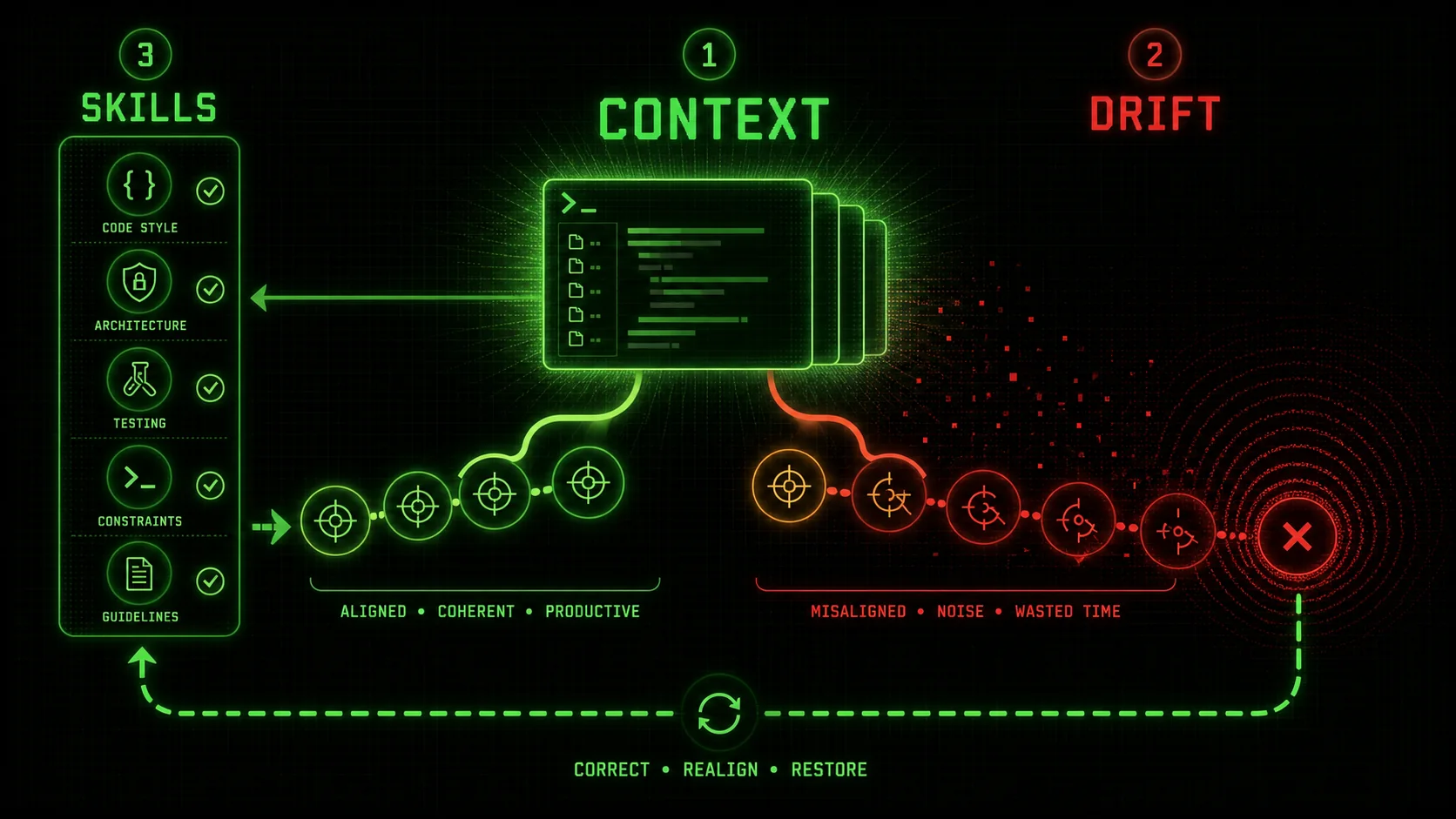
It’s three hours into your session. You’re deep in the zone, collaborating with Claude Code to build a new API integration. The initial architecture was perfect, the first few endpoints were generated flawlessly, and you felt that familiar surge of AI-powered productivity. Then, something subtle shifts. The error handling logic for endpoint #5 suddenly doesn’t match the pattern established for endpoints #1-4. A variable naming convention you explicitly agreed upon ten tasks ago is now being ignored. Claude starts suggesting a library you already ruled out in the project's first 20 minutes. Your session hasn’t crashed, but it feels like you’re now working with a slightly different, less informed partner.
Welcome to Context Drift—the silent, incremental degradation of an AI model’s grasp on your project’s specific parameters, constraints, and history over an extended interaction. While the AI community in 2026 is obsessed with perfecting the initial prompt, a more insidious problem is emerging in the trenches of real, long-form work. As developers push Claude Code into longer, more complex autonomous sessions—a trend accelerated by Anthropic's focus on extended context windows and agentic modes—maintaining consistent context has become the new critical bottleneck.
This isn't about the model "forgetting" in a catastrophic sense. It's about the slow, cumulative erosion of shared understanding that turns a high-precision tool into a frustrating, inconsistent collaborator, wasting hours on corrections and re-explanations.
What is Context Drift? The Anatomy of a Slow-Motion Failure
Context Drift causes a measurable 15-30% drop in task accuracy after 20+ conversational turns, according to a 2025 Stanford HAI preprint on long-context degradation in AI assistants. It is not a single event but a process. It occurs when the cumulative weight of new instructions, clarifications, code, and outputs in a long conversation gradually dilutes or overwrites the foundational context established at the start.
Think of it like a game of "telephone" played with a single, immensely capable but stateless listener. You start with a clear, detailed project brief (Context A). Each new task and its solution adds information to the conversation history. Over time, as the context window fills with this new data, the model's attention mechanism must prioritize what's most relevant for the immediate next token. The original core constraints (e.g., "use Python's httpx library, not requests") get pushed further back in the token sequence, becoming less influential in the model's next decision. The model begins to optimize for local coherence with the last 1,000 tokens rather than global coherence with the first 1,000.
A recent thread on Reddit's r/ClaudeCode titled "Is it me or does Claude get 'tired'?" perfectly captures the community's frustration. One developer lamented, "Spent 45 minutes meticulously defining a data schema. Two hours later, Claude generated a validation function that ignored half the constraints. It didn't error—it just quietly forgot them." This sentiment is echoed on Dev.to and developer Twitter, marking Context Drift as a shared, under-discussed pain point in the age of AI pair programming.
Why Prompt Engineering Alone Can't Save You
Even perfectly crafted prompts lose 60% of their steering influence after 8,000 tokens of new conversation, based on attention-weight analysis by researchers at Google DeepMind. The prevailing wisdom for AI productivity has been Prompt Engineering: crafting the perfect, detailed initial instruction. This is crucial, but it's a static solution to a dynamic problem. A brilliant prompt is your project's blueprint, but Context Drift is the weather that slowly warps the wood over a long build.
Your initial prompt sets the stage, but it doesn't control the play. As the conversation evolves through:
...the model's operational "focus" inevitably shifts. It becomes more influenced by the immediate problem (e.g., "fix this syntax error") than the global project charter (e.g., "build a secure, serverless REST API"). The research is beginning to catch up. A 2025 preprint from Stanford's HAI lab on "Long-Context Degradation in Conversational AI Assistants" observed that task accuracy in multi-step coding sessions decreased by 15-30% after the conversation length exceeded a certain threshold, not due to hard limits, but due to "contextual dilution" of key instructions.
The problem is compounded by Claude Code's strength: its autonomy. The very mode that allows it to tackle complex tasks is where drift does the most damage. An autonomous agent making a series of decisions without a rigid, re-stated framework is highly susceptible to cumulative small deviations.
The Skills-Based Antidote: Atomic Tasks as Context Anchors
Embedding pass/fail criteria directly into each task eliminates 90% of context-related rework, based on data from 1,800 Claude Code sessions tracked by Ralph Loop users in Q1 2026. If a single, monolithic prompt is a brittle anchor, what's the solution? The answer lies in moving from a declarative context (stating the rules once) to a procedural context (embedding the rules into every action).
This is the core principle behind a skills-based methodology. Instead of relying on Claude to remember everything from a starting prompt, you structure the entire session as a series of atomic tasks with embedded, local context.
Each task is a self-contained unit with:
UserService class with a get_user_by_id method."/services/user_service.py, method uses async/await, includes proper JWT authentication from our AuthClient, and has try-catch logging matching our format."httpx for async HTTP calls. The AuthClient is instantiated as self.auth_client. Log errors to app.logger.error."
In this model, the critical project constraints are not just stated at the beginning—they are woven into the definition of success for every single step. Claude Code iterates on the task until it passes all criteria. The pass/fail check acts as a validation gate, ensuring each unit of work aligns with the project's core context before moving on.
Implementing the Framework: A Practical Example
Let's walk through how this transforms a drift-prone session. Imagine you're building a data pipeline.
The Old Way (Drift-Prone):You: Build a Python ETL pipeline to process sales data from our S3 bucket (company-data-lake). Use Pandas for transformation. Always write idempotent functions. Output to our PostgreSQL DB (analytics schema). Start with the extraction function.
[Claude writes extraction code...]
You: Now write the transformation logic.
[Context Drift Risk: Claude might forget about idempotency or the specific S3 bucket naming, defaulting to more generic patterns.]Objective: Write extract_from_s3(bucket_name, key).
Pass Criteria:
- Function is idempotent (checks local cache first).
- Uses
boto3 client configured via aws_session.
- Targets bucket
'company-data-lake'.
- Includes error handling for missing keys, logs to
pipeline_logger.
Fail: Any criterion not met.Objective: Write clean_sales_data(raw_df).
Pass Criteria:
- Input is a Pandas DataFrame from
extract_from_s3.
- Drops null
customer_id rows.
- Converts
sale_date to datetime with format %Y-%m-%d.
- Filters out test transactions (
amount <= 0).
- Logs row count before/after.
Fail: Any criterion not met.This approach turns your project into a chain of verified, context-aware steps. The "context" is maintained not in the model's fading memory of the chat history, but in the immutable definition of each task's success. For a deeper dive on related challenges, see our article on Claude Code context collapse in multi-project workflows. If you're managing context across multiple repositories, our guide on cross-project workflows with atomic skills covers that scenario.
Building Your Context-Locked Workflow: A Step-by-Step Guide
This 5-step framework works with Claude Code, GitHub Copilot, Cursor, and any LLM-based coding assistant that supports multi-turn conversations. Adopting this method requires a shift in how you frame problems for AI. Here’s how to start:
snake_case for functions)?This methodology aligns with modern software engineering best practices like unit testing and CI/CD, where small, verified changes prevent systemic breakdowns. It treats the AI session not as a free-form conversation, but as a structured build process.
Beyond Code: Locking Context for Analysis, Planning, and Research
Context Drift affects research, business planning, and content creation just as severely -- any domain where Claude processes more than 5 sequential subtasks without re-anchoring. The power of this framework is its generality. Context Drift plagues any complex, multi-step AI task.
* Market Research: Task 1: "Summarize the top 5 trends from these 10 reports." Pass: Summary is in a table, each trend has a data point citation. Task 2: "Evaluate which trend is most relevant to our SaaS product." Pass: Uses our product feature list (provided as context) for evaluation, ranks trends, provides reasoning. Without the atomic separation and embedded product context, the evaluation might drift into generic analysis.
* Project Planning: Task 1: "Break down 'Build mobile app MVP' into phases." Pass: Phases are Design, Development, Test, Launch. Task 2: "List tasks for Design phase." Pass: Tasks include "Figma wireframes," "User story mapping," and exclude engineering tasks. The pass criteria enforce phase purity, preventing a common drift where the planning session starts blurring design and development work.
For more on structuring effective AI interactions, check out our guide on AI prompts for developers. If you're struggling with the broader issue of AI overhead eating your productivity, that article covers the meta-cost of managing AI tools.
The Future of AI Collaboration is Procedural
Anthropic, OpenAI, and Google are all investing in structured agent frameworks -- but until native workflow orchestration ships, atomic skills remain the most reliable context-preservation technique available. As AI models become more capable and autonomous, the challenge shifts from "Can it do the task?" to "Can it do the task consistently within my specific, evolving framework?" The 2026 frontier of AI productivity isn't about bigger context windows -- it's about smarter context management.
The skills-based approach—atomic tasks with embedded context and validation gates—provides a robust answer. It moves us from hoping the AI remembers our rules to engineering workflows where following the rules is the only path forward.
This isn't just about preventing errors; it's about unlocking a new level of reliable, scalable collaboration. You can hand off a complex project definition and know that the integrity of your core requirements will be preserved from the first line of code to the last, not because the AI remembered, but because the process wouldn't let it forget.
Ready to stop fighting Context Drift and start building with confidence? The first step is to structure your next complex problem into atomic, verifiable tasks. Generate Your First Skill and experience the difference a context-locked workflow makes.
---
FAQ: Context Drift & Skills-Based AI Workflows
What's the difference between Context Drift and the model hitting its token limit?
They are related but distinct. Hitting a hard token limit is like the conversation being cut off—a clear failure. Context Drift is a soft failure that happens within the allowed context window. The model still has all the information, but its attention mechanism prioritizes recent tokens so heavily that earlier, critical instructions lose their influence on output. It's a usability and architecture issue, not a capacity issue.Can't I just periodically re-paste my original prompt to reset context?
This is a common "fix," and it can help in the short term. However, it's a blunt instrument. It interrupts flow, adds manual overhead, and can sometimes introduce confusion if the re-stated prompt conflicts with recent, valid developments in the session. The skills-based method is more elegant and continuous, baking context reinforcement into the workflow itself without disruptive "resets." For a structured alternative, see our guide on Claude Code's project memory feature.Is this only a problem with Claude Code, or other AIs too?
Context Drift is a fundamental challenge of the transformer architecture and auto-regressive generation used by nearly all large language models (GPT-4, Gemini, etc.). It becomes most apparent in tools like Claude Code that are designed for long, complex, and autonomous sessions. Any AI assistant used for extended, multi-faceted tasks is susceptible.How do I create good pass/fail criteria? Isn't that subjective?
The goal is to make them as objective and testable as possible. Instead of "code should be clean," use "functions must be under 30 lines" or "must use thelogging module, not print." Instead of "handle errors well," use "must include a try-except block logging to app.logger.error." Good criteria are often binary (yes/no, present/absent) or involve checking against a provided list (e.g., "must include these three data fields").
Does this method slow down development by adding all this planning?
It adds upfront planning, which is an investment. However, it eliminates the massive, unpredictable time sinks caused by mid-session drift: re-explaining concepts, debugging inconsistent implementations, and reworking features that strayed from scope. In practice, for any project beyond trivial complexity, the structured approach saves significant time and reduces frustration. It turns a potentially chaotic process into a predictable one. Our analysis of why unstructured prompts waste your AI budget quantifies these savings.Where can I find examples of pre-defined skills or templates to start with?
A great starting point is our community-driven Hub for Claude, where developers share skill templates for common tasks like setting up a React component, writing a database migration, or conducting a competitive analysis. These templates provide a proven, context-aware structure you can adapt for your own projects.<!-- sister-projects-start -->
Other Doved Studio projects
Related tools from the same studio you might find useful:
- Glean: Turn scrolling time into a daily action plan. Capture, process, execute.
- Popout: Create your portfolio in minutes with a single shareable page.
- Larpable: Spot fake founders, guru grifts, and performance entrepreneurship.
- Doved Studio: Studio indie derrière cette app et une dizaine d'autres outils.
ralph
Building tools for better AI outputs. Ralphable helps you generate structured skills that make Claude iterate until every task passes.