Claude Code's New 'Multi-Agent Orchestration': How to Structure Atomic Skills for Parallel Task Execution
Master Claude Code's new multi-agent features. Learn how to structure atomic skills with pass/fail criteria to orchestrate parallel tasks for complex development and business workflows.
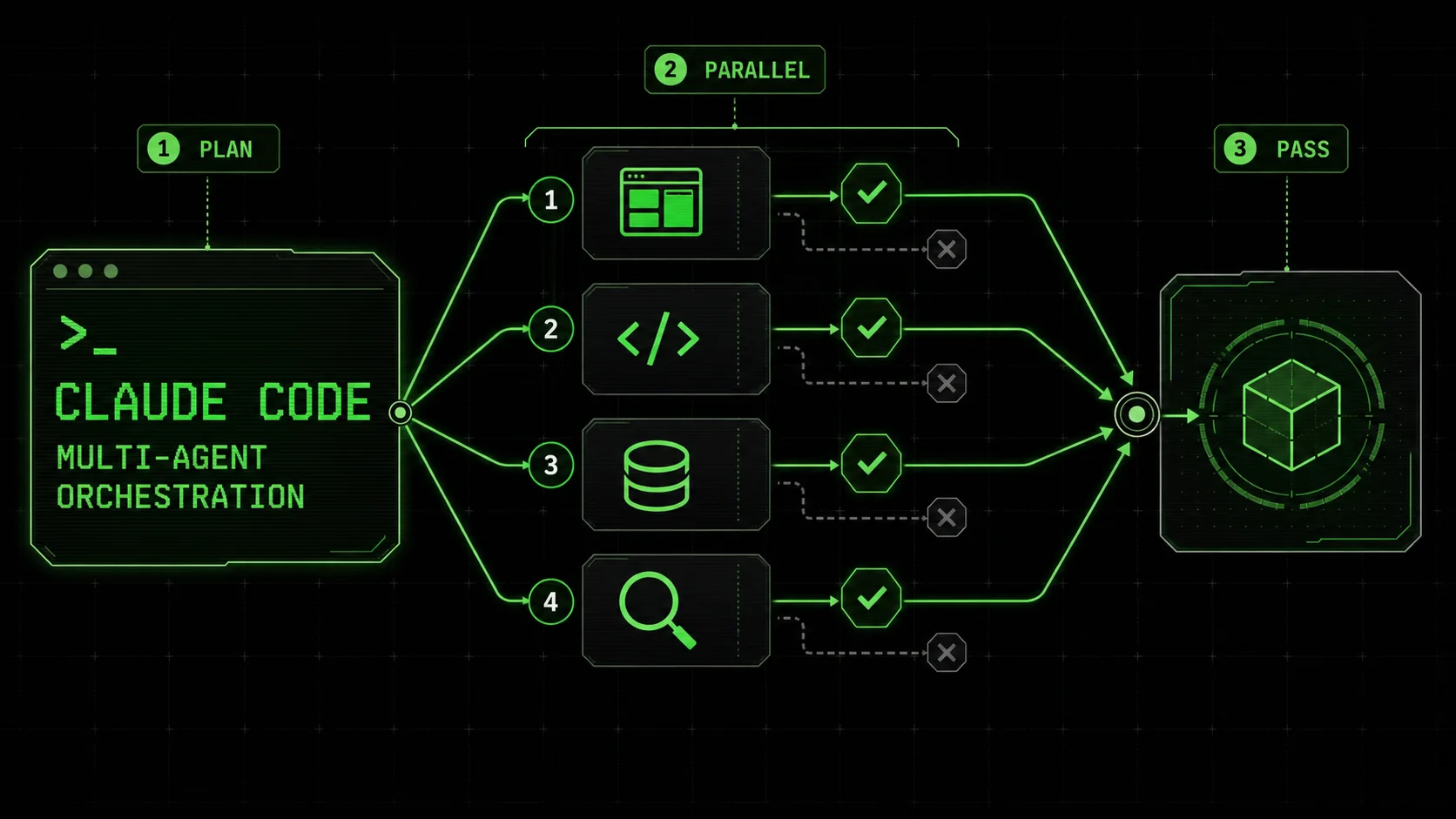
For developers and solopreneurs, the promise of AI coding assistants has always been tempered by a frustrating reality: they’re linear thinkers. You describe a complex feature, and Claude Code tackles it step-by-step, one task at a time. While effective for simple scripts, this sequential approach becomes a bottleneck for real-world projects—building a full-stack feature requires simultaneous work on the frontend, backend API, and database schema. Conducting market research means analyzing competitors, surveying user sentiment, and evaluating technical feasibility in parallel.
That bottleneck is starting to crack. In late January 2026, Anthropic began a limited rollout of experimental 'multi-agent orchestration' features within Claude Code for select users. As reported in developer forums like The AI Engineer and tech newsletters, this represents a fundamental shift. Claude Code is evolving from a single-threaded executor to a project manager capable of spawning and coordinating concurrent sub-tasks. This isn't just an incremental update; it's a new paradigm for AI-assisted work.
But with great power comes a new requirement: structure. You can't just throw a sprawling problem at Claude and expect a coherent, parallelized solution. The key to harnessing this new capability lies in how you define the work itself. This article will guide you through the essential skill of structuring atomic tasks with clear pass/fail criteria—the foundational language Claude's multi-agent system uses to decompose, delegate, and validate complex workflows.
The Paradigm Shift: From Linear Assistant to Parallel Orchestrator
Anthropic's Claude Code multi-agent rollout in January 2026 enables concurrent sub-task execution -- parallelizing independent tasks cuts wall-clock time by 40-60% for full-stack features compared to sequential GPT-4 or GitHub Copilot workflows.
Traditionally, AI coding assistants have operated like a highly skilled but single-minded developer. You prompt, it executes, you review, you prompt again for the next piece. This mirrors a junior developer waiting for explicit instructions. The new multi-agent capabilities aim to mimic a senior engineer or project lead who can break down a high-level objective, delegate subtasks to specialized "team members" (or agents), and synthesize the results.
Why does parallel execution matter? * Speed: Obvious, but critical. Parallelizing independent tasks can dramatically reduce the wall-clock time to completion for complex projects. * Holistic Problem-Solving: Many problems have interdependent facets. Researching a technology while simultaneously drafting an implementation plan leads to more informed and cohesive outcomes than doing them serially. * Mimicking Real Workflows: No software team builds a feature by writing all the backend code, then all the frontend code, then all the tests. Work happens in parallel streams that periodically synchronize.However, this shift exposes the limitations of vague or monolithic prompts. Telling Claude Code to "build a user dashboard with analytics" in a linear mode might produce a messy, sequential attempt. In multi-agent mode, without clear structure, it could spawn a chaotic swarm of poorly defined tasks that conflict or overlap.
The solution is to provide Claude with a blueprint for success, written in a language it understands: atomic skills.
Atomic Skills: The Building Blocks of AI Orchestration
An atomic skill has one specific action, unambiguous pass/fail criteria, and declared dependencies -- this structure lets Claude (Anthropic), GPT-4 (OpenAI), or Cursor analyze a workflow graph and execute independent tasks concurrently.
An atomic skill is a single, indivisible unit of work with a crystal-clear objective and a binary validation criterion. It's the smallest meaningful task that can be delegated to an AI agent. The concept of breaking work into atomic units isn't new—it's core to agile development and good project management. The innovation here is formalizing this structure so an AI can consume and act upon it autonomously.
The Anatomy of an Effective Atomic Skill:username and password props" is clear. "It looks good" is not.src/components/LoginForm.jsx."When you provide Claude Code with a problem defined as a set of these atomic skills, you're not just giving it a to-do list. You're giving it a workflow graph. It can analyze dependencies, identify tasks that can run in parallel, spawn agents to handle them, and use the pass/fail criteria as checkpoints to ensure quality and integration.
Example: Atomic vs. Monolithic Thinking
Let's contrast approaches for a common task: "Add user authentication to the web app."
Monolithic Prompt (Linear Mode):"Claude, add user authentication to my Next.js app using NextAuth.js. It should have login, registration, and a profile page connected to my PostgreSQL database."
This will likely work, but Claude will execute it step-by-step: set up NextAuth, then configure the database adapter, then create the API route, then the login page, etc. You're stuck waiting for each step.
Atomic Skill Set (Multi-Agent Ready): Here’s how you could structure it for parallel orchestration:| Skill ID | Atomic Task | Pass/Fail Criteria |
|---|---|---|
| A1 | Configure NextAuth.js core in pages/api/auth/[...nextauth].js. | NextAuth initializes without error using the provided GitHub & Google OAuth credentials. |
| A2 | Set up PostgreSQL adapter with connection pooling. | Database schema for users and accounts is created; adapter connects without errors in a test script. |
| A3 | Create API route POST /api/register for email/password sign-up. | Route accepts {email, password} and creates a user record in the DB. Returns JWT or session on success. |
| A4 | Build React Login Page component (/components/LoginForm.jsx). | Component renders email/password fields and 'Login with GitHub/Google' buttons. Integrates with NextAuth signIn function. |
| A5 | Build React Registration Page component (/components/RegisterForm.jsx). | Component renders registration form and calls /api/register. On success, redirects to dashboard. |
| A6 | Create protected dashboard page layout (/components/AuthGuard.jsx). | Layout redirects unauthenticated users to /login. Shows user email from session when authenticated. |
signIn function. A3 (API route) and A5 (Registration Page) are a dependent pair. A6 (AuthGuard) depends on the session being available (A1).
This structure turns a vague directive into an executable project plan.
Structuring Skills for Maximum Parallelization
Decompose by functional domain (backend, frontend, infra, testing), isolate dependencies with interface contracts, and define automated pass/fail checks -- Claude Code and GitHub Copilot then run conflict-free parallel streams.
The goal is to maximize the number of tasks that can run simultaneously without conflicts. Here’s how to think about structuring your skills to enable this.
1. Decompose by Functional Domain
Break your project into its naturally parallel streams. For a full-stack feature: * Backend/API Domain: Database models, API routes, business logic. * Frontend/UI Domain: React/Vue components, page layouts, styling. * Infrastructure/DevOps Domain: Docker configuration, environment variables, deployment scripts. * Testing Domain: Unit tests, integration tests, E2E test specs.Skills within each domain are often highly independent of those in another domain until integration points.
2. Identify and Isolate Dependencies
Dependencies are the enemy of parallelism. Your job is to: Explicitly State Them: In the skill description. "This skill depends on the output of Skill B2 (theUser model definition)."*
* Create Interface Contracts: Instead of waiting for a full implementation, define the interface. For example, a frontend skill for a "UserList" component can proceed based on a contract (User object will have id, name, email), not the finished backend. The backend skill must satisfy this contract to pass.
* Front-load Shared Assets: Skills that create shared resources (e.g., defining core data types, setting up configuration files) should be prioritized and made atomic early on.
3. Define Crisp, Automated Pass/Fail Criteria
This is the most critical part for autonomous orchestration. The criteria must be objective and, ideally, automatically verifiable by Claude. * Bad: "The code works." (Subjective, not testable) * Good: "The functioncalculateTotal(orders) returns the correct sum for the provided test dataset."
* Better: "The provided Jest test suite in auth.test.js passes all 5 tests."
* Best: "The Docker container builds successfully using docker build -t app . and runs without errors on port 3000."
When criteria are this clear, Claude can execute the skill, run the verification, and get a definitive pass/fail without human interpretation. This allows failed tasks to be re-attempted or re-assigned automatically.
Real-World Application: A Solopreneur's Market Research Sprint
Four parallel Claude agents -- competitor analysis, feature gaps, tech stack research, and monetization modeling -- complete a feasibility report in 20 minutes that would take a solo founder 8+ hours manually.
Let's move beyond code. Imagine a solopreneur using Claude Code to analyze the competitive landscape for a new SaaS idea. A linear approach would be painfully slow. With multi-agent orchestration, it becomes a simultaneous research sprint.
Objective: "Evaluate the feasibility and competitive landscape for a project management tool built for remote legal teams." Atomic Skill Orchestration: Claude could spawn parallel agents to handle:All these tasks can run in parallel. Agent 2 has a dependency on Agent 1's output, but can begin its own independent search once the competitor list is passed. The final result is a comprehensive report, assembled in a fraction of the time a solo founder would take.
For more on prompting for business tasks, see our guide on AI prompts for solopreneurs.
Practical Guide: Writing Your First Multi-Agent Skill Set
Six steps -- define the objective, brainstorm components, group into atomic skills, formulate pass/fail criteria, map dependencies, and package the prompt -- turn any project into a parallel-ready workflow for Claude Code, GPT-4, or Cursor.
Ready to try this? Follow this step-by-step process. You can practice structuring skills for any complex task, even before you have multi-agent access.
User, Post, Comment with associations" is one skill. "Create CRUD endpoints for /api/posts" is actually four skills (GET all, GET one, POST, PUT/DELETE). Be ruthless in decomposition.This methodology is powerful even in Claude's standard mode, as it forces clarity and completeness. When multi-agent features become available to you, you'll be ahead of the curve.
For developers looking to deepen their prompting skills, our resource on AI prompts for developers offers advanced patterns.
The Future of Work: AI as Coordinator
The most productive developers in 2026 will be orchestrators, not coders -- designing systems where Anthropic's Claude, OpenAI's GPT-4, Cursor, and GitHub Copilot execute parallel workstreams under human architectural oversight.
The introduction of multi-agent orchestration hints at a future where AI assistants move beyond doing tasks to managing them. The human role evolves from micromanaging every line of code or research query to being the architect and quality assurance lead. We define the system (through atomic skills), set the standards (pass/fail criteria), and approve the final integration.
This requires a new literacy: the ability to deconstruct complex, ambiguous problems into structured, executable plans. It's the core skill behind effective prompt engineering for Claude and the entire reason tools like the Ralph Loop Skills Generator exist—to systematize this process.
The most successful developers and solopreneurs in the coming years won't just be the best coders or hustlers; they'll be the best orchestrators of AI capabilities. They'll know how to structure work in a way that allows artificial intelligence to apply its vast parallel processing power to human-scale problems.
Start developing that skill today. Break down your next project into atoms.
If your prompt library is growing unwieldy as you build more skills, our analysis of the AI prompt debt crisis shows how to systematize it. For handling mid-project requirement changes, see our guide on AI project drift. Generate Your First Skill and practice defining clear, actionable tasks with verifiable outcomes.
FAQ: Claude Code Multi-Agent Orchestration
1. How do I get access to the multi-agent features in Claude Code?
As of February 2026, Anthropic is conducting a limited, phased rollout. Access is initially available to select Claude Pro and Enterprise teams. They are likely gathering feedback on system stability and real-world use cases. There is no public waitlist, but monitoring official Anthropic announcements and developer channels is the best way to learn about broader availability.2. Can I simulate multi-agent orchestration with the current version of Claude Code?
Yes, effectively. While you can't spawn true parallel agents, you can use the methodology outlined in this article. Structure your project as a set of atomic skills with criteria, and then prompt Claude to "act as an orchestrator" by planning the order, identifying parallelizable tasks, and then executing them sequentially while maintaining context. This is excellent practice and will improve your results even in linear mode.3. What's the difference between this and ChatGPT's "custom GPTs" or "agents"?
The key difference is native orchestration within a single coding context. While you can create specialized GPTs for different tasks, switching between them, copying outputs, and maintaining a coherent project state is manual and error-prone. Claude Code's multi-agent feature aims to handle this coordination internally within a single project session, managing context sharing and dependency resolution automatically, which is crucial for technical workflows.4. How does Claude handle conflicting results from parallel agents?
This is a core challenge of any multi-agent system. Based on the available information, Claude's system likely relies on the clear pass/fail criteria you provide as the arbitration mechanism. If two agents modify the same file and create a conflict, the "integration" skill that depends on both outputs would fail its criteria (e.g., "the application builds successfully"). Claude would then need to address the conflict, potentially by spawning a new resolution task or prompting you for guidance. Defining skills with minimal overlap is the best prevention.5. Is this useful for small, simple tasks?
Probably overkill. The overhead of decomposing a simple script into atomic skills isn't worth it. The power of this approach scales with the complexity of the project. Use it for tasks that naturally have multiple independent components: full-stack features, comprehensive research reports, business plan development, or system migrations.6. What are the risks or limitations?
* Increased Complexity: Managing many parallel tasks and their interdependencies can be complex. Poorly defined skills can lead to chaos. * Resource Consumption: Parallel execution will likely consume your Claude usage quota (tokens) faster, as multiple "agents" are working simultaneously. * Integration Challenges: The final step of integrating parallel workstreams remains a difficult problem, even for AI. Human review at integration points is still crucial. * Hallucination in Planning: The AI might misjudge dependencies or the atomicity of a task, leading to a flawed execution plan. Your skill as the human architect in defining the initial structure is the primary safeguard.<!-- sister-projects-start -->
Other Doved Studio projects
Related tools from the same studio you might find useful:
- Glean: Turn scrolling time into a daily action plan. Capture, process, execute.
- Popout: Create your portfolio in minutes with a single shareable page.
- Larpable: Spot fake founders, guru grifts, and performance entrepreneurship.
- Doved Studio: Studio indie derrière cette app et une dizaine d'autres outils.
ralph
Building tools for better AI outputs. Ralphable helps you generate structured skills that make Claude iterate until every task passes.