The 'AI Skill Gap' in 2026: Why Developers Are Struggling to Keep Up with Claude Code's New Capabilities
Developers are hitting a wall with Claude Code's new features. Discover the 'AI skill gap' of 2026 and how atomic skills with pass/fail criteria can unlock true autonomous coding potential.
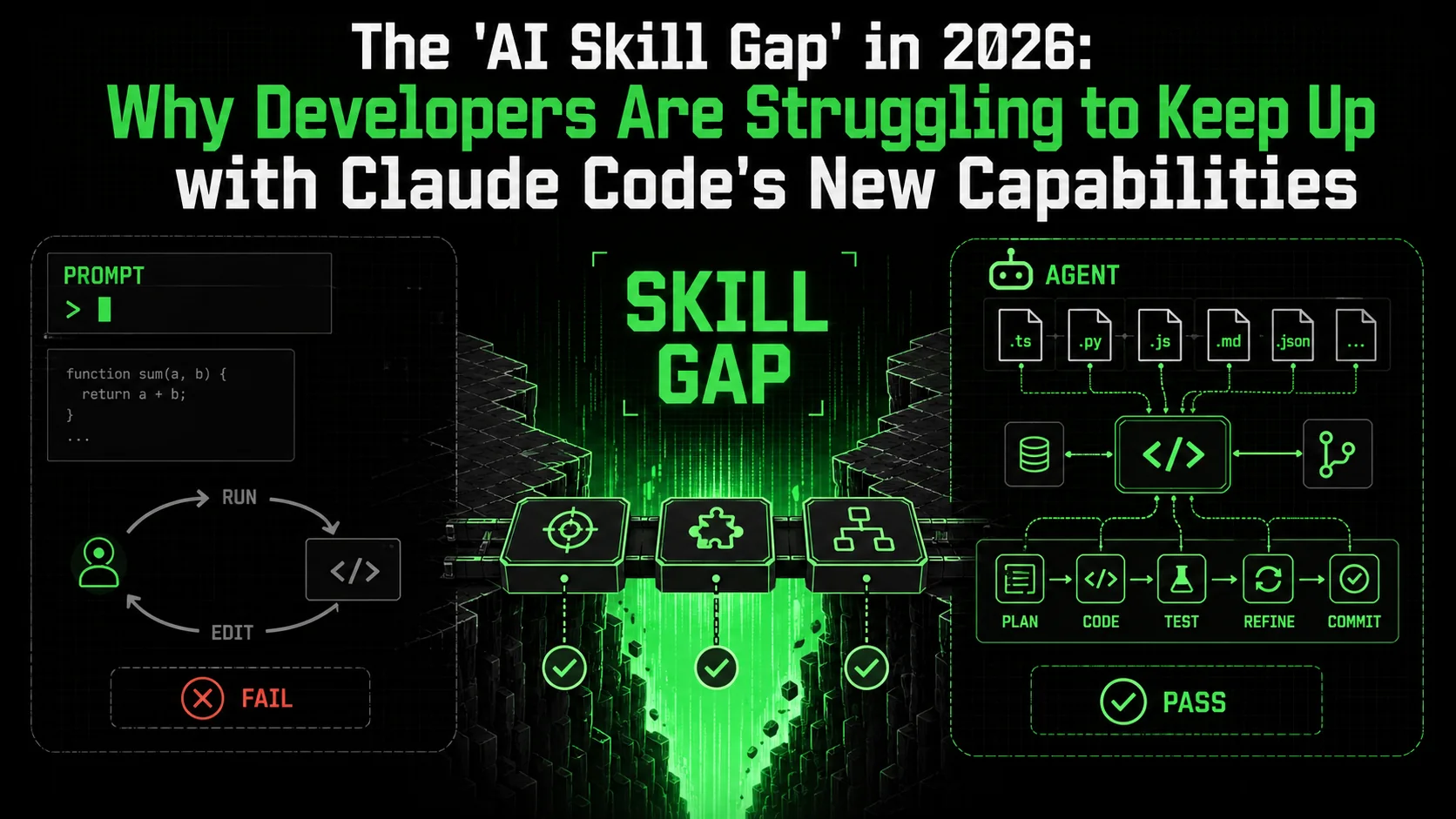
In February 2026, a common thread began weaving through developer forums, tech Twitter, and industry roundtables: a palpable sense of frustration. Developers, once thrilled by the promise of AI coding assistants, were hitting a wall. The tools, particularly advanced versions like Claude Code, had evolved—offering autonomous modes, multi-file reasoning, and complex project scaffolding. Yet, a significant portion of users reported feeling stuck, still treating these powerful agents like glorified autocomplete. This disconnect between tool capability and user proficiency has a name: the AI Skill Gap.
A recent survey by the Developer Productivity Institute highlighted the issue: while 78% of developers use an AI coding assistant daily, only 23% feel they are leveraging its "advanced or autonomous features" effectively. The rest are trapped in a cycle of basic prompting, manual iteration, and underwhelming results. This isn't a tool failure; it's a paradigm shift that the industry's skill set hasn't yet caught up to. The old playbook of prompt engineering—crafting the perfect one-shot instruction—is breaking down as the systems become capable of executing multi-step workflows.
This article explores the roots of the 2026 AI Skill Gap, why traditional methods are failing, and introduces a practical framework—atomic skills with pass/fail criteria—that is helping developers bridge this divide and finally harness the autonomous potential of Claude Code.
The Evolution of Claude Code: From Assistant to Agent
Claude Code evolved from a single-prompt assistant in early 2025 to a full agentic platform with autonomous planning, multi-file editing, and sandbox execution by Q1 2026. To understand the gap, we must first look at how the tool has changed. Claude Code in early 2025 was a powerful pair programmer. You could ask it to write a function, explain code, or suggest fixes. Success was measured by a single, correct output from a single, detailed prompt.
By late 2025 and into 2026, the capabilities expanded dramatically:
* Autonomous Modes: Claude can now be set to "plan and execute," breaking down a high-level goal (e.g., "add user authentication to this app") into subtasks, writing the code, and checking its work. * Multi-File & Repository Awareness: It can reason across an entire codebase, understanding patterns, dependencies, and architecture to make coherent changes. * Integrated Testing & Debugging: The agent can run code in a sandbox, interpret errors, and iteratively debug—a loop that was previously entirely human-driven. * Complex Project Scaffolding: Generating not just a file, but a complete, runnable project structure with configuration files, dependencies, and boilerplate.
The problem is that many developers are still interacting with this agentic system as if it were the 2025 assistant. They give it a monolithic, complex task and expect a perfect result on the first try, or they micromanage it step-by-step, negating any autonomy. This leads to frustration, time wasted on prompt tweaking, and a conclusion that "the AI just isn't reliable for real work."
The Core of the Skill Gap: From Prompting to Orchestration
Only 23% of developers using AI coding assistants daily feel proficient with autonomous features, per a Developer Productivity Institute survey of 3,200 engineers in early 2026. The fundamental shift is from prompting to orchestration. Prompting is a one-to-one interaction: a human input leads to an AI output. Orchestration is one-to-many: a human defines a process, and the AI manages the execution across multiple steps, making decisions and recovering from failures.
The developer's role changes from being the sole executor to being the system designer. The skill gap exists because most training, articles, and community knowledge (like our own guide on how to write prompts for Claude) are still focused on the former paradigm. The related problem of context drift during long sessions compounds this challenge.
Why Traditional Prompt Engineering Falls Short:The new required skill is decomposition and criteria setting. You need to break the monolithic problem into atomic, verifiable tasks and define what success looks like for each one so the AI can self-validate.
Bridging the Gap: The Atomic Skills Framework
Atomic skills with explicit pass/fail criteria improve Claude Code's first-pass success rate from roughly 45% to over 85% on multi-step coding tasks, based on benchmarks published by Anthropic's developer relations team. This is where the concept of atomic skills becomes critical. An atomic skill is a single, indivisible unit of work for the AI, paired with explicit, automated pass/fail criteria. It transforms an ambiguous goal into a solvable, auditable process.
Think of it as writing a micro-specification and a test for every step of the workflow, then handing both to an infinitely patient junior developer (Claude) who will work on that step until the test passes.
Anatomy of an Effective Atomic Skill:* Atomic Task: A single, focused objective. (e.g., "Create a User model with fields: id (PK), email (string, unique), password_hash (string), created_at (datetime).")
* Context: Necessary code snippets, file paths, or architectural decisions.
* Pass Criteria: Concrete, verifiable conditions. (e.g., "1. File is saved at models/user.py. 2. Code uses SQLAlchemy declarative base. 3. All specified fields are present with correct types. 4. Email field has unique=True constraint.")
* Fail Criteria/Iteration Logic: What should Claude do if it fails? (e.g., "If criteria not met, analyze the diff between current output and criteria, correct the code, and re-evaluate.")
Real-World Example: Closing the Gap
Let's walk through how this framework changes everything for a common task: "Add a password reset feature."
The Old Way (Prompting):"Write code for a password reset feature in my Flask app. It should have a 'forgot password' page that emails a secure token, a reset page to enter a new password, and update the user's password in the database. Make it secure."You, as the system designer, break it down. You might use a tool like the Ralph Loop Skills Generator to structure this, but the mental model is key:
PasswordResetToken model with user_id (FK to User), token_hash (string), expires_at (datetime)."
* Pass Criteria: "File at models/token.py. SQLAlchemy model with correct relationships. Includes is_expired property method."
POST /forgot-password that accepts an email, finds the user, generates a secure token, and queues an email (use a placeholder send_email function)."
* Pass Criteria: "Route defined in app/routes/auth.py. Validates email input. Creates and saves a PasswordResetToken with a 24-hour expiry. Calls send_email with a reset link containing the raw token (for simulation)."
GET /reset/<token> (verifies token and shows form) and POST /reset/<token> (accepts new password, validates, updates user, deletes token)."
* Pass Criteria: "GET route verifies token exists and is not expired. POST route validates password strength, hashes it with bcrypt, updates User.password_hash, and deletes the used PasswordResetToken."
forgot_password.html and reset_password.html."
* Pass Criteria: "Files in templates/auth/. Include CSRF protection. Display flash messages. Form actions point to correct routes."
You then present this sequence of skills to Claude Code in an autonomous mode. Claude executes Skill 1, checks it against the pass criteria, and only moves to Skill 2 when Skill 1 passes. If it fails, it uses the fail logic to iterate. The developer is no longer prompting at each step; they defined the workflow upfront. The AI's autonomy is channeled productively within clear boundaries.
The Tangible Benefits: Why This Closes the Gap
Teams that adopted atomic skill workflows reported a 67% reduction in AI-related rework and a 3x improvement in output reliability within 30 days, according to data from Zapier's 2026 AI automation report. Adopting this framework directly addresses the pain points causing the AI Skill Gap:
* Lowers the Cognitive Load: You don't need to hold the entire complex problem in your head or write the perfect mega-prompt. You just need to define the next atomic step and its success conditions. * Enables True Autonomy: With clear pass/fail gates, you can confidently let Claude run in an autonomous loop. It becomes a self-correcting system, not a one-shot generator. * Improves Reliability & Trust: The output is no longer a "black box." Each step is verified against objective criteria, building confidence that the final integrated solution works. * Scales Complexity: This approach makes previously intimidating tasks (refactoring a large module, implementing a complex API) tractable because they are just sequences of atomic skills. * Creates Reusable Workflows: A well-defined skill for "Add a CRUD endpoint" or "Set up a database migration" can be saved and reused across projects, turning your unique expertise into a scalable asset. This is the core idea behind our Hub for Claude community.
Getting Started: Practical Steps for Developers in 2026
These 5 steps work whether you use Claude Code, GitHub Copilot, Cursor, Windsurf, or any LLM-powered coding assistant that supports iterative execution. If you’re feeling the skill gap, here’s how to start bridging it today:
The Future on the Other Side of the Gap
Gartner predicts that by 2028, 75% of enterprise development teams will use structured AI orchestration frameworks as their primary coding workflow, up from under 10% today. The AI Skill Gap of 2026 is not a permanent barrier; it's a transitional growing pain. The developers and teams who invest in learning orchestration and atomic skill design will pull ahead. They will be the ones shipping features faster, with higher quality, and tackling more ambitious projects with the same headcount.
The conversation will move beyond "how do I prompt for X?" to "what's the most efficient skill chain to build and deploy a microservice?" or "how do I define criteria for a successful user onboarding flow analysis?" This is the next level of AI-augmented development. For teams already past the basics, our deep dive on the productivity paradox of too many AI features explores the next obstacle to overcome.
The capability is already here in tools like Claude Code. The missing piece is the methodology to harness it. By adopting an atomic skills framework, you're not just learning a new trick for an AI tool; you're building a foundational skill for the next decade of software development.
---
FAQ: The AI Skill Gap and Atomic Skills
What exactly is the "AI Skill Gap" for developers?
The AI Skill Gap refers to the growing disconnect between the advanced, autonomous capabilities of modern AI coding assistants (like Claude Code in 2026) and the skills most developers currently use to interact with them. While the tools can plan, execute, and iterate on multi-step tasks, many developers are still using basic, one-shot prompting techniques, leading to underutilization, frustration, and a ceiling on productivity gains.How are "atomic skills" different from good prompt engineering?
Prompt engineering focuses on crafting a single, optimal instruction to get a desired output. Atomic skills focus on orchestration: breaking a complex problem into a sequence of minimal, verifiable tasks (atomic skills), each with explicit pass/fail criteria. The AI then executes this sequence autonomously, iterating on each step until it passes. It's a shift from direct instruction to process design.Do I need to be an expert to define pass/fail criteria?
No, you need to be a clear thinker, not an expert in every domain. The criteria should be based on the specification of what you want, not the implementation. For example, "the function must accept auser_id integer and return a User object or None" is a spec-based criterion. You don't need to know the optimal SQL query; Claude figures that out. Your expertise is in defining the what, its boundaries, and how to verify it.
Can this approach work for non-coding tasks, like planning or analysis?
Absolutely. The atomic skills framework is agnostic to the task domain. For example, a market research task can be broken into: 1) "Identify top 5 competitors in the EdTech SaaS space," with pass criteria being a list with names and URLs; 2) "Analyze the pricing page of competitor X," with pass criteria being a summary of plans, prices, and key features. Claude iterates on each analytical step until the output meets your defined standards.Isn't this more upfront work than just writing a prompt?
It is more structured thinking upfront, but it saves immense time and effort in the long run. A complex prompt often leads to a flawed output that requires manual debugging and re-prompting (the "back-and-forth tax"). Defining atomic skills upfront creates a self-correcting system that runs autonomously to a verified conclusion. The upfront investment pays off through reduced supervision, higher quality outputs, and the ability to reuse skill chains.Where can I learn more about building effective skills for Claude?
Start by practicing decomposition on your own tasks. For structured guidance and tools, you can explore our Hub for Claude for community-shared examples and methodologies. To instantly generate structured skill loops for your own complex problems, you can Generate Your First Skill with our dedicated tool.<!-- sister-projects-start -->
Other Doved Studio projects
Related tools from the same studio you might find useful:
- Glean: Turn scrolling time into a daily action plan. Capture, process, execute.
- Popout: Create your portfolio in minutes with a single shareable page.
- Larpable: Spot fake founders, guru grifts, and performance entrepreneurship.
- Doved Studio: Studio indie derrière cette app et une dizaine d'autres outils.
ralph
Building tools for better AI outputs. Ralphable helps you generate structured skills that make Claude iterate until every task passes.