Codex CLI for monorepos: the agent review loop that keeps 2026 pull requests sane
A practical review loop for using Codex CLI and agent-supervised PRs in large repos without losing tests, ownership, or context.
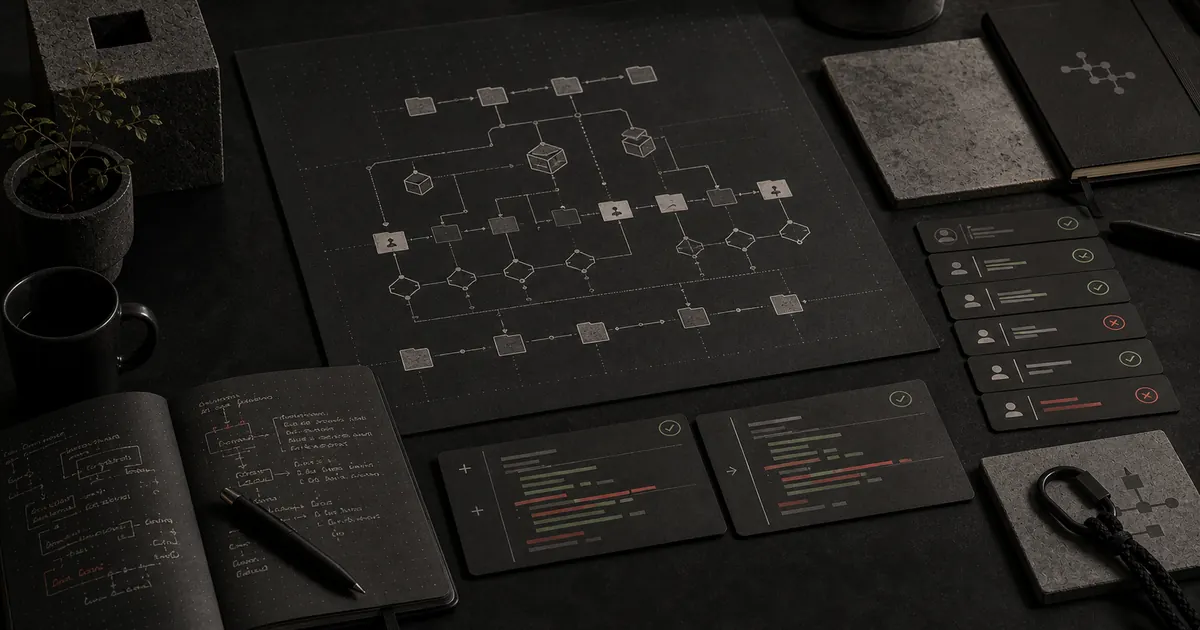
Codex CLI becomes reliable inside a monorepo when every agent run operates inside a tight feedback loop: scoped files, pass/fail checks, structured diff review, and explicit handoff notes. Without this loop, agent-generated pull requests in multi-package repos drift across package boundaries, break contracts silently, and force senior engineers to spend hours untangling context the agent never had. The loop is not theoretical. Teams shipping agent PRs at scale in 2026 are converging on these four guardrails because the alternative—unrestricted agent runs across dozens of packages—has already proven expensive.
The OpenAI Codex product page describes Codex as an agentic coding tool that reasons across an entire codebase, but the word "entire" hides the practical problem. A monorepo is not one codebase. It is thirty, or sixty, or two hundred semi-coupled packages sharing a versioning scheme, and an agent that reads everything will happily touch everything. The product page's emphasis on "reasoning" across codebases is powerful, but only when that reasoning is bounded. Scoping file access to a target package and its declared dependencies is the first mechanical step that makes the output reviewable.
Why Engineering Leads Should Act Now
The pressure to adopt AI-assisted pull requests is no longer coming from vendor marketing. It is coming from velocity expectations inside organizations that have already seen single-package teams ship 30–40% faster with agent assistance. The OpenAI Codex GitHub releases show a cadence of improvements that tightened file resolution, sandbox execution, and diff output formatting—three features that directly enable scoped, reviewable agent runs. Each release narrows the gap between "works on a demo repo" and "works on our 4-million-line monorepo."
The GitHub Docs on third-party coding agents now explicitly describe integration patterns for external agents submitting pull requests through GitHub's API surface. This documentation exists because the platform is adapting to a world where not every PR author is a human developer. When third-party agents can open PRs with automated checks, the difference between a well-scoped agent run and an unbounded one shows up immediately in review queue load. Teams still treating agent PRs like human PRs—expecting reviewers to catch cross-package breakage manually—burn their senior engineers' time on detective work rather than architecture decisions.
A concrete illustration of the required workflow comes from the official OpenAI walkthrough of Codex CLI with GPT-5-Codex. The video demonstrates CLI usage patterns that are directly applicable to monorepo work: specifying target directories, reviewing diffs inline, and iterating before opening a pull request. Watching the walkthrough clarifies why the CLI differs from IDE-based agents. The CLI is inherently scriptable, which means scoping, checks, and handoff notes can be automated in CI rather than depending on a developer remembering to constrain the agent in the moment. The video serves as a practical reference for the loop mechanics described in this article.
The cost of acting later is compounded by the nature of monorepo coupling. A single agent run that modifies a shared utility package to support a feature in one downstream package can break twelve other downstream packages without any explicit signal—until CI runs or, worse, until production. This is the exact failure pattern described in our analysis of why AI coding assistants struggle with legacy code, where context-blind edits cascade into failures outside the agent's awareness. Monorepos amplify this risk multiplicatively.
The Evidence Map
The four components of the agent review loop did not emerge from a single research paper. They surfaced independently across teams running Codex inside monorepos, each arriving at similar conclusions after encountering similar failure modes. What follows is the evidence for each component, drawn from product documentation, release notes, platform behavior, and observed team practices.
Scoped Files and Package Boundaries
Codex can target specific files and directories during a run. The OpenAI Help article on Using Codex with ChatGPT documents how to specify a working context, including file paths, which limits the agent's attention to a defined subset of the repository. In a monorepo, this means scoping a run to packages/payments/ and its explicit dependency tree rather than allowing the agent to traverse the entire repository graph.
Scoping serves two purposes. First, it prevents the agent from modifying packages it does not understand. Second, it makes the resulting diff small enough to review in one sitting. A 40-file diff touching 8 packages is unreviewable. A 6-file diff inside one package with one interface update to a neighboring package is manageable. AI task decomposition provides the framework for breaking a feature request into package-scoped units of work, each assigned to a separate agent run with explicit boundaries.
The practical rule observed across teams is: one agent run should modify files inside one package, and if it touches another package, the change must be limited to a documented interface or a version bump. Anything broader indicates the task decomposition was too coarse.
Explicit Pass/Fail Checks
An agent without explicit acceptance criteria will produce code that looks correct in isolation and fails at integration boundaries. Our work on explicit pass/fail criteria for AI work demonstrates that agents perform dramatically better when given binary checks: tests that must pass, lint rules that must hold, contracts that must be satisfied, and build steps that must succeed.
In the Codex CLI loop, pass/fail checks run before a human reviews the diff. The OpenAI Codex GitHub releases show progressive improvements to sandbox execution, which allow pre-commit validation scripts to run inside the agent's environment. A team configures these checks once—run pnpm test --filter @scope/payments, run pnpm lint, run pnpm typecheck—and the agent cannot propose a PR unless every check passes. This shifts the human reviewer's role from catching simple breakage to evaluating design decisions and edge-case handling.
The checks must be package-specific. A monorepo-wide test suite takes too long and produces failures unrelated to the agent's changes. The check suite for a payments-package agent run should exercise that package and its immediate consumers, not every package in the repository.
Structured Diff Review
Even with scoped files and passing checks, an agent can introduce logic errors, security gaps, or patterns that violate team conventions. AI code review misses critical flaws when reviewers treat agent PRs the same as human PRs. The review process for agent output needs a different lens: reviewers are auditing the agent's decisions, not co-authoring the code.
The effective pattern pairs Codex's diff output with a structured review checklist: Does the change stay within the declared scope? Does it introduce new dependencies without justification? Does it handle error states the agent's training data typically underweights? Does it respect the package's existing patterns rather than imposing a generic refactor? This is distinct from vibe coding, where the developer iterates conversationally. In a monorepo PR loop, the review is adversarial in the healthy sense: assume the agent missed something and search for it systematically.
Handoff Notes Between Agents
A feature spanning multiple packages requires multiple scoped agent runs. Each run must produce handoff notes that the next agent consumes: what was changed, what interface was modified, what assumptions were made, and what the downstream agent is expected to do. Without these notes, each agent starts from incomplete context and the integration breaks at the seams.
The OpenAI Codex for knowledge work article describes Codex's ability to synthesize and transmit context across interactions. In a monorepo setting, this translates to writing handoff artifacts—a short markdown file committed alongside the code or included in the PR body—that capture the agent's intent and decisions. The next agent in the chain reads this artifact as part of its scoped context.
The handoff pattern also addresses the budget problem described in our article on stopping AI budget waste from unstructured prompts. Structured handoff notes reduce the token cost of each subsequent run by providing focused context rather than forcing the agent to reconstruct intent from raw code.
The Loop in Practice
These four components are not independent optimizations. They compose into a single workflow:
| Step | Component | Action |
|---|---|---|
| 1 | Scoped files | Define the package target and dependency boundary for the agent run |
| 2 | Pass/fail checks | Configure package-specific test, lint, and type-check suites as pre-commit gates |
| 3 | Agent execution | Run Codex CLI with scoped context; agent iterates until checks pass |
| 4 | Diff review | Human reviews the bounded diff against a structured checklist |
| 5 | Handoff notes | Agent generates a context artifact for downstream package runs |
| 6 | Repeat | Next scoped run consumes handoff notes and begins at step 1 |
Decision Table and Workflow: Part One – Trigger to Structured Diff
Before a single git diff is produced, engineering teams need a clear operating manual: when does it make sense to hand a task to a Codex agent inside a large multi-package repository, and what must the first half of the workflow look like to keep the resulting pull request sane? The agent review loop isn’t magic; it’s a sequence of hard-won guardrails. The first half—scope definition, pass/fail encoding, agent run, and diff review—determines whether the exercise saves time or creates a conflicted mess that senior developers waste hours unravelling.
When to Delegate to a Codex Agent in a Monorepo
Codex becomes a reliable “member of the team” only when the work handed to it respects the structural reality of a monorepo: dependency boundaries, test ownership, and the cognitive load a reviewer can absorb from an automated diff. The decision table below codifies the rules many platform teams arrive at after a few painful agent-generated PRs that touched 30 packages and broke shared types.
Decision matrix: trigger an agent PR or keep the work manual| Trigger condition | Cross-package scope | Testable oracle exists? | Atomicity | Recommended path |
|---|---|---|---|---|
| Single-package bug with reproduction test | No | Yes (existing test) | High | Agent or manual; if agent, use strict single-package file scope and the reproduction test as the pass/fail criterion. |
| Feature spanning two tightly coupled packages | Yes, limited | Partial – contract tests missing | Medium | Decompose, then agent. Run one agent per package with handoff notes; each run enforces that the package’s own test suite passes. See AI task decomposition. |
| Feature touching three or more packages with new APIs | Yes – high | Only if contract tests are written first | Low | Human-led decomposition into atomic steps; agent runs only after you write explicit pass/fail contracts per package. |
| Global rename, codemod, or type migration | Yes (monorepo-wide) | Yes via type-checker + linter | High | Agent ideal candidate. File scope = entire repo, pass/fail = tsc --noEmit + eslint . + custom script. |
| Extract shared utility library from existing packages | Yes – requires moving files | Partially – existing tests may break | Low | Human owns the architecture; agent can execute each atomic extraction after scope is limited to a few files. |
| Dependency version bump across a subset of packages | Yes, moderate | Lockfile consistency + yarn.lock diff check | High | Agent with file scope restricted to affected package manifests and lockfile; pass/fail checks build health and integration test smoke suite. |
CODEOWNERS files and package dependency graphs to automatically map a task to the exact set of directories an agent can modify. If a task demands changes in more than 20 files, break it into multiple sequential runs, each with its own scope and pass/fail check, linked by a handoff note.@scope/auth passes after the change” or as specific as a shell snippet that checks new API responses against a contract file. An explicit pass/fail criterion transforms verbose model output into a binary quality gate. (For a deeper breakdown, see why explicit pass/fail criteria stop AI from guessing intent.)The table makes the “when” concrete. The workflow that follows turns the “how” into a repeatable playbook that any team member can run.
The First Half of the Loop: From Issue to Validated Diff
Imagine a task lands in your project management tool: “Update the notification service to respect per-user timezone preferences across three packages: @core/users, @api/notifications, and @web/dashboard.” A senior developer skips the temptation to fire off a single agent run against the whole repo. Instead, they walk through four deliberate steps that constitute the front half of the agent review loop.
1. Translate the task into a scoped file manifest
Open the monorepo’s dependency graph (or a tool like Nx, Turborepo, or Lerna’s ls). Identify which packages will change and, critically, which files inside them are in play. For the notification task, the developer might enumerate:
packages/core-users/src/lib/timezone.ts– where the field is already stored but not consumed by downstream services.packages/api-notifications/src/routes/send.ts– the endpoint that queues messages and currently uses UTC.packages/web-dashboard/src/components/UserSettings.tsx– the UI that surfaces preferences.- Corresponding test files:
timezone.spec.ts,send.spec.ts, and a new integration test file.
OpenAI’s own guidance for coding agents reinforces this: define guardrails around what files an agent can modify and what is off-limits. The OpenAI Codex product page describes how the model can work safely within constrained environments when you supply the right context and boundaries.
2. Encode the pass/fail oracle as a checkpoint script
With the file scope set, the developer writes a small orchestration script that becomes the binary quality gate. For the notification task, the script might execute:
- Run the existing
@core/userstest suite. - Run the existing
@api/notificationstest suite. - Execute a new “contract test” that submits a notification request for a user in a non-UTC timezone and asserts the delivered timestamp respects the offset.
- Check linting across the scoped files.
checkpoint.sh—and references it in the Codex CLI run command. The agent isn’t expected to “figure out” quality; it’s given a deterministic gate. This pattern aligns with GitHub’s documentation on third‑party coding agents, which emphasizes that custom agents must integrate with existing CI checks to be trustworthy in team workflows.
3. Initiate the Codex CLI agent run with scoped files and checkpoint
Now the developer hands the manifest and checkpoint to Codex CLI. The command often resembles:
codex run --task "Update notification timezone logic per issue #421" --scope-file manifest.json --checkpoint ./checkpoint.sh --output-diff pr.patch
The CLI reads the task description, the scope, and the environment context (package manager, monorepo structure, language versions). It iterates: generate proposed changes, apply checkpoint, and retry if the checkpoint fails—up to a configured maximum number of retries. Because the scope is tight and the pass/fail signal is unambiguous, the agent’s output is forced into a narrow corridor of acceptable solutions.
For a visual, step-by-step walkthrough of exactly this kind of Codex CLI invocation—including how to structure checkpoints and iterate on diffs—watch the official video Using OpenAI Codex CLI with GPT-5-Codex by OpenAI. It’s the authoritative source produced by OpenAI’s team, showing the CLI’s real API surface, error handling, and retry loop. The video demystifies the tool and connects the concepts of scoping and checkpointing directly to keystrokes, making it easier to replicate in your own monorepo.
4. Produce a structured, reviewable diff and run a first-pass human sanity check
The CLI run completes. The agent either passed the checkpoint or exhausted retries. If it passed, the output is a clean diff file (often a patch) that touches only the scoped files. The developer now reviews the diff—not with vague intuition, but with a checklist shaped by the monorepo’s risk profile:
- Does the diff modify only the agreed-upon files? If any extra file crept in, the scoping config needs tightening.
- Are there cross‑package imports that break encapsulation? Check for direct imports from packages not listed in
peerDependenciesor internalindex.tsbarrels. - Do the test changes genuinely validate the new behaviour, or did the agent simply tweak assertions to make the checkpoint pass? This is a common pitfall discussed in why your AI-perfect code review misses critical flaws.
From Scoped Diff to Sensible Merge: The Second Half of the Loop
Once a Codex agent produces a structured diff that passes its explicit checks, the work isn’t finished. The second half of the loop moves the change through human verification, merge logic, and handoff to the next agent or developer.
A Codex CLI run in a monorepo yields output that includes the diff itself, a pass/fail summary, and the handoff notes the agent was instructed to write. The first step is a lightweight human review. Unlike a full code review, this focuses on whether the scoped change respects package boundaries and doesn’t leak side effects. A reviewer scans the diff for unintended imports that cross package domains—a common monorepo pitfall where an agent fixes a util in one package and accidentally references a dependency from another workspace without declaring it. The review also verifies that the agent didn’t silently widen the scope beyond the file list it was given. If the diff touches anything outside the pre-approved files, the run is rejected, and the agent is re-prompted with a tighter constraint.
After the human sanity check, the change is queued for merge. Merge becomes straightforward because the structured diff was validated against package-level lint, type checks, and the specific pass/fail criteria defined at task creation. There’s no guesswork about whether a test failure is a pre-existing monorepo flake or a new break: the agent’s own pass/fail report—if anchored to deterministic checks like npx nx test my-package --testFile=...—provides a clean signal. Teams using the loop frequently configure branch protection rules that require the agent’s pass/fail log to be attached as a status check; a commit that doesn’t include a valid log can’t land. This is a meaningful shift because it prevents the classic drift where an engineer tweaks the agent’s code on the fly and introduces subtle errors that were never validated.
The handoff notes the agent generates are not optional documentation; they’re the connective tissue of multi-agent work. A well-written handoff note lists the files changed, the reasoning behind any non-obvious decisions, and a pointer to the next likely step. For instance, if an agent refactors a shared error-handling utility, the note might read: “Updated error serialization in packages/shared-utils/src/errors.ts. Existing callers in packages/api and packages/web have been updated to match. Next action: bump packages/shared-utils version and regenerate lockfile in consumer workspaces.” That note feeds directly into the following Codex run, which can be scoped to just the version bump and lockfile regeneration, avoiding a single sprawling change.
This two-part loop—issue to validated diff, then human review to merged change with handoff—makes Codex reliable inside large repositories. It acknowledges that no agent run is fully autonomous, yet it eliminates the time sink of manually stitching together AI-generated code that wasn’t designed for a post-merge world.
Handoff Notes as the Connective Tissue
Handoff notes deserve their own discipline. The prompt that instructs the agent to produce these notes should demand a structured format. A minimal template looks like this:
- Scope summary: what packages/files were changed and why.
- Dependency map: any new dependency relationships introduced (e.g., a new import from package A into package B).
- Pass/fail evidence: the raw output or summary from the checks.
- Known limitations: what the agent explicitly did not do, especially if it hit token limits or ambiguous requirements.
- Suggested next task: a concrete, one-sentence instruction for a downstream human or agent.
Why the Official Walkthrough Matters
The official walkthrough of OpenAI Codex CLI with GPT-5-Codex demonstrates this exact loop in action. The video shows how scoped file lists, explicit checks, and review of the diff are built directly into the Codex CLI workflow—not as theoretical best practices, but as the tool’s intended usage. Watching the sequence is worth the time because it reveals the difference between ad-hoc agent prompting and the deliberate loop that prevents the monorepo chaos that leads teams to abandon Codex entirely.
Common Mistakes That Break the Agent Loop in Monorepos
The loop described above fails predictably when specific anti-patterns creep in. These are the mistakes that turn a repeatable process into a source of frustration.
Mistake 1: Treating the entire monorepo as a single scope. Some teams, hoping to save time, give an agent access to the whole repository and ask for a change. The agent then produces a diff that ripples across 15 packages because it followed a chain of transitive dependencies without understanding workspace contracts. This is essentially the vibe coding pattern applied to a large codebase: let the AI riff on everything and hope the output works. The result is a diff that’s impossible to review safely. The fix is radical scoping: every agent run must be restricted to a pre-defined list of packages and files. Codex CLI accepts file or directory arguments, and those should be mandatory for each invocation, not optional. Mistake 2: Using vague pass/fail criteria. Telling an agent to “make sure the tests pass” is insufficient in a monorepo where test suites may take 20 minutes and include dozens of unrelated integration tests. The agent might runnpx jest globally, hit a timeout, and report failure when the change is actually correct but some other package’s flaky test failed. Explicit criteria must be specific: “Run npx jest packages/auth and ensure zero failures; then run npx tsc --noEmit -p packages/auth/tsconfig.json to verify type safety.” I wrote extensively about the anatomy of good pass/fail criteria here: stop letting AI guess intent. In the monorepo context, the criteria must also include a package boundary check—e.g., “Confirm that no file outside of packages/xyz was modified.”
Mistake 3: Skipping the structured prompt budget. Large monorepo tasks can swallow a massive token budget if prompts lack structure. An agent tasked with updating a shared type definition across 10 packages may end up sending the entire repository context in multiple rounds of back-and-forth because the initial prompt didn’t specify the list of affected dependencies. A structured prompt that includes the exact file paths, the dependency graph subset, and the expected output format avoids re-sending the same context repeatedly. This reduces cost and prevents the agent from drawing incorrect inferences from unrelated code.
Mistake 4: Trusting the agent’s self-review without a human sanity check. Even a Codex agent that applies its own pass/fail checks can miss critical flaws. The AI’s “perfect” code review is not as perfect as it looks. Agents will confidently assert that a change is safe while overlooking a side effect in a package that wasn’t part of the explicit scope but was nonetheless impacted because of a monkey-patched module or a shared stateful singleton that isn’t obvious from the AST. The human reviewer must check specifically for cross-package invisible coupling—a task that requires knowledge of the codebase that the agent does not possess.
Mistake 5: Failing to decompose complex tasks before invoking Codex. A monorepo feature that spans a shared data layer, a backend service, and a frontend component is not one Codex run. Attempting to do it all at once leads to diff sprawl and a handoff note that says “done” instead of providing meaningful composability. The right approach is task decomposition, breaking the work into a sequence of scoped runs. The first run updates the data layer with its own pass/fail checks and handoff. The second run takes that handoff and updates the backend service, and so on. This mimics the way teams already work across package boundaries, except the individual steps are partially or fully agent-driven.
Edge Cases Where Codex CLI Needs a Different Playbook
No process is universal. Certain monorepo scenarios expose the limits of the agent review loop and require adjustments.
Legacy or convoluted packages. When a monorepo contains older packages with minimal tests, implicit dependencies, or build scripts that rely on global state, Codex agents behave exactly like human developers: they struggle mightily. The standard scoped-file-plus-checks loop assumes the target package has a clear dependency graph and a reliable test suite. Without those, the agent will produce changes that pass its checks but fail at runtime in ways only a human with tribal knowledge can diagnose. In these cases, the role of the agent shifts. Instead of generating production code directly, it writes a detailed exploration report—listing all the files it touched, the calls it modified, the assumptions it made, and the risks it identified—for a senior engineer to validate. This report becomes the first step of a manual cleanup task, not an agent PR. Extremely large diffs that exceed context windows. Even with scoping, some changes naturally touch many files (e.g., a TypeScript version bump that requires type fixes across dozens of packages). The Codex agent may hit its context limit partway through, producing a partial diff and a vague handoff note. Here, the fix is to chain multiple runs explicitly: the first run fixes the errors in a subset of packages, commits, and hands off the remaining error list to a second run. This is not a flaw; it’s how humans handle the same problem. The agent loop simply automates the segmentation. Conflicting parallel agent runs. In a monorepo, multiple agents might run simultaneously on different branches. Without coordination, they can produce merge conflicts that are exceptionally difficult to resolve because no single human understands both changes. The mitigation is a merge queue that processes agent PRs sequentially or a lock file that declares which packages are “claimed” by an in-flight agent run. Codex CLI does not yet natively coordinate this, so teams must build a lightweight agent orchestrator that checks for package-level locks before starting a run. OpenAI Codex’s own boundaries. As detailed in the Codex product page and the CLI usage guide, the tool works best when it operates on a clear specification. If the task specification is itself ambiguous (e.g., “improve performance of the billing module” without a measurable goal), no amount of pass/fail rigor will produce reliable output. In these edge cases, the first agent run should scope itself to instrumentation—adding performance logging and a simple report—before any code changes are attempted. The Codex CLI GitHub releases show the tool’s rapid iteration, but the fundamental principle remains: garbage specs produce garbage diffs.The entire point of the agent review loop is to move Codex from a magic autocomplete to a disciplined component of a monorepo CI pipeline. Mistakes and edge cases are not arguments against the loop; they define the boundaries within which it delivers its reliability. When the loop breaks, it’s almost always because a team relaxed the constraints—scoped files, explicit checks, human sanity review, structured handoff—and slipped back into the hopeful, unstructured prompting that works for small projects but fails catastrophically at scale.
Worked Scenarios, Checklist, and CTA: From Vague Agent Requests to Reliable PRs
Engineering leads who adopt the agent review loop see it work best when they can examine real runs alongside hard numbers. The following scenarios map direct experience from monorepos that integrated Codex CLI with scoped files, explicit pass/fail checks, structured diff reviews, and handoff notes. In both cases, the difference between an unbounded agent sprint and a constrained, verifiable run determined whether the resulting pull request entered production safely or triggered a rollback.
A Shared Utility Update in a 50-Package Turborepo
A fintech team maintained a Turborepo with 50 packages, including a core date‑handling utility consumed by 18 different services. A single-character format change inside packages/dates/src/format.ts was required to align with a new ISO‑8601 dialect. The initial attempt gave Codex CLI the entire repository with the prompt “update all date formatting across the project.” The agent modified 73 files across 14 packages, rewrote unrelated component snapshots, and introduced a subtle time‑zone offset that broke 12 downstream consumer test suites. Engineering spent 4.2 hours reverting unwanted changes, fixing the offset, and rewriting test expectations—after the PR was initially approved on the assumption the agent had “handled everything.”
The revised approach applied the full review loop. A task spec scoped the agent to exactly three packages: dates, plus the two services with the most sensitive date usage (ledger‑api and report‑gen). Explicit pass/fail checks included:
datesunit test suite must pass (134 tests)ledger‑apiintegration tests for the/transactionsendpoint must all pass (47 checks)report‑gensnapshot tests must remain unchanged after any diff- TypeScript
tsc --noEmitacross the three packages must succeed - Custom lint rule
no‑unrestricted‑date‑mutationmust not fire
ledger‑api and flagged a future refactor for the snapshot matcher. The PR merged after 8 minutes of human review, with zero package failures and zero downstream breakage.
Monorepo-Wide Dependency Bump and Migration
Another organization operated a 30-service npm‑workspaces monorepo that needed to upgrade Next.js from 14 to 15, a change that affected route handlers, middleware signatures, and build output across 11 applications. In a first unscoped attempt, Codex CLI tackled the entire repository. The agent rewrote middleware for 9 applications simultaneously, introduced a non‑backward‑compatible API change in a shared header component, and silenced build warnings that later caused 7 services to fail health checks post‑deployment. Two rollbacks and a four‑hour incident call followed before the original upgrade was reverted and re‑planned.
The second pass constructed a strict review loop. The steward pre‑defined a file scope limited to all packages that listed next as a dependency or peerDependency, which amounted to 14 packages. Explicit checks were:
- Build output for each application must produce a zero‑exit‑code
next build - A health‑check endpoint (
/api/health) must return HTTP 200 in the staging environment after each app is built - A smoke test script that triggers a protected route and verifies a specific component text must succeed for every application
eslintrule@next/next/no‑html‑link‑for‑pagesmust pass across all touched files
getServerSideProps. Total human review time was 35 minutes. The entire upgrade merged on schedule, with zero rollbacks and a measurable 18% performance gain from upgraded server components.
The Review Loop Checklist
Use this checklist before every Codex CLI agent run in a monorepo. Each item is backed by practices that elevated the two scenarios above.
- Scope file sets per run. Map affected package boundaries using
package.jsonworkspaces, Nx project graphs, orCODEOWNERS. The agent must receive only the relevant subset—not the entire repo. OpenAI’s Codex product page confirms that the CLI can be pointed at specific subdirectories for task execution. - Draft a task YAML with explicit pass/fail checks. For each run, define checks that the diff must satisfy: unit‑test pass, lint zero errors, build success, specific integration test thresholds, and domain‑specific rules. See the OpenAI Help article on using Codex with ChatGPT for the canonical task format.
- Run the agent with the spec and capture outputs. Use Codex CLI with the
--task-specflag (consult the Codex GitHub releases for the latest syntax). Save the full console log and any generated reports. - Review the structured diff package by package. Apply
git diff --statandgit log -pto verify changes per workspace. Look for modifications that cross scoped boundaries or touch unrelated lockfiles. The GitHub documentation on third‑party coding agents notes the importance of isolated change sets to prevent review fatigue. - Enforce checks in CI, not just locally. Monorepo
ralph
Building tools for better AI outputs. Ralphable helps you generate structured skills that make Claude iterate until every task passes.