From Prompt to Production: How to Build a Self-Healing API with Claude Code
Stop just generating code. Learn how to structure a Claude Code project with atomic skills to build an API that can diagnose, debug, and repair itself autonomously.
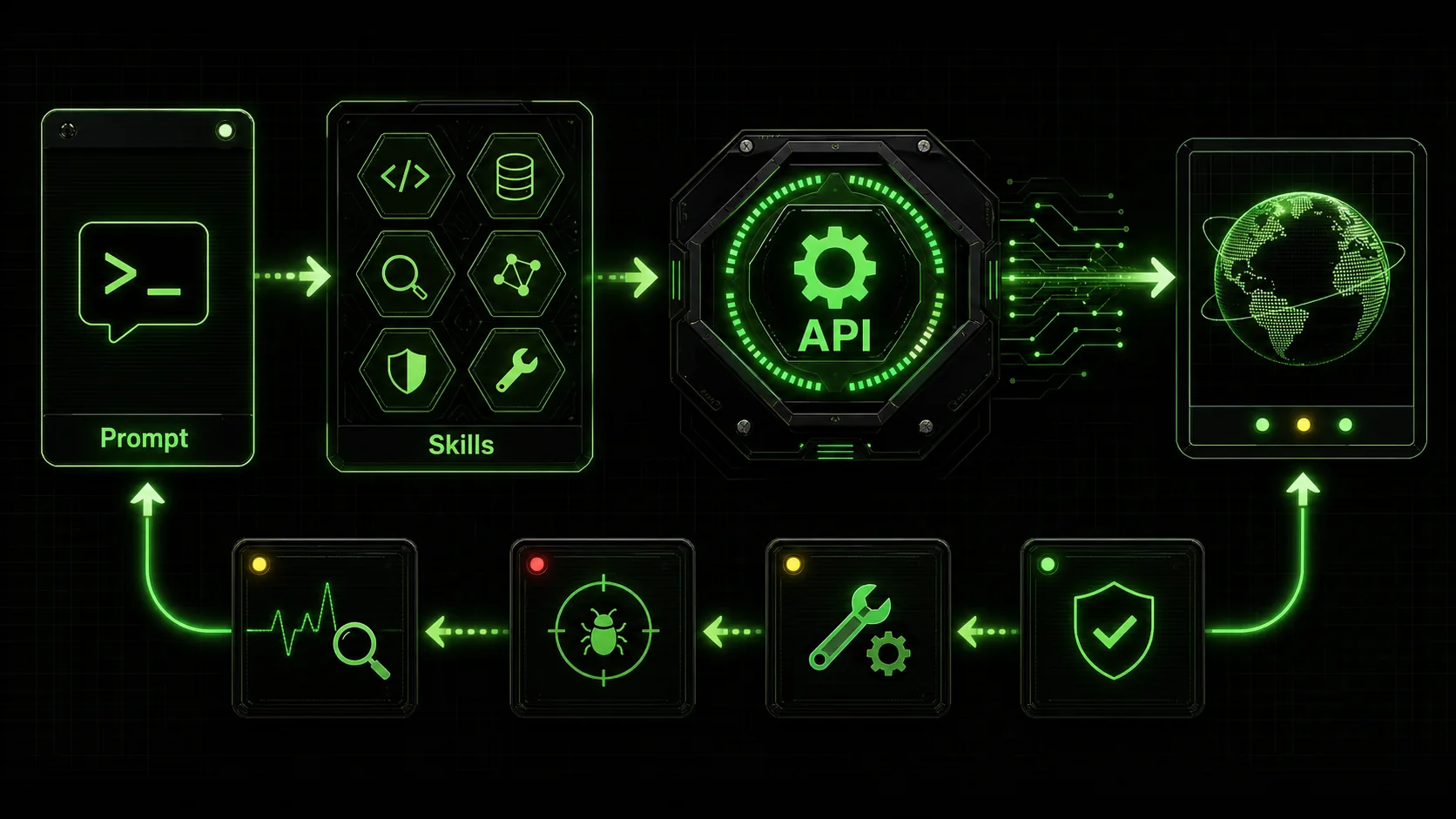
The conversation in software engineering circles has shifted. It’s no longer just about "Can AI write this function?" but "Can AI own this system?" Recent discussions in early 2026 point to a clear trend: developers are moving beyond using AI as a sophisticated autocomplete and are beginning to explore its potential as an autonomous engineer. The goal is to delegate not just the initial build, but the entire lifecycle—monitoring, debugging, patching, and scaling.
This shift demands a new approach, as we explored in our piece on why AI coding assistants struggle with legacy code. You can't just give an AI agent a vague prompt like "build a resilient API" and expect a production-ready, self-sustaining system. The magic lies in how you structure the problem. Instead of one monumental task, you break it down into a series of atomic, verifiable skills that an agent like Claude Code can execute, test, and iterate upon until everything passes.
In this guide, we'll move from a high-level concept to a concrete blueprint. We'll architect a self-healing API—a service that can detect failures, diagnose issues, and implement fixes with minimal human intervention—by defining it as a sequence of skills for Claude Code. This is the practical application of the autonomous engineering trend.
The Anatomy of a Self-Healing System
A self-healing API combines proactive health monitoring, automated diagnosis, and coded remediation -- Gartner predicts 50% of cloud teams will use this AI-augmented pattern by 2027, and Claude Code makes it buildable in atomic skill steps.
Before we write a single line of prompt, we need to define what "self-healing" means for our API. It's more than just having a try-catch block. A robust system exhibits several key behaviors:
Our project will be a Product Information API that serves product data from a database. Its self-healing capabilities will focus on the most common failure points: database connectivity and high latency.
Phase 1: Decomposing the Vision into Atomic Skills
Break the system into six Claude Code skills -- scaffold, health check, monitoring agent, diagnosis logic, remediation actions, and fallback -- each with binary pass/fail criteria that Anthropic's iterative execution model validates before proceeding.
This is where the Ralph Loop Skills Generator methodology is crucial. We don't ask Claude Code to "build a self-healing API." We define the project as a series of skills, each with a clear, verifiable pass/fail criterion. Claude will iterate on each skill until it passes before moving to the next, ensuring a solid foundation.
Here is our skill blueprint for the self-healing API:
Skill 1: Scaffold the Core API Service
* Objective: Create a basic Node.js/Express (or Python/FastAPI) API with a/products and /products/:id endpoint connected to a mock database layer.
* Pass/Fail Criterion: A curl request to GET /products returns a 200 OK status and a JSON array of mock product objects. The project structure includes separate files for routes, controllers, and services.
Skill 2: Implement Health Check & Metrics Endpoint
* Objective: Add a/health endpoint that reports API status, database connection status, and average response latency.
* Pass/Fail Criterion: The /health endpoint returns a JSON object with fields { "status": "UP", "database": "CONNECTED", "avgLatencyMs": <number> }. A simulated database disconnect (by mocking) changes the database field to "DISCONNECTED".
Skill 3: Build the Monitoring Agent
* Objective: Create a background service/agent that pings the/health endpoint at a regular interval (e.g., every 30 seconds) and logs the state.
* Pass/Fail Criterion: The agent runs continuously, logging a timestamp and the health status to a file or console every interval. It correctly identifies and logs a "UNHEALTHY" state when the /health endpoint returns a database: "DISCONNECTED".
Skill 4: Implement Diagnosis Logic
* Objective: Extend the monitoring agent. When an "UNHEALTHY" state is detected, it must run diagnostic routines to guess the cause (e.g., "DatabaseConnectionError", "HighLatencyError"). * Pass/Fail Criterion: For a simulated database connection error, the agent's logs must state:"Issue diagnosed: DatabaseConnectionError". For simulated high latency (>500ms), it logs: "Issue diagnosed: HighLatencyError".
Skill 5: Create Automated Remediation Actions
* Objective: Code the repair functions that the agent can execute based on the diagnosis. * ForDatabaseConnectionError: Execute a function that attempts to re-establish the database connection pool.
* For HighLatencyError: Execute a function that clears an in-memory cache (if applicable) or restarts a background worker process.
* Pass/Fail Criterion: After simulating a database disconnect, triggering the agent must result in logs showing the diagnosis and the action: "Executing remediation: resetDatabasePool". A subsequent health check must show database: "CONNECTED".
Skill 6: Add Alerting & Fallback Mechanism
* Objective: If remediation fails after N attempts, the system should send an alert (log to a dedicated file) and activate a fallback (e.g., serve static product data from a local JSON file). * Pass/Fail Criterion: After forcing a permanent database failure, the agent logs an alert:"ALERT: Critical database failure after 3 retries" and the /products endpoint switches to returning data from the local fallback file.
By structuring the project this way, we give Claude Code a clear, step-by-step roadmap. Each skill is a manageable unit with a binary success condition. This is the core principle behind turning a complex vision into an AI-executable project plan. You can start applying this to your own projects by using our Generate Your First Skill tool.
Phase 2: Prompting Claude Code with the Skill Blueprint
Feed Claude Code a sequential skill list with explicit pass/fail checkpoints -- Anthropic’s Claude executes each step iteratively, similar to how GPT-4-powered Cursor and GitHub Copilot handle guided task chains, but with stronger multi-file context.
Now, we engage Claude Code. We provide context and then guide it through the skills one by one. Here’s how the initial prompt might look:
Project: Build a Self-Healing Product Information API.
Tech Stack: Node.js, Express, PostgreSQL (use pg library with a mock client for simulation).
Core Principle: The system must monitor itself, diagnose common failures, and attempt automated repairs.
We will build this as a series of atomic skills. I will provide the skills in order. For each skill, first understand the objective and the pass/fail criterion. Then, write the necessary code and tests to meet that criterion. Do not proceed to the next skill until the current one is fully satisfied and verified.
Let's begin with Skill 1.
You would then paste the description for Skill 1. Claude Code will generate the code. You run the tests (the pass/fail criterion), and if it passes, you move on. If it fails, you provide the error output to Claude, and it iterates on the code until the criterion is met.
This iterative, criterion-driven process is what transforms a static code generator into an autonomous developer. It mirrors the new autonomous debugging mode that's changing how developers interact with AI.
Phase 3: Key Implementation Patterns for Autonomy
The monitoring agent and fallback controller patterns below demonstrate how Claude Code generates production-grade self-healing logic -- a class-based agent polling /health and a controller with automatic static-data failover.
Let's look at some concrete code patterns Claude would generate for critical skills.
The Monitoring Agent (Skill 3):// monitoringAgent.js
import fetch from 'node-fetch';
class MonitoringAgent {
constructor(apiBaseUrl, checkIntervalMs = 30000) {
this.apiBaseUrl = apiBaseUrl;
this.checkIntervalMs = checkIntervalMs;
this.isRunning = false;
}
async checkHealth() {
try {
const response = await fetch(${this.apiBaseUrl}/health);
const health = await response.json();
const timestamp = new Date().toISOString();
const status = health.database === 'CONNECTED' ? 'HEALTHY' : 'UNHEALTHY';
console.log([${timestamp}] Status: ${status}, health);
if (status === 'UNHEALTHY') {
await this.diagnose(health);
}
} catch (error) {
console.error([${new Date().toISOString()}] Health check failed:, error.message);
}
}
async diagnose(healthData) {
// Diagnosis logic from Skill 4
if (healthData.database === 'DISCONNECTED') {
console.log([${new Date().toISOString()}] Issue diagnosed: DatabaseConnectionError);
await this.remediate('DatabaseConnectionError');
} else if (healthData.avgLatencyMs > 500) {
console.log([${new Date().toISOString()}] Issue diagnosed: HighLatencyError);
await this.remediate('HighLatencyError');
}
}
async remediate(issue) {
// Remediation logic from Skill 5
const remediationActions = {
'DatabaseConnectionError': () => databaseService.resetConnectionPool(),
'HighLatencyError': () => cacheService.clear()
};
const action = remediationActions[issue];
if (action) {
console.log([${new Date().toISOString()}] Executing remediation: ${action.name});
await action();
}
}
start() {
if (this.isRunning) return;
this.isRunning = true;
console.log('Monitoring agent started.');
this.intervalId = setInterval(() => this.checkHealth(), this.checkIntervalMs);
}
stop() {
clearInterval(this.intervalId);
this.isRunning = false;
console.log('Monitoring agent stopped.');
}
}
// productController.js
import { getProductsFromDB, getFallbackProducts } from '../services/productService.js';
export async function getProducts(req, res) {
  try {
    // Attempt primary source
    const products = await getProductsFromDB();
    res.json(products);
  } catch (error) {
    console.error('Primary data source failed:', error);
// Activate fallback
    const fallbackProducts = getFallbackProducts();
    res.status(200).json({
      data: fallbackProducts,
      _meta: { source: 'fallback', note: 'Primary database unavailable' }
    });
// Trigger critical alert (could be integrated with PagerDuty, Slack, etc.)
    alertService.sendCriticalAlert('Product API using fallback data after DB failure.');
  }
}
These patterns illustrate how the skills combine to create autonomous behavior. The agent isn't just code; it's a workflow encoded into the system. If you are concerned about Claude Code or GitHub Copilot introducing security flaws during autonomous generation, our analysis of whether your AI coding assistant is a security liability covers the key risks. For more on crafting effective prompts to guide this process, see our guide on AI Prompts for Developers.
The Bigger Picture: Towards Autonomous Operations
AutoOps and NoOps are the end-state: Gartner projects AI-augmented automation will reduce manual cloud operations by 70% by 2027, and Claude Code's atomic-skill approach is the practical on-ramp for developers adopting this pattern today.
Building this self-healing API is a microcosm of a larger movement in DevOps and platform engineering often referred to as AutoOps or NoOps. The goal is to minimize human-in-the-loop for routine operational tasks. According to a 2025 report by Gartner, "By 2027, over 50% of cloud platform teams will use AI-augmented automation to manage routine operations, reducing manual intervention by at least 70%."
Our skill-based approach with Claude Code is a practical on-ramp to this future. You start by automating the recovery from a database blip. Next, you could add skills for: * Auto-scaling based on traffic predictions. * Automated security patching for dependencies. * Intelligent rollback of failed deployments.
Each new capability is just another set of atomic skills to be defined and implemented. This modular approach prevents the "magical black box" problem and keeps the system understandable and maintainable.
Getting Started with Your Own Autonomous Projects
Start small -- database reconnection and latency remediation -- then expand to auto-scaling, security patching, and deployment rollback using the same Claude Code atomic-skill decomposition pattern.
The journey from a prompt to a production-ready, self-healing system is a structured process:
This methodology turns Claude Code from a code writer into a system builder. It allows you to architect not just software, but software that cares for itself. For broader context on structuring Anthropic's Claude for autonomous workflows, see our guide on Claude Code task chaining with atomic skills for end-to-end workflows. Explore more complex project blueprints and share your own in our Hub Claude community.
Ready to architect your first autonomous system? Break down your idea into its core atomic skills and Generate Your First Skill today.
---
Frequently Asked Questions (FAQ)
Answers to the six most common questions about building self-healing APIs with Anthropic's Claude Code, covering language choice, security, microservices, APM integration, testing, and retrofitting.
What programming languages are best for building self-healing systems with Claude Code?
The principles are language-agnostic. However, languages with strong ecosystems for monitoring, testing, and process management make implementation smoother. Node.js (JavaScript/TypeScript) and Python are excellent starting points due to their extensive libraries for web frameworks (Express, FastAPI), background jobs, and metrics. Claude Code is proficient in these and many other languages, so choose the one that best fits your team and existing infrastructure.How do I handle security when an AI agent can execute remediation commands?
Security is paramount. Never grant an autonomous agent root or admin privileges in production from the start. Follow the principle of least privilege:Can this approach work with microservices and distributed systems?
Absolutely. In fact, it becomes even more valuable. The skill blueprint scales by treating each service as its own "self-healing" unit with local health checks. You then add higher-order skills for cross-service monitoring. For example, a "Circuit Breaker" skill can be defined: if Service A detects Service B is consistently failing, it can trip a circuit breaker and use a fallback, while a separate "Orchestrator" skill attempts to diagnose and heal Service B.What's the difference between this and using a traditional APM (Application Performance Monitoring) tool?
Traditional APMs like DataDog or New Relic are brilliant at detection and visualization. They tell you what is broken and when. A self-healing system built with Claude Code adds the diagnosis and action layer. It uses the data an APM provides (or its own simpler metrics) to not just alert, but to run a decision tree ("Is it the database or the cache?") and execute a coded response. They are complementary: use an APM for deep observability and your autonomous system for first-response remediation.How do I test a self-healing system before deploying it?
Testing requires a "chaos engineering" mindset. You must simulate failures in a controlled environment (staging, not production). Your test suite should include: * Unit Tests: For each diagnosis and remediation function. * Integration Tests: Simulate a database disconnect and verify the monitoring agent logs the correct diagnosis. * End-to-End (E2E) Tests: In a full environment, kill a dependent service and verify the API activates its fallback mechanism and continues to serve requests (even if in a degraded state). * Recovery Tests: After simulating a failure and allowing the system to self-heal, verify that normal operation resumes correctly.Is this approach only for greenfield projects, or can I add autonomy to an existing API?
You can absolutely retrofit autonomy. Start by implementing Skill 2: The Health Check Endpoint for your existing API. This is non-invasive and provides immediate value. Then, run the monitoring agent (Skill 3) externally against your live API to gather data. Finally, incrementally add diagnosis and safe remediation actions (e.g., restarting a specific background job) by integrating the agent's logic into your deployment or orchestration layer (like a Kubernetes sidecar). The skill-based approach allows for incremental adoption.<!-- sister-projects-start -->
Other Doved Studio projects
Related tools from the same studio you might find useful:
- Glean: Turn scrolling time into a daily action plan. Capture, process, execute.
- Popout: Create your portfolio in minutes with a single shareable page.
- Larpable: Spot fake founders, guru grifts, and performance entrepreneurship.
- Doved Studio: Studio indie derrière cette app et une dizaine d'autres outils.
ralph
Building tools for better AI outputs. Ralphable helps you generate structured skills that make Claude iterate until every task passes.