Beyond Code Generation: How Claude Code's New 'Agentic' Features Demand Better Prompt Engineering
Claude Code's new autonomous features require a new approach to prompts. Learn how to structure 'skills' with atomic tasks and pass/fail criteria to automate complex development workflows in 2026.
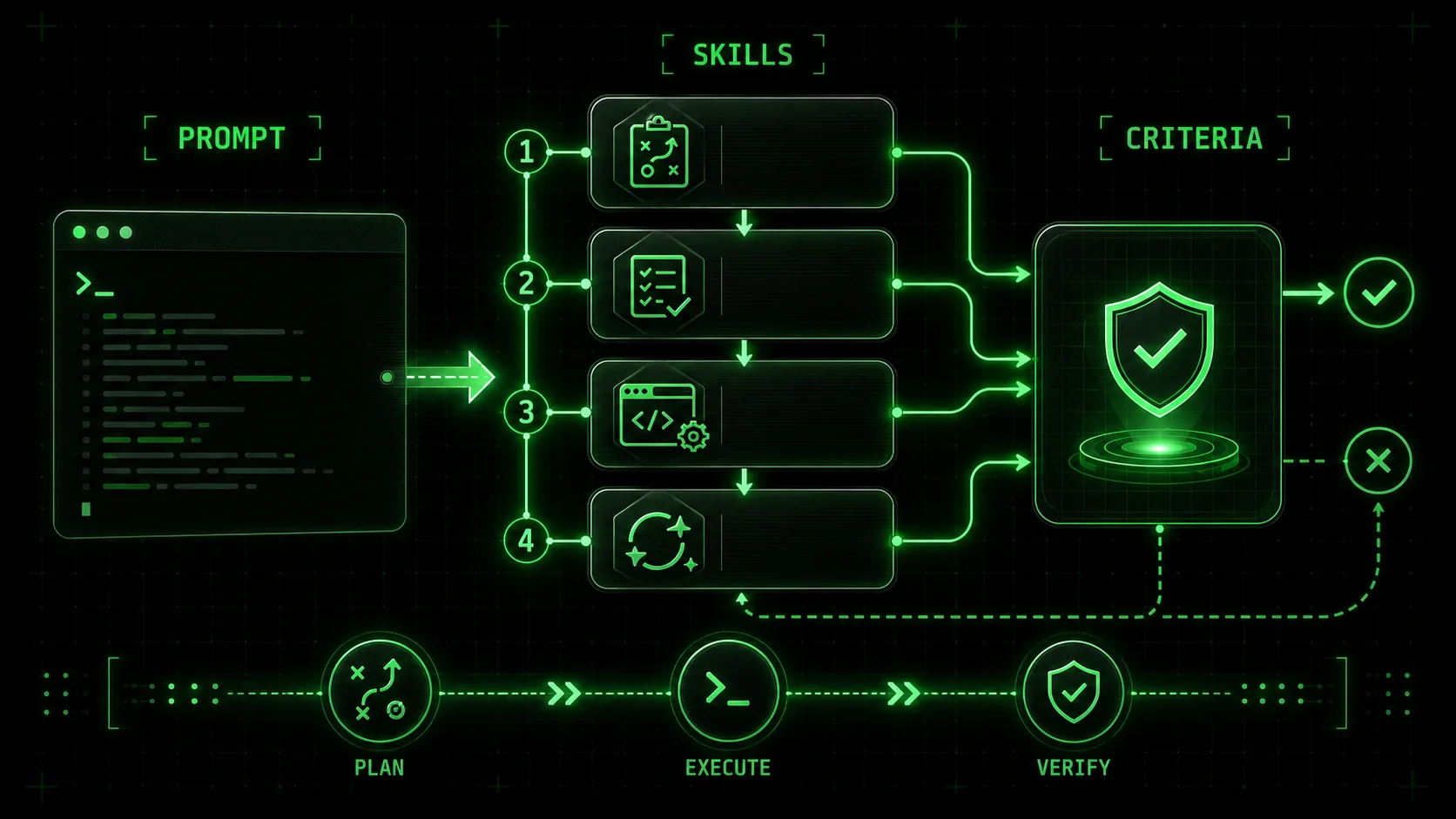
If you’ve used Claude Code recently, you’ve likely noticed a shift. The assistant no longer just spits out a code snippet and calls it a day. Instead, it asks clarifying questions, proposes a multi-step plan, and iteratively refines its output. It’s becoming agentic.
This evolution, highlighted in Anthropic's recent updates and mirrored across the AI coding landscape in early 2026, marks a fundamental change. The AI is no longer just a tool; it's becoming a junior partner capable of autonomous execution. But there’s a catch, widely discussed on Hacker News and developer forums: our old prompting habits are breaking. Asking for "a React component that fetches data" yields a decent starting point, but it fails to unlock the true potential of an AI that can plan, test, debug, and refine.
The gap is clear. We have powerful agents, but we’re still giving them one-line commands. To harness this new autonomy, we need a new paradigm in prompt engineering—one that structures complex problems into solvable, verifiable workflows. This article will show you how.
The Rise of the Agentic Coder: More Than a Code Generator
Agentic AI refers to systems like Claude Code that autonomously plan, execute, debug, and iterate on multi-step development tasks without manual prompting at each stage.
The term "agentic AI" refers to systems that can perceive their environment, make decisions, and take actions to achieve a goal without step-by-step human guidance. For Claude Code, this translates to capabilities like:
* Autonomous Planning: Breaking down a high-level request ("build a dashboard") into a logical sequence of subtasks (setup project, create layout, integrate API, add charts). * Iterative Execution: Writing code, running it (in a sandbox), interpreting errors, and debugging—all in a loop. * Contextual Decision-Making: Choosing libraries, architectural patterns, or algorithms based on the project's existing codebase and stated constraints. * Self-Validation: Checking its own work against predefined criteria before declaring a task complete.
As noted in a recent Stanford HAI article on AI agents, the move towards agentic systems represents a shift from tools that assist to tools that act. The promise is immense: automate entire development workflows, from scaffolding a new service to refactoring a legacy module.
However, the common frustration is that these agents often get "lost." They might pursue a flawed approach, get stuck in a loop on a minor issue, or produce working but architecturally poor code. The problem isn't the agent's capability; it's the clarity of its mission.
Why Traditional Prompts Fail Agentic AI
Traditional one-shot prompts fail because agentic AI from Anthropic and OpenAI requires explicit pass/fail criteria and task boundaries, not open-ended goals.
Your old prompts are failing because agentic AI exposes two critical weaknesses in vague, goal-oriented instructions:
This leads to the cycle of disappointment: excitement about the agent's plan, followed by micromanagement as you constantly correct its course, negating the promised autonomy.
The solution is to engineer prompts that provide clear constraints, atomic tasks, and unambiguous completion criteria. In essence, you need to define a Skill for the AI.
Building AI "Skills": The Atomic Task Framework
A skill is a reusable procedure that decomposes a complex goal into atomic tasks, each with a clear objective and binary pass/fail criteria the AI must satisfy before proceeding.
A "Skill" in this context is a reusable, well-defined procedure for the AI to accomplish a specific type of complex task. It turns a fuzzy objective into a reliable workflow. The core of this framework is the Atomic Task.
An Atomic Task is a single, indivisible unit of work for the AI, with two non-negotiable components:
This structure transforms the interaction from a conversation into a managed process. The AI executes a task, evaluates it against the criteria, and only proceeds upon a "pass." If it fails, it has a concrete reason to debug and retry.
From Vague Goal to Structured Skill: A Practical Example
Let's translate theory into practice. Suppose you want to migrate a JavaScript function to TypeScript.
❌ The Old Way (Vague Prompt):"Convert this function to TypeScript."✅ The Agentic Skill Way (Structured Prompt):
Skill: JavaScript to TypeScript Function Migration
Objective: Safely convert a given plain JavaScript function into a fully typed TypeScript function, improving type safety without altering runtime behavior.
Atomic Tasks:
 Task: Analyze the provided JavaScript function.
    Pass Criteria: Produce a summary identifying all parameters, return value, and potential implicit types based on variable usage and operations.
    Fail Criteria: Cannot list parameters or guess return types.
 Task: Define TypeScript interfaces or types for all function parameters and the return value.
    Pass Criteria: Types are defined using interface or type. Nullable values use | null or optional properties (?). No use of any.
    Fail Criteria: Uses any type or leaves parameters implicitly any.
 Task: Rewrite the function signature and body with explicit types.
    Pass Criteria: Function compiles with tsc --noEmit (strict mode). All variables and parameters have explicit types. Original logic is unchanged.
    Fail Criteria: TypeScript compiler reports errors, or logic differs from original.
 Task: Create a simple test case to verify runtime behavior matches the original.
    Pass Criteria: Provide a code snippet that calls the new function with example inputs and logs the output, matching the output of the original function.
    Fail Criteria: No test provided, or test shows behavioral discrepancy.
When Claude Code operates with this Skill, its behavior changes. It becomes systematic, checkable, and reliable. It won't move from Task 2 to Task 3 until it has created types without any. This is the precision that agentic features require.
Designing Pass/Fail Criteria for Development Workflows
Effective pass/fail criteria are binary, shell-checkable conditions -- like "code compiles with zero errors" or "tests pass" -- that remove subjectivity from AI output validation.
The art of building effective Skills lies in crafting ironclad pass/fail criteria. They must be machine- or self-checkable by the AI.
| Task Type | Example Pass Criteria | Example Fail Criteria |
|---|---|---|
| Code Generation | Code compiles with go build ./... with zero errors. | Compilation fails or produces warnings. |
| Test Writing | Test suite passes (npm test) and covers >80% of the target function's branches (per jest --coverage). | Tests fail, or coverage is below threshold. |
| API Integration | curl command to the new endpoint returns a 200 status and a valid JSON schema. | curl returns non-2xx status or invalid JSON. |
| Database Change | New migration file can be run (knex migrate:up) and a SELECT query returns the expected new column. | Migration fails or schema is incorrect. |
| Refactoring | All existing unit tests pass. New code has identical cyclomatic complexity or lower. | Tests break or complexity increases. |
Advanced Pattern: Chaining Skills for Complex Projects
Skill chaining sequences multiple atomic skills end-to-end, letting Claude Code autonomously execute an entire feature build from database schema to integration tests.
The true power emerges when you chain Skills together to manage entire projects. A "Build a Full-Stack Feature" project can decompose into sequential Skills. For a deep dive into chaining patterns, see our dedicated guide on task chaining with Claude Code.
Project: Add Commenting System to Blog
Execute Skill: "Design Database Schema for Threaded Comments"
   - Pass: SQL CREATE TABLE statements are provided and are normalized.
Execute Skill: "Create Express.js API Endpoints (CRUD)"
   - Pass: Endpoints defined for POST /comment, GET /post/:id/comments, etc. Pass curl smoke tests.
Execute Skill: "Build React Comment Component Tree"
   - Pass: Components for CommentList, CommentItem, CommentForm render without errors in isolation (Storybook or test).
Execute Skill: "Integrate Frontend with Backend API"
   - Pass: Component can fetch and display real comments from the local API. Form submission successfully POSTs data.
This is where Claude Code's agentic features shine. You can present this chain as the initial prompt. Claude will then autonomously execute each Skill, managing the context shift from database design to React props, only proceeding when each atomic pass criteria is met.
This approach mirrors modern CI/CD pipelines and professional development workflows, making the AI a true automation engine for your software development lifecycle.
Implementing This Approach: Practical Tips for 2026
Start small with a single reusable skill, iterate on your pass/fail criteria, store your best skills in Claude’s memory, and combine structured prompts with conversational debugging.
Adopting this structured prompting mindset requires a shift in how you interact with Claude Code. Here’s how to start:
For a deeper dive into the fundamentals of crafting effective instructions, our guide on how to write prompts for Claude is an essential resource.
The Future of Development Workflow
The shift from code generation to workflow orchestration is redefining how developers use Claude Code, Cursor, and GitHub Copilot in production environments.
The move to agentic AI assistants isn't just about writing code faster. It's about orchestrating development processes. By defining Skills with atomic tasks, you're not just prompting an AI; you're encoding best practices, architectural decisions, and quality gates into a repeatable, automated process.
This allows developers to focus on the truly complex, creative, and ambiguous parts of system design while delegating the structured, repetitive implementation work to a capable, self-verifying agent.
The tools are here. Claude Code's new features are a gateway. The limiting factor is now our ability to clearly define the work. By mastering this new form of prompt engineering—engineering not for answers, but for autonomous execution—you unlock a new tier of productivity and reliability.
Ready to structure your first complex task? Stop writing prompts and start defining Skills. Generate Your First Skill with a template designed for Claude Code's agentic workflow.
---
FAQ: Agentic AI and Prompt Engineering for Claude Code
What exactly are "agentic features" in Claude Code?
Agentic features refer to Claude Code's ability to autonomously plan and execute multi-step development tasks without requiring detailed human instruction for each step. Instead of just responding to a single request, it can break down a problem, create a plan, write code, run tests, debug errors, and iterate until the objective is met. This represents a shift from a tool that assists with coding to a partner that manages coding workflows.
How is "prompt engineering" different for agentic AI vs. classic ChatGPT-style prompts?
Classic prompt engineering focuses on crafting a single query to get the best possible one-shot answer (e.g., "explain this code" or "write a function that does X"). For agentic AI, prompt engineering is about process design. It involves defining the step-by-step procedure, the rules for each step (pass/fail criteria), and the overall goal. It's less about the perfect question and more about writing the perfect "workflow spec" for the AI to execute.
Can I use this atomic task framework with other AI coding assistants (like GitHub Copilot or Cursor)?
Absolutely. While the examples here are tailored for Claude Code, the core principle -- decomposing work into verifiable steps -- is universal and improves results with any advanced AI assistant that supports multi-turn conversation and code execution, including GitHub Copilot, Cursor, and OpenAI's GPT-4-powered tools. The specific pass/fail criteria (like tsc or npm test commands) are tool-agnostic. The framework helps you provide the structure these tools need to be more reliable. If you've ever had an AI coding assistant stall on a complex task, our article on AI Agent Fatigue explains the root cause and how atomic skills fix it.
What are the most common mistakes when defining pass/fail criteria?
The two biggest mistakes are:
Do I need to be an expert in a technology to create a Skill for it?
Not necessarily. You need to understand the desired outcome and quality gates. For example, to create a Skill for "Set up a PostgreSQL Docker container," you don't need to be a Docker expert, but you should know the success criteria: a running container that responds to psql connection commands. The AI possesses the expert knowledge to meet the criteria you define.
Is this approach only useful for coding tasks?
No. The atomic task framework is highly effective for any complex, procedural work an AI can assist with. This includes research tasks (e.g., "Summarize this technical paper" with criteria for length and key point inclusion), business analysis (e.g., "Compare pricing models" with criteria for a structured table output), and content planning. Any process that can be broken down into clear steps with verifiable outcomes can be turned into a Skill. For non-code applications, see our guide to applying the Ralph Loop beyond code and our prompt engineering learning path.
<!-- sister-projects-start -->
Other Doved Studio projects
Related tools from the same studio you might find useful:
- Glean: Turn scrolling time into a daily action plan. Capture, process, execute.
- Popout: Create your portfolio in minutes with a single shareable page.
- Larpable: Spot fake founders, guru grifts, and performance entrepreneurship.
- Doved Studio: Studio indie derrière cette app et une dizaine d'autres outils.
ralph
Building tools for better AI outputs. Ralphable helps you generate structured skills that make Claude iterate until every task passes.