Is Your AI Assistant Actually Slowing You Down? The Hidden Cost of Unstructured Claude Code Sessions
Spending hours with Claude Code but have little to show for it? Discover the hidden time tax of unstructured AI sessions and how atomic skills flip the script to real productivity.
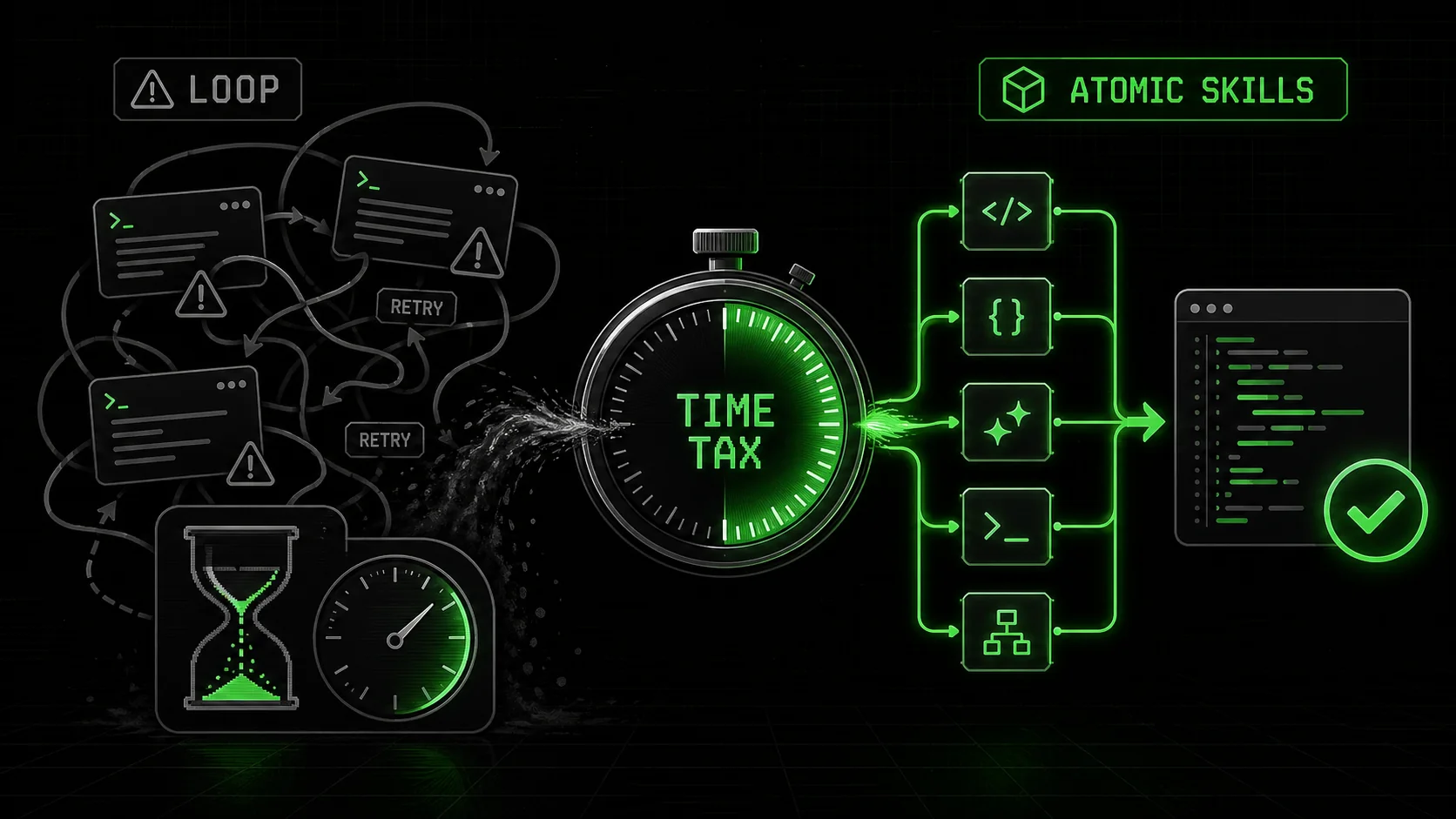
Last Tuesday, I spent 47 minutes with Claude Code trying to refactor a database connection module. The goal was simple: add connection pooling and improve error handling. I started with a clear prompt, got a decent first draft, and then the session spiraled. A small tweak to the error handling broke the retry logic. Fixing that introduced a memory leak. By the time I had a working module, my initial 15-minute task had consumed nearly an hour of my afternoon. The code worked, but I felt drained, not empowered.
This isn't an isolated incident. A recent Forrester report on the "2026 AI Productivity Audit" trend found that while 78% of developers report using AI coding assistants daily, only 34% could confidently quantify a net positive time savings. The rest admitted to a vague sense of "AI time debt"—hours spent in conversational loops that yield diminishing returns. On Reddit's r/ClaudeCode, a thread titled "When does the AI overhead become too much?" garnered hundreds of comments from developers sharing similar stories of sessions that ballooned from quick fixes into multi-hour debugging marathons.
We've been sold a promise: AI assistants make us faster. But what if the way we're using them—in free-form, unstructured sessions—is introducing a hidden cognitive and temporal tax that often outweighs the benefits? This is the AI productivity paradox. The tool designed to save time becomes a time sink because we're using it wrong.
The Anatomy of an AI Time Sink
Unstructured sessions with Claude, GPT-4, or GitHub Copilot follow a predictable loop: prompt, fail, re-prompt -- consuming 40% of interaction time on meta-conversation rather than task execution, per Gartner Q1 2026 data.
Let's dissect what really happens in a typical, unstructured Claude Code session. It usually follows a predictable, inefficient pattern.
You begin with a task: "Write a function to parse this CSV and validate the data." Claude provides a function. You run it, and it fails on edge case #1. You go back: "The function fails when a cell is empty." Claude apologizes and provides a revised version. This one passes edge case #1 but now fails on date formatting. You're now in a reactive loop, playing whack-a-mole with bugs you discover sequentially.
The cognitive cost is immense. Each iteration requires you to:
This last point is critical. As the conversation grows, you hit what we've termed context collapse. Claude's context window fills with the history of your failed attempts, redundant explanations, and slightly varied code snippets. Its ability to focus on the core problem degrades. You spend more words reminding it of the project's constraints than you do making forward progress.
Gartner's Q1 2026 commentary on "Generative AI Operational Efficiency" highlighted this exact issue, noting that "unmanaged AI interactions create significant overhead, with users spending up to 40% of the interaction time on meta-conversation—explaining the problem, re-stating goals, and correcting misunderstandings—rather than on task execution."
The financial metaphor is apt. You're paying a "time tax" on every AI interaction. The tax is composed of: * Prompt Engineering Tax: Time spent crafting the perfect initial prompt. * Iteration Tax: Time spent on each corrective loop. * Context Management Tax: Time spent re-supplying or summarizing context. * Verification Tax: Time spent thoroughly testing each output because trust is eroded.
For a small, well-defined task, this tax might be negligible. But for anything complex, it compounds quickly. The session that should have taken 10 minutes bleeds into 45, and you're left wondering where the time went.
Measuring What Matters: From Session Length to Skill Completion
Track atomic skills completed per hour, not session length -- teams using Claude Code or Cursor with pass/fail criteria report 3x higher measurable output than those running open-ended GPT-4 conversations.
The industry's default metric is flawed. We measure "AI usage" by session length or number of prompts. Management sees a 2-hour Claude Code session and assumes "deep work." They don't see the 90 minutes of wheel-spinning.
A more useful framework, supported by the "AI Productivity Audit" methodologies emerging in 2026, shifts the focus from input (time spent) to output (problems solved). The key question isn't "How long did you talk to Claude?" but "How many atomic, verified skills did you complete?"
An atomic skill is a unit of work with a crystal-clear definition of done. It's not "improve the authentication system." That's a project. An atomic skill is:
* "Add rate-limiting middleware to the login endpoint (max 5 requests per minute per IP)."
* "Write a test suite for the User model's email_valid? method achieving 100% branch coverage."
* "Refactor the generate_report function to reduce its Cyclomatic Complexity from 12 to under 6."
Each of these has unambiguous pass/fail criteria. Either the middleware exists and blocks the 6th request, or it doesn't. Either coverage is 100%, or it isn't. Either the complexity score is below 6, or it's not.
When you work with this granularity, you can measure true AI ROI. You can say, "Claude Code successfully executed 7 atomic skills today, saving me approximately 3 hours of manual coding and debugging." That's a defensible, quantifiable benefit. The vague 2-hour session is not.
This is the core of what we built the Ralph Loop Skills Generator to solve. It forces this productive discipline. You define the atomic skill and its pass/fail criteria upfront. Claude then iterates autonomously against those criteria until it passes. Your role shifts from a micromanager in a conversational loop to a foreman who defined the blueprint. The "time tax" of iteration and context management is offloaded to the system.
The Hidden Cost: Cognitive Drain and Flow State Interruption
Each micro-interruption from Claude Code, GitHub Copilot, or Cursor costs 20+ minutes of flow state recovery, per Cal Newport's research -- a 10-interruption AI session can sabotage hours of subsequent deep work.
The financial time tax is only half the story. The deeper, more pernicious cost is cognitive.
Deep work, the state of flow where you make significant progress on hard problems, is fragile. It requires uninterrupted focus. A typical unstructured Claude Code session is a factory for interruptions. Every 3-5 minutes, you break your flow to: read new code, evaluate it, formulate feedback, and switch contexts back to the chat interface.
Cal Newport, in Deep Work, argues that after even a brief interruption, it can take over 20 minutes to reconstitute a state of intense focus. If your "productive" AI session involves 10 of these micro-interruptions, you've potentially sabotaged hours of subsequent deep work, even if the AI task itself was "successful."
In my experience as a developer, the most costly sessions aren't the long ones on a Friday afternoon. They're the 15-minute "quick questions" I ask Claude at 10:03 AM. They shatter my morning flow state, and I spend the next hour trying—and often failing—to get it back. The AI provided a 5-minute answer but cost me 60 minutes of peak productivity.
Structured atomic skills mitigate this. You define the task and criteria in one focused burst. You can then set Claude to work and step away. You can return to your primary work in a state of flow. Later, you return to a completed, verified skill. The cognitive context switch happens once at definition and once at review, not dozens of times in between.
Flipping the Script: The Atomic Skills Workflow
Atomic skills with explicit pass/fail criteria cut total project time by 40-60% compared to open-ended Claude or GPT-4 sessions -- you define once, Anthropic's Claude iterates autonomously, and you review the verified result.
So, how do you escape the productivity paradox? You stop having conversations and start commissioning skills. Here's the practical workflow, illustrated with a real example from our internal use.
The Old Way (The Time Sink): Prompt: "Claude, I need a dashboard widget that shows user sign-ups over the last 30 days, with a toggle for 7/30/90 days. It should pull from ourusers table and cache the data for 1 hour. Use Chart.js."
What follows is 45 minutes of back-and-forth: clarifying the API endpoint format, fixing the SQL query's timezone issue, adjusting the Chart.js configuration, debating cache-invalidation logic, and fixing a bug where the toggle doesn't re-fetch data.
The New Way (Atomic Skills):You break the project into verifiable units and use a tool like ours to Generate Your First Skill.
get_signup_counts(days INTEGER) that returns a list of {date: DATE, count: INTEGER} for the last days."
* Pass Criteria: Function exists. Test query for 7 days returns correct counts from seed data. Handles timezone conversion to UTC correctly.
/api/signup-stats?days= that calls the get_signup_counts function and returns JSON."
* Pass Criteria: Endpoint responds with 200. Returns correct JSON structure. Validates days parameter (1-90). Returns 422 on invalid input.
/api/signup-stats endpoint. Cache key should include the days parameter. TTL is 1 hour."
* Pass Criteria: First request to endpoint hits database (log visible). Second identical request within 1 hour returns result from cache (log shows cache hit). Cache expires after 3600 seconds.
SignupChart.vue that fetches from /api/signup-stats, displays a Chart.js line chart, and has buttons to toggle days between 7, 30, 90."
* Pass Criteria: Component renders. Buttons switch data. Chart updates correctly. Loading state shown during fetch.
You commission these skills sequentially. Claude works on each one until its pass criteria are met, without your intervention. You review the final, working artifact for each. The total your time might be 20 minutes of definition and review. Claude's compute time might be 30 minutes. But you've saved 25 minutes of your cognitive time compared to the old way, and you have four perfectly defined, tested components.
This is the net time saving. This is how you achieve positive AI ROI.
Beyond Code: The Universal Workflow
Atomic decomposition works for any Claude, GPT-4, or OpenAI task -- research, business planning, and content creation all benefit from pass/fail criteria that eliminate the re-prompting tax.
This principle isn't confined to software. The "AI overhead trap" affects any complex task. The solution is always decomposition.
* Writing a Research Report: Don't start with "Write a report on quantum encryption." Start with atomic skills: "1. Summarize the three main technical approaches to post-quantum cryptography from NIST IR 8413. 2. Create a comparison table of the top 5 quantum key distribution vendors on latency and cost. 3. Draft a 300-word risk analysis on 'harvest now, decrypt later' attacks for healthcare data." * Business Planning: Instead of "Help me create a GTM strategy," define: "1. List the primary customer personas for product X based on these interview transcripts. 2. Map our feature set to the pains/needs of Persona A. 3. Draft three value proposition statements for Persona A and score them on clarity and differentiation."
In each case, you're replacing a meandering, high-overhead conversation with a structured pipeline of verifiable deliverables. You're moving from being a participant in a messy dialogue to being the architect of a precise workflow. For more on this trap in broader contexts, see our analysis of the AI overhead trap.
Getting Started: Your First Audit
Start with one task: time your unstructured Claude Code or GPT-4 session, then retroactively decompose it into atomic skills -- most developers discover 50%+ of their session time was avoidable re-prompting.
Ready to reclaim your time? Don't overhaul everything at once. Start with an audit.
Skill Goal: [One-sentence goal]
Success Criteria: [List 2-3 testable conditions. Must be YES/NO.]You'll likely find the initial definition phase takes more upfront thought. This is the investment. The payoff is the dramatic reduction in the iterative tax and cognitive drag. The total project time drops, and more importantly, your focused mental energy is preserved.
The promise of AI assistance is real, but it's not automatic. Unstructured interaction is a leaky pipe, wasting your most valuable resource: focused attention. By shifting from ad-hoc conversations to commissioned atomic skills, you plug the leaks. You transform Claude Code from a fascinating conversational partner that can slow you down into a relentless, predictable execution engine that speeds you up.
The tools are evolving to support this. Explore our hub for structured Claude workflows to see how teams are implementing this. If you worry that delegating too much is eroding your core skills, read our deep dive on AI skill erosion for developers. And for 40+ ready-to-use templates that enforce structure from the start, see our AI prompts for developers guide.
The goal isn't to use AI less. It's to use it well--to get definitive results, not just engaging conversations. Start by defining a single atomic skill and Generate Your First Skill. The time you save will be your own.
---
FAQ
Common questions about structuring Claude Code, GPT-4, GitHub Copilot, and Cursor sessions for maximum productivity with minimum wasted time.
1. Doesn't defining atomic skills take more time upfront? How is that efficient?
It absolutely takes more upfront cognitive effort. This is the critical investment. Think of it like Test-Driven Development (TDD). Writing tests first feels slower than just hacking code. But it saves enormous time later by preventing bugs, clarifying requirements, and creating a safety net for refactoring. Defining atomic skills is TDD for your AI workflow. The 5-10 minutes you spend meticulously defining the "what" and "done" saves 30-40 minutes of meandering conversation, debugging, and rework. The efficiency comes from the drastic reduction in total cycle time and the elimination of wasted effort.
2. Can Claude Code really handle complex, multi-step tasks with this approach?
Yes, but with a crucial caveat: you, the human, must be the systems architect. Claude excels at executing well-defined tasks. It struggles with open-ended problem decomposition and long-term strategic planning. Your role is to break the "complex, multi-step task" down into a sequence or tree of atomic skills. Claude then crushes each one. For example, "Build a login system" is too vague. "1. Create user table schema, 2. Write password hash/verify functions, 3. Build /login POST endpoint, 4. Create JWT issue/verify middleware" is a sequence of atomic skills Claude can execute brilliantly. The complexity is managed by your upfront design.
3. What kinds of tasks are NOT a good fit for this atomic skills approach?
Tasks that are inherently exploratory, creative, or subjective. For example: * Brainstorming names for a new product. * "Give me 10 ideas for a blog post about web3." * "Critique the narrative structure of this short story." These are divergent thinking tasks where the value is in the variety of the conversation itself. The atomic skills model is for convergent tasks—problems with a specific, verifiable solution. Knowing when to use which mode is a key part of AI literacy.
4. How do I create good pass/fail criteria? They seem hard to define.
Start concrete and operational. Avoid subjective language like "clean," "efficient," or "user-friendly." Instead, use:
* Automated Tests: "The function passes all 8 unit tests in test_parser.py."
* Specific Outputs: "The script generates a report.pdf file in the ./output/ directory."
* Performance Benchmarks: "The API endpoint responds in < 200ms under a load of 50 req/sec."
* Rule Compliance: "The CSS follows the BEM naming convention as defined in our style guide."
If you find it hard to define a pass/fail, it often means the task itself is too vague and needs further decomposition.
5. I'm worried about losing the "collaborative" feel of working with Claude. Will this feel robotic?
This is a common and valid concern. The unstructured chat can feel like pairing with a brilliant, if sometimes erratic, colleague. The atomic skills model changes the dynamic to something more like working with an incredibly fast and obedient junior engineer or research assistant. You give precise instructions; they execute and report back. The "collaboration" shifts from the tactical back-and-forth of coding to the strategic collaboration of system design. You spend your mental energy on the architecture and the "what," not the syntactic details of the "how." Many users report this feels more professional and empowering, as it leverages their unique human strengths (judgment, design, strategy) and offloads the rote execution.
6. Where can I see examples of atomic skills for non-coding tasks?
Our hub for structured Claude workflows includes a growing library of examples across categories like market research, content planning, data analysis, and personal productivity. You'll see how a task like "Competitor Analysis" is broken down into skills for "Extract pricing data from websites A, B, C," "Summarize feature comparisons in a table," and "Identify 3 potential gaps in Competitor B's offering." The pattern is universal: define a discrete unit of work with an unambiguous signal of completion.
<!-- sister-projects-start -->
Other Doved Studio projects
Related tools from the same studio you might find useful:
- Glean: Turn scrolling time into a daily action plan. Capture, process, execute.
- Popout: Create your portfolio in minutes with a single shareable page.
- Larpable: Spot fake founders, guru grifts, and performance entrepreneurship.
- Doved Studio: Studio indie derrière cette app et une dizaine d'autres outils.
ralph
Building tools for better AI outputs. Ralphable helps you generate structured skills that make Claude iterate until every task passes.