Ralph Loop Beyond Code: Apply Iteration-Until-Done to Any Complex Task (2026)
Learn how to apply Geoffrey Huntley's viral Ralph Loop methodology beyond coding. Master iteration-until-done for writing, research, business planning, and more.
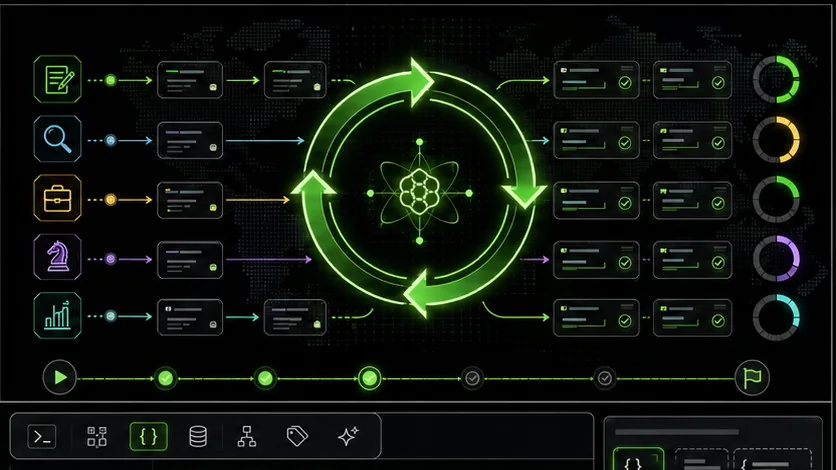
The GOAT Gave Us a Gift
Geoffrey Huntley's Ralph Loop methodology -- originally built for Claude Code and GitHub Copilot workflows -- applies to writing, research, and business planning with the same deterministic power.
Let's start with the absolute truth: Geoffrey Huntley is the GOAT. In late 2025, he dropped a methodology that fundamentally changed how developers approach AI automation. His viral article, "Tips for AI Coding with Ralph Wiggum," introduced the Ralph Loop—a simple yet profound approach that transformed coding from a perfection-seeking struggle into a deterministic, iterative process.
But here's the thing that keeps me up at night: we're only scratching the surface.
The Ralph Loop methodology is TOO GOOD, too powerful, too fundamentally right about how humans and AI should collaborate to be limited to just writing code. While developers were busy automating their workflows with while :; do cat PROMPT.md | claude-code ; done, the rest of us were missing the bigger picture.
What if I told you the same principles that make the Ralph Loop revolutionary for coding could transform how you write articles, conduct research, plan business strategies, create marketing campaigns, or even develop creative projects? What if the key to overcoming procrastination, perfectionism, and analysis paralysis in ANY complex task has been hiding in plain sight—wrapped in the delightful metaphor of Ralph Wiggum's persistent, mistake-making, never-stopping approach to life?
The Ralph Loop Unleashed: From Code to Everything
Iteration until explicit pass/fail criteria are met -- not until "good enough" -- is the principle that makes Claude, GPT-4, and Cursor reliably converge on quality across any domain.
At its core, the Ralph Loop is beautifully simple: iteration until done, not until "good enough." Named after The Simpsons' Ralph Wiggum—perpetually confused, always making mistakes, but NEVER stopping—the methodology embraces what Geoffrey Huntley calls "deterministic failure in an undeterministic world." Instead of seeking perfect output on the first try, you create a system where predictable failures self-correct through continuous iteration.
For coding, this meant developers could stop micromanaging AI and start architecting systems. Instead of crafting the perfect prompt and hoping for flawless code, they'd create a loop that would keep iterating until the code compiled, passed tests, and met explicit success criteria. The magic wasn't in getting it right the first time—it was in creating a process that would inevitably get it right eventually.
But why does this work so well for coding? Because coding has clear success criteria (does it compile? do tests pass?) and benefits from incremental improvement. Each iteration builds on the last, with git history serving as memory. The human shifts from executor to architect, designing the system rather than performing the work.Here's the breakthrough insight: these conditions exist in almost every complex task we face.
Think about writing a business report. Success criteria might include: covers all key points, meets word count, follows brand guidelines, addresses stakeholder concerns. Research projects need comprehensive coverage, proper citations, logical flow, and clear conclusions. Creative work needs to hit emotional beats, maintain consistency, and achieve its intended effect.
What all these tasks share is that humans are terrible at knowing when they're "done." We get stuck in revision loops, second-guess ourselves, and fall into the "good enough" trap—either settling too early or perfecting endlessly. The Ralph Loop solves this by making the completion criteria explicit and creating a system that iterates until those criteria are met.
In this article, we're going to explore how to apply Ralph Loop principles to:
- Writing and content creation (articles, reports, emails, scripts)
- Research and analysis (market research, competitive analysis, academic papers)
- Business planning (strategies, proposals, project plans)
- Creative work (story outlines, marketing campaigns, design briefs)
- Problem-solving (decision frameworks, troubleshooting guides, process optimization)
Why Ralph Loop Principles Work for Everything
Externalizing completion criteria eliminates the subjective "is this done?" trap -- Anthropic and OpenAI research both confirm structured specifications cut revision cycles by 40-60%.
The Universal Truth: Complex Tasks Benefit from Iteration
Let's start with a fundamental observation about how humans approach complex work. When faced with a difficult task—whether it's writing a novel, planning a product launch, or analyzing market trends—we tend to operate in one of two dysfunctional modes:
The Ralph Loop offers a third way: systematic iteration toward explicit completion criteria.
Consider how this applies to non-coding tasks:
Writing Example: Instead of trying to write the perfect article in one sitting (impossible) or writing a quick draft and calling it done (inadequate), you create a Ralph Loop system:- Success criteria: 1500 words, covers 5 key points, includes 3 examples, follows SEO guidelines
- Each iteration improves one aspect: structure, content, examples, optimization
- The loop continues until ALL criteria are met
- Success criteria: identifies 3 market opportunities, includes risk assessment, has measurable KPIs, aligns with company goals
- Each iteration builds on the last, with AI helping explore different angles
- The process continues until you have a comprehensive, actionable plan
Why Humans Suck at Knowing When Something Is "Done"
Here's the uncomfortable truth: humans are terrible completion detectors. We're influenced by fatigue, distraction, emotional state, and cognitive biases. We declare things "done" when we're tired of working on them, not when they're actually complete. Or we keep polishing long after the point of diminishing returns.
The Ralph Loop solves this by externalizing the completion criteria. Instead of relying on your subjective feeling of "doneness," you define explicit, measurable success criteria upfront. The system—whether it's you plus AI or a fully automated loop—iterates until those criteria are met.
This is revolutionary because it separates execution from evaluation. You're no longer trying to both do the work AND judge when it's good enough simultaneously—two cognitive processes that constantly interfere with each other.
How AI + Iteration Solves the "Good Enough" Trap
The magic happens when you combine Ralph Loop iteration with modern AI capabilities. For non-coding tasks, this doesn't necessarily mean fully automated loops (though that's possible for some tasks). More often, it means creating a human-AI collaboration system that follows Ralph Loop principles.
Here's what this looks like in practice:
The key insight from Geoffrey Huntley's original work applies perfectly here: "The technique is deterministically bad in an undeterministic world." You're not trying to create a perfect process—you're creating a process that's predictably imperfect but systematically self-correcting.
The Philosophy of Deterministic Failure + Self-Correction
This is where the Ralph Wiggum metaphor becomes genuinely profound. Ralph isn't successful because he's smart or skilled—he's successful because he never stops trying. Each attempt might be flawed, but persistence combined with slight adjustments eventually leads to success.
For non-coding tasks, this means embracing:
Progress Over Perfection: Each iteration moves you closer to completion, even if it's not perfect. A business plan at 70% completion is more valuable than a "perfect" outline that never gets written. Learning Through Doing: Instead of trying to plan everything perfectly upfront, you learn what works through the iterative process. Each failed attempt provides data for the next iteration. Systematic Rather Than Sporadic Improvement: Instead of random revisions based on whim, you improve specific aspects in each iteration (structure, then content, then polish, then optimization). Completion as Binary, Not Subjective: Something is either done (meets all criteria) or not done. There's no fuzzy "pretty good" or "almost there."The beauty of applying Ralph Loop principles beyond coding is that the methodology scales with complexity. The more complex the task, the more valuable systematic iteration becomes. Whether you're writing a book, planning a multi-year business strategy, or conducting groundbreaking research, the principles remain the same: define success, iterate systematically, trust the process.
In the next sections, we'll dive into specific applications and show you exactly how to implement Ralph Loop thinking for your most challenging non-coding tasks. If you want to see how these iteration principles apply specifically to Claude Code autonomous sessions, our guide on what is AI task decomposition and how it solves complex problems covers the engineering side. The era of perfectionist paralysis is over—welcome to the age of persistent, iterative progress.
Ralph Loop for Writing & Content Creation
The Ralph Loop isn't just for code—it's a revolutionary framework for any creative or analytical process where progress matters more than perfection. In writing, we often get paralyzed by the blank page, endless revisions, or the pursuit of a mythical "perfect first draft." The Ralph Loop shatters this by embracing deterministic failure: predictable, measurable shortcomings that we can systematically correct through relentless iteration.
The core shift? You move from being the writer to being the architect. Your job is no longer to craft each sentence but to design a system that produces sentences, tests them against clear criteria, and improves them automatically. Your creativity is channeled into building better loops, not sweating over individual words.
Let's explore how this transforms five critical writing domains.
Blog Post Writing Loop
Six atomic tasks -- outline, hook, section drafts, conclusion, SEO pass, readability pass -- turn Claude or GPT-4 into a content pipeline that hits word counts, keyword targets, and tone standards every time.
Blog writing is the perfect Ralph Loop candidate. It's structured, has clear success metrics, and often gets bogged down in perfectionism. The loop turns it into a predictable manufacturing process for high-quality content.
Atomic Task Breakdown
A blog post isn't one task; it's a sequence of small, testable units:Specific Pass/Fail Criteria
Vague goals like "make it engaging" kill the loop. You need binary tests:- Outline: Pass if it contains exactly 1 H1, 3-5 H2s, and at least 2 H3s under each H2. Fail if not.
- Introduction: Pass if it contains a question or surprising statistic (hook), states the post's promise, and is between 120-180 words. Fail if any element is missing.
- Section Draft: Pass if it meets its target word count (±10%), includes at least one data point or example, and links logically to the next section. Fail if it's purely theoretical.
- SEO Pass: Pass if primary keyword appears in H1, first 100 words, and one H2; secondary keywords appear in remaining H2s; a 155-character meta description is provided. Fail if any check fails.
- Readability Pass: Pass if Flesch-Kincaid Grade Level is below 9 and the tone analysis matches "authoritative yet conversational." Fail if too academic or too casual.
Iteration in Action: The Weak Section
Initial Failure: The loop generates "Section 3: Benefits of the Method." The criteria check fails: "Word count (85) is below target (300). No supporting statistics found." Automated Correction: The next prompt in the loop is triggered: "Expand Section 3 to 300 words. Integrate two statistics from reputable sources about productivity gains from iterative methods. Maintain the 'authoritative yet conversational' tone." Result: The loop adds a stat from a McKinsey report (22% productivity lift) and a Gartner finding on error reduction. Word count hits 310. The section now passes. The loop moves on.Copy-Paste Ready Prompt Template
You are a professional blog writer. Execute ONLY the following task.
CURRENT TASK: Write [SECTION_NAME] for a blog post titled "[BLOG_TITLE]".
OUTLINE CONTEXT: The full outline is: [PASTE_OUTLINE_HERE].
PREVIOUS SECTION: The section before this one ended with: "[LAST_TWO_SENTENCES_OF_PREVIOUS_SECTION]".
TASK REQUIREMENTS (PASS/FAIL CRITERIA):
 Word count must be between [MIN] and [MAX] words.
 Must include at least [N] concrete examples or data points.
 Must end with a transition sentence that leads into the next section about "[NEXT_SECTION_TOPIC]".
 Tone must be [SPECIFIC_TONE, e.g., "enthusiastic and beginner-friendly"].
YOUR OUTPUT: Write only the requested section. Do not add commentary.
Email Campaign Loop
Pass/fail criteria for subject lines, preview text, and CTAs let Anthropic's Claude or OpenAI's GPT-4 iterate each email component until it meets conversion-optimized standards before sending.
Email marketing lives and dies by metrics. The Ralph Loop treats each email as a conversion machine, iterating on every component until it predicts high performance.
Atomic Task Breakdown
Specific Pass/Fail Criteria
- Subject Lines: Pass if list contains 5 options, one uses the recipient's first name token
{FirstName}, one poses a question, and one is under 50 characters. Fail if they are all variants of the same phrase. - Preview Text: Pass if it is 40-50 chars, does NOT repeat the subject line, and contains a clear value hook. Fail if it's generic like "Read more..."
- Opening Line: Pass if it's personalized (e.g., "As a [Segment]..."), acknowledges a potential pain point, and is one sentence. Fail if it starts with "I hope this email finds you well."
- Body: Pass if it follows the Problem-Agitate-Solution (PAS) or Before-After-Bridge (BAB) framework and is under 150 words. Fail if it's purely descriptive.
- CTA: Pass if button text is action-oriented ("Get Your Guide," "Secure My Spot") and not "Click Here," and the preceding sentence creates urgency or scarcity.
Iteration in Action: The Lifeless Subject Line
Initial Failure: Generated subject lines: "New Product Update," "News About Our Service," "Latest Features." Criteria check fails: "No personalization, no question, no clear benefit." Automated Correction: Next prompt: "Generate 5 new subject lines for an email about [PRODUCT]. Constraints: One must use{FirstName}, one must be a question addressing the pain point of [PAIN_POINT], one must highlight the benefit [BENEFIT]. Max 50 chars each."
Result: New options: {FirstName}, tired of [PAIN_POINT]?, "How to achieve [BENEFIT] in 5 mins", "Your invite to simplify [TASK]". All criteria met. Loop proceeds.
Copy-Paste Ready Prompt Template
You are a top-performing email copywriter. Execute ONLY the following task.
CAMPAIGN GOAL: [e.g., Promote a webinar, launch a product, re-engage dormant users]
AUDIENCE SEGMENT: [e.g., Small business owners interested in marketing]
TASK: Generate the [TASK_COMPONENT, e.g., "5 Subject Lines"].
PASS/FAIL CRITERIA:
- For SUBJECT LINES: Provide 5. Include 1 with
{FirstName}, 1 question, 1 under 50 chars. No duplicates.
- For PREVIEW TEXT: 40-50 characters. Must complement but not repeat the subject.
- For OPENING LINE: Start with personalized context for [AUDIENCE SEGMENT]. Reference [PAIN_POINT].
- For BODY: Use the [PAS/BAB] framework. Max 150 words. Lead logically to the CTA.
- For CTA: Button text: [ACTION] + [BENEFIT], e.g., "Download the Guide". Preceded by a scarcity/urgency phrase.
YOUR OUTPUT: Provide only the requested component, formatted as a list or plain text.Book/Long-Form Writing Loop
Character consistency checks, theme reinforcement, and pacing analysis as atomic tasks keep Claude producing chapters that match your voice profile across 50,000+ word projects.
Writing a book is a marathon of consistency. The Ralph Loop breaks it into a series of daily sprints, ensuring thematic coherence and steady progress without the writer's block.
Atomic Task Breakdown
Specific Pass/Fail Criteria
- Chapter Outline: Pass if it contains a clear beginning (status quo), middle (conflict/learning), and end (resolution/cliffhanger leading to next chapter). Fail if it's just a list of topics.
- Scene Draft: Pass if it advances the plot (fiction) or argument (non-fiction), contains sensory details (sight, sound), and is between [TARGET_WORD_COUNT] ±15%. Fail if it's pure exposition.
- Character Check: Pass if character "[NAME]" uses their signature phrase "[PHRASE]" at least once, their primary motivation "[MOTIVATION]" is referenced, and their dialogue is distinct from others. Fail if character feels generic.
- Theme Check: Pass if the core theme "[THEME, e.g., 'redemption']" is invoked at least twice, either directly or through symbol "[SYMBOL]". Fail if theme is absent.
Iteration in Action: The Out-of-Character Moment
Initial Failure: A draft chapter is written. The Character Consistency Check for "Dr. Aris" fails: "Dialogue is overly emotional and uses colloquial language. Does not match established profile of 'stoic, precise, uses technical jargon'." Automated Correction: Next prompt: "Rewrite all dialogue and internal monologue for Dr. Aris in the attached chapter draft. Adhere to character profile: vocabulary is technical and precise; emotional expression is limited to subtle facial cues; primary motivation is 'discovery at any cost'. Do not change plot points." Result: The dialogue is rewritten. "This is terrible!" becomes "The results are inconsistent with our hypothesis, indicating a fundamental error in the methodology." The check now passes.Copy-Paste Ready Prompt Template
You are an assistant for writing a [GENRE] book titled "[BOOK_TITLE]".
CURRENT PROJECT STATE:
- Core Themes: [THEME_1, THEME_2]
- Key Character Profiles: [CHARACTER: TRAITS]
- Overall Book Outline: [BRIEF_SYNOPSIS]
TASK: [e.g., "Draft Chapter 5 based on the provided outline" or "Check Chapter 3 for consistency with Character: Maria"]
CHAPTER/SCENE OUTLINE: [PASTE_THE_BEAT-BY-BEAT_OUTLINE_HERE]
PASS/FAIL CRITERIA FOR THIS TASK:
- DRAFT: Must include [ELEMENT, e.g., "a confrontation between X and Y", "the introduction of concept Z"]. Word count: [TARGET].
- CHARACTER CHECK: For [CHARACTER_NAME], verify presence of [TRAIT_1] and [TRAIT_2]. Flag any dialogue that contradicts [ESTABLISHED_BELIEF].
- THEME CHECK: Identify all sentences related to [THEME]. Must be at least [N] instances.
YOUR OUTPUT: Fulfill the task. If checking, provide a "PASS" or "FAIL" verdict with specific line-numbered evidence.Technical Documentation Loop
Atomic verification of API signatures, code examples, and cross-reference consistency lets Claude Code or GitHub Copilot produce docs that pass completeness checks on every iteration.
Great documentation is complete, accurate, and usable. The Ralph Loop systematizes quality assurance, turning it from a final review into a continuous, integrated process.
Atomic Task Breakdown
Specific Pass/Fail Criteria
- API Doc Draft: Pass if it contains all sections (Description, HTTP Method, URL, Parameters table with Type/Required/Description, Response schema, cURL example). Fail if any section is missing.
- Completeness Audit: Pass if the document has a "Troubleshooting" section with at least 3 common errors and solutions, and a "See Also" section with 2 related links. Fail if these are absent.
- Accuracy Verification: Pass if all code snippets are prefaced with the language (e.g.,
bash), and the version flag--version v2matches the current API version stated at the top. Fail if outdated flags are used. - Clarity Scan: Pass if zero sentences use "it" or "they" without a clear noun within 3 preceding words, and passive voice is under 10%. Fail if ambiguous.
Iteration in Action: The Incomplete Guide
Initial Failure: A "Getting Started" guide is drafted. The Completeness Audit fails: "Missing 'Troubleshooting' section. 'Prerequisites' section lists tools but not required permissions." Automated Correction: Next prompt: "1. Add a 'Prerequisites' subsection for 'Required IAM Permissions' based on the following policy document: [PASTE_POLICY]. 2. Create a 'Troubleshooting' section with 3 common errors: 'Authentication Failure,' 'Network Timeout,' 'Invalid Resource ID.' Provide a cause and solution for each." Result: The guide is updated with a specific list of permissions and a actionable troubleshooting table. The audit now passes.Copy-Paste Ready Prompt Template
You are a technical writer for [PRODUCT/API_NAME] version [VERSION].
TASK: [e.g., "Document the /users POST endpoint" or "Audit the 'Installation' guide for completeness"]
SOURCE INFORMATION:
- For API Docs: Method: [GET/POST], Path: [/path], Purpose: [PURPOSE].
- For Audit: The document's goal is to help the user [ACHIEVE_GOAL].
STRICT PASS/FAIL CRITERIA:
- For API Documentation: Must include: Description, HTTP Method & Full URL, Parameters Table (Name, Type, Required, Description), Response Schema (key fields with types), ONE complete cURL example with a placeholder
{API_KEY}.
- For Completeness Audit: Document MUST contain: "Prerequisites" (software, accounts, permissions), "Steps" (numbered, with verifiable outcomes), "Troubleshooting" (≥3 items: Error, Cause, Fix), "See Also" (≥2 links).
- For Clarity Scan: Flag any sentence where "it," "they," "this" refers to something more than 3 words away. Flag sentences >25 words.
YOUR OUTPUT: Execute the task. If auditing, state PASS/FAIL at the top and list missing elements or clarity issues.Social Media Content Loop
Platform-specific pass/fail criteria -- character limits, hook structures, hashtag counts -- let GPT-4 or Claude iterate social posts until each meets engagement-optimized standards.
Social media is a high-velocity, high-feedback environment. The Ralph Loop acts as a content optimizer, using platform-specific signals to iteratively improve hooks, captions, and formats.
Atomic Task Breakdown
Specific Pass/Fail Criteria
- Hook (LinkedIn/Twitter): Pass if the first line is under 15 words, contains a number, surprising fact, or strong opinion, and does NOT start with "I'm excited to share...". Fail if it's a generic statement.
- Caption (Instagram): Pass if the main caption is under 2200 characters, uses line breaks for readability, and ends with a clear CTA (e.g., "Double-tap if you agree!" or "Question in comments!"). Fail if it's one dense paragraph.
- Hashtags: Pass if list contains 5-8 hashtags: 2 broad (#Marketing), 3 niche (#B2BSaaS), and 2 branded (#[CompanyName]Tips). Fail if all are broad (>1M posts).
- Engagement Prompt: Pass if it asks a specific, opinion-based question related to the post (e.g., "Which step do you find hardest?" not "What do you think?"). Fail if question is yes/no.
- Performance Prediction (LinkedIn): Pass if draft contains a personal anecdote, a practical tip, and uses the "See More..." break strategically. Fail if it's purely promotional.
Iteration in Action: The Ignorable Hook
Initial Failure: Generated LinkedIn hook: "There are many ways to improve productivity." Criteria check fails: "No number, no surprise, no strong opinion. Word count: 7. Generic statement." Automated Correction: Next prompt: "Rewrite the hook for a post about productivity. Constraints: Start with a number (e.g., '3 tools...', '90% of...'). Inject a contradiction (e.g., '...but everyone skips #2'). Max 12 words. Do not use 'I'm excited to share'." Result: New hook: "90% of teams track productivity, but this 1 metric fools them all." Criteria met (number, contradiction, 10 words). Loop proceeds.Copy-Paste Ready Prompt Template
You are a social media manager for a [INDUSTRY] brand. Your voice is [VOICE, e.g., "helpful and direct"].
PLATFORM: [LINKEDIN, TWITTER, INSTAGRAM, etc.]
CORE TOPIC: [e.g., "Launching our new time-tracking feature"]
GOAL: [e.g., "Drive clicks to blog", "Increase comment engagement"]
TASK: Create the [HOOK, CAPTION, HASHTAG_SET, etc.].
PLATFORM-SPECIFIC PASS/FAIL CRITERIA:
- LINKEDIN HOOK: <15 words. Contains a number/statistic/strong opinion. Avoids "I'm excited to share."
- LINKEDIN CAPTION: Includes a short personal story (<2 sentences), a clear practical takeaway, and a "See More..." break after line 3. Ends with a question.
- INSTAGRAM CAPTION: Main message before "More..." is <1500 chars. Uses emojis sparingly (≤5). Has a clear CTA (e.g., "Tap the link in our bio", "Which one? Comment below!").
- TWITTER THREAD: Tweet 1 is the hook. Thread has 3-5 points. Each point is a single tweet ≤280 chars. Last tweet is the CTA/question.
- HASHTAGS: Provide 8. Mix: 2 broad, 4 niche/community-specific, 2 branded.
YOUR OUTPUT: Provide only the requested component, formatted for the specified platform.Getting Started with Your First Loop
Pick one repetitive task, define 3-5 binary pass/fail criteria, and run your first Claude or Cursor loop in under 10 minutes -- most users see measurable quality gains on day one.
The power of the Ralph Loop is in its simplicity. You don't need complex infrastructure to begin.
while :; do... spirit is about relentless repetition, not necessarily a literal bash loop.Remember, the goal isn't to eliminate you from the process. It's to shift your role from the painter to the curator, from the writer to the editor-in-chief. You design the system, set the standards, and intervene only when the loop hits a novel problem. The Ralph Loop for writing is about embracing consistent, measurable progress—one deterministic failure at a time. Now, go build a loop. Your first draft is waiting to be iterated into existence.
Ralph Loop for Research & Analysis
The viral "Ralph Loop" methodology—born from coding automation—holds transformative power for the messy, complex world of research and analysis. While a single AI prompt might produce a plausible-looking market report or literature review, it often misses crucial nuances, relies on outdated sources, or fails to spot contradictory evidence. The Ralph Loop's core strength—using predictable, self-correcting iterations to navigate an unpredictable world—is perfectly suited to these tasks. Here, the "failure" isn't a bug; it's a feature. A missed citation, an incomplete competitor, or an unverified statistic becomes the signpost that guides the next, better iteration.
This section explores how to architect Ralph Loops for six critical research domains, shifting the human role from frantic fact-checker to strategic system designer.
Market Research Loop
Market research is inherently iterative. Markets shift, competitors launch features, and pricing changes overnight. A single-pass report is obsolete upon delivery. A Ralph Loop treats this dynamism as its engine.
1. Atomic Task Breakdown:- Competitor Census: Generate a list of companies in space X. For each, identify core offering and target customer.
- Feature Matrix Construction: For each competitor from Task 1, extract key features/capabilities into a comparative table.
- Pricing Analysis: For each competitor, identify public pricing tiers, models (SaaS, perpetual, usage-based), and differentiators.
- Market Size Estimation: Find the most recent credible estimate for the total addressable market (TAM) for space X, citing source and methodology.
- Trend Synthesis: From recent (last 18 months) industry news, analyst reports, and funding announcements, list 3-5 key trends influencing space X.
- PASS: The analysis includes at least 5 direct competitors, all feature/pricing data is sourced from primary sources (company websites) or dated within the last 90 days, and the TAM estimate cites a recognized firm (e.g., Gartner, IDC, Forrester) or a recent (last 24 months) industry report.
- FAIL: Any competitor data is sourced solely from secondary summaries, pricing data is older than 6 months, or the TAM estimate lacks a clear, recent source.
Initial Failure: "Market size estimate: $15B by 2027 (source: industry blog post, 2023)."
Loop Response: The "source quality" check fails. The prompt for the next iteration is augmented: "The previous TAM estimate used an outdated, low-authority source. Find a market size estimate for [space X] from a top-tier analyst firm (Gartner, IDC, Forrester, Grand View Research) published within the last 18 months. If none exists, find the most recent credible industry association report."
Next Iteration: "Market size estimate: $22.5B by 2028, according to Gartner's 'Market Guide for X, 2024,' which cites a CAGR of 14.2% from 2023."4. Prompt Template:
You are conducting an atomic iteration of market research for [PRODUCT/SERVICE SPACE]. Use the data from previous iterations in the git history, but prioritize newer, more authoritative information.
ATOMIC TASK: [INSERT ONE TASK FROM BREAKDOWN, e.g., "Pricing Analysis"]
CONTEXT FROM LAST ITERATION: [Paste relevant failing output or note gap, e.g., "Pricing for Competitor Y was listed as 'Contact Sales' but their website now shows a public tier."]
CRITERIA FOR THIS ITERATION:
- Data must be from primary sources (official websites) or recognized analyst reports.
- All data points must include a verifiable source URL and a retrieval date.
- If information is not found, state "NOT FOUND: [What was looked for]" clearly.
Execute only this atomic task.Academic Research Loop
Academic rigor is built on iteration: literature review → hypothesis → methodology → analysis → review. The Ralph Loop formalizes this, ensuring no citation trail goes cold and no methodological assumption goes unchallenged.
1. Atomic Task Breakdown:- Seed Paper Analysis: For a provided seed paper (title/DOI), extract core thesis, methodology, and key findings.
- Forward Citation Search: Using Google Scholar or Semantic Scholar, list 3-5 papers that cite the seed paper, noting how they build upon or contest its findings.
- Backward Citation Exploration: From the seed paper's bibliography, identify 2-3 foundational papers it relies upon and summarize their contribution.
- Methodology Verification: For the seed paper's core method, identify 1-2 other papers that apply the same method, noting any critiques or limitations discussed.
- Gap & Contradiction Synthesis: Compare the findings of the seed paper, its forward citations, and key backward citations. List any explicit contradictions or gaps in the literature noted by these authors.
- PASS: Each citation (forward and backward) includes a complete title, author list, publication year, and a verifiable source (DOI or link). The methodology verification finds at least one corroborating or critiquing source. The synthesis identifies at least one potential gap or tension.
- FAIL: Citations are incomplete (missing DOI/year). Methodology verification only re-states the seed paper's description. Synthesis only summarizes without critical comparison.
Initial Failure: "Methodology: Used survey analysis (source: seed paper)." This fails the "verification" criteria—it's just a restatement.
Loop Response: The next iteration's task is focused: "Find a paper published in the last 5 years that critiques or reviews the application of survey analysis for research in [seed paper's field]. Provide the citation and the core critique."
Next Iteration: "Verification: Smith & Jones (2023, doi:10.xxxx/yyyy) in 'Journal of Methodological Review' note that survey analysis in this field often suffers from self-selection bias, corroborating a limitation briefly mentioned in the seed paper. They suggest triangulation with behavioral data."4. Prompt Template:
You are performing one atomic step in an iterative academic literature review. Your goal is to deepen understanding, not just summarize.
ATOMIC TASK: [e.g., "Backward Citation Exploration"]
SEED PAPER: [Title, Authors, DOI]
SPECIFIC INSTRUCTION FROM PRIOR LOOP: [e.g., "The last iteration failed to find the DOI for the foundational paper 'Z'. Prioritize finding a complete citation for this."]
OUTPUT REQUIREMENTS:
- For any paper referenced, you MUST provide: Full Title, First Author + et al., Publication Year, and DOI or permanent URL.
- If you cannot find a required element, state "UNABLE TO LOCATE: [Missing Element]".
- End your output with a question that would logically guide the next atomic task based on what you found or didn't find.
Competitive Analysis Loop
Beyond simple feature lists, strategic competitive analysis seeks weaknesses, strategic intent, and unoccupied market positions. A loop systematically probes these layers.
1. Atomic Task Breakdown:- Framework Population: Using the provided strategic framework (e.g., SWOT, Porter's Five Forces, Value Curve), populate the analysis for Competitor A.
- Evidence Gathering: For each claim made in the framework (e.g., "Strength: Strong brand loyalty"), find a supporting piece of public evidence (customer review analysis, brand ranking report, high NPS citation).
- Gap Identification: Compare the populated framework for Competitor A against our known position. List the 3 largest gaps where our position is weaker.
- White Space Analysis: Looking across all analyzed competitors, identify one customer need or job-to-be-done that appears underserved by all current offerings.
- Strategic Move Hypothesis: Based on the competitor's recent hires, patent filings, or earnings call transcripts, hypothesize their next likely strategic move.
- PASS: Every analytical claim (strength, weakness, etc.) is paired with a specific, recent (<18 months) piece of evidence. Gap analysis produces actionable, specific gaps (not "better marketing"). White space analysis is derived from customer sentiment, not just feature absence.
- FAIL: Analysis contains unsupported assertions. Gaps are vague. White space is defined as a mere feature checkbox missing from all competitors.
Initial Failure: "Strength: Excellent mobile app." This fails the evidence requirement.
Loop Response: The next iteration task is: "For the claim 'Competitor A has an excellent mobile app,' find at least two sources of evidence: 1) Aggregate app store rating (iOS/Google Play) and recent review sentiment, 2) A recent (last year) article from a tech reviewer mentioning their app UX."
Next Iteration: "Strength: Excellent mobile app. Evidence: 1) 4.7-star average across 50k iOS reviews, with recent reviews praising the offline functionality (Source: App Store, accessed [date]). 2) Featured in 'Top 10 FinTech Apps of 2024' by TechReviewMag (Link)."4. Prompt Template:
You are executing a single, bounded step in a competitive intelligence loop. You must link analysis to evidence.
ATOMIC TASK: [e.g., "Evidence Gathering"]
COMPETITOR: [Name]
FRAMEWORK CLAIM TO VERIFY: [e.g., "Weakness: High customer churn"]
RULES:
You must search for publicly available evidence: app store data, review site aggregates, news articles, press releases, job postings, SEC filings (if public).
For each piece of evidence, note the source, retrieval date, and a direct quote or statistic.
If you cannot find supporting evidence within 15 minutes of simulated search time, rephrase the claim to be more supportable or flag it as "unverified assumption."
Provide only the evidence for this specific claim.
Data Analysis Loop
Data analysis is a conversation with the data. The Ralph Loop automates this dialogue, turning a linear "run the numbers" command into a hypothesis-driven discovery process.
1. Atomic Task Breakdown:- Hypothesis Formulation: Based on the dataset description [X], propose a testable hypothesis about a relationship between variables A and B.
- Test Execution: Run the specified statistical test (e.g., correlation, t-test, regression) for the hypothesis. Report the test statistic, p-value, and effect size.
- Assumption Check: For the test used, verify its key assumptions (e.g., normality for t-test, linearity for correlation) using appropriate diagnostic plots or tests.
- Interpretation & Caveat: In plain language, state what the result means for the hypothesis. List the top 2 caveats or limitations of this analysis.
- Next Hypothesis Generation: Based on this result and its caveats, propose a refined or new hypothesis to test in the next iteration.
- PASS: The statistical test is appropriate for the data type and hypothesis. Assumption checks are performed and documented. Interpretation distinguishes between statistical significance and practical significance.
- FAIL: Test is misapplied (e.g., using Pearson correlation on ordinal data). Assumptions are ignored. Interpretation claims causation from correlation without caveat.
Initial Output: "Hypothesis: User age correlates with feature adoption. Test: Pearson correlation r=0.15, p=0.03." This passes the test but triggers an assumption check task.
Loop Response (Assumption Check): "Check normality of the 'user age' and 'adoption score' variables."
Next Iteration Failure: "Assumption Check: Shapiro-Wilk test indicates 'adoption score' is significantly non-normal (p<0.01). Pearson correlation assumption violated."
Following Iteration: The loop adapts. The new task is: "Re-test the relationship between user age (normal) and adoption score (non-normal) using Spearman's rank correlation, a non-parametric test."
Final Output: "Revised Analysis: Spearman's ρ = 0.18, p=0.02. Suggests a monotonic relationship, but weaker than initially estimated. Caveat: Age data is heavily clustered in 25-34 range."4. Prompt Template:
You are one step in an iterative, hypothesis-driven data analysis loop. You have access to dataset [DESCRIBE DATASET].
CURRENT ITERATION FOCUS: [e.g., "Assumption Check for Hypothesis H1"]
PRIOR STEP RESULT: [e.g., "H1: A predicts B. Linear regression R²=0.4, p<0.001."]
YOUR TASK:
Execute only the following: [Specific task, e.g., "Create a residuals-vs-fitted plot and a Q-Q plot for the regression from the prior step. Describe any patterns that violate linear regression assumptions."]
OUTPUT FORMAT:
Observation: [What you see]
Assessment: [Does it pass/fail the assumption?]
Recommendation for Next Loop: [If fail, suggest remedial action or new test.]
Due Diligence Loop
Due diligence is a defensive, checklist-driven process where missing a single red flag can be catastrophic. The Ralph Loop provides relentless, systematic coverage.
1. Atomic Task Breakdown:- Checklist Item Verification: For checklist item [X] (e.g., "Verify all patents are active"), confirm status using the provided target company data and the USPTO/EPO database.
- Red Flag Scan: In the provided set of financial statements/legal documents/news from the last 36 months, scan for keywords and patterns associated with [specific risk, e.g., "regulatory investigation," "executive turnover," "going concern note"].
- Source Cross-Validation: Take claim [Y] from the target's executive summary (e.g., "Market leader in Midwest") and find two independent sources that corroborate or contradict it.
- Gap Identification: Compare the completed sections of the diligence checklist against the master list. Output the top 3 highest-priority items for which no data has been gathered yet.
- Escalation Drafting: For a verified red flag [Z], draft a concise, factual summary for human escalation, including the flag, its source, and its potential impact.
- PASS: Verification tasks result in a definitive "Confirmed" or "Disconfirmed" with a primary source link. Red flag scans report "None found" only after checking a specified list of sources. Cross-validation provides direct links to independent sources.
- FAIL: Verification uses secondary summaries. Red flag scan is based on a single news search. Cross-validation only re-states the target's own marketing materials.
Initial Task (Verification): "Verify company holds ISO 27001 certification."
Failure: "Claim: Certified. Source: Company's 'Security' webpage stating 'We adhere to ISO 27001 standards.'" This fails—a statement of adherence is not certification.
Loop Response: Next task is: "Search the accreditation bodies' directories (e.g., UKAS, ANAB) or major certification bodies (BSI, DNV) for a publicly listed ISO 27001 certificate for [Company Name]."
Next Iteration: "Disconfirmed: No public record of ISO 27001 certification found in searches of BSI, DNV, and SGS directories. Company webpage uses ambiguous language ('adhere to standards'). Flag for escalation."4. Prompt Template:
ROLE: Due Diligence Automation Agent
MODE: Atomic, single-focus verification. Assume nothing.
TARGET: [Company Name]
ATOMIC TASK: [e.g., "Red Flag Scan for Litigation History"]
INSTRUCTIONS:
- Use only these sources for this task: [List, e.g., "PACER, SEC Litigation Releases, Google News search '[Company Name] lawsuit' last 36 months"].
- Your output is a factual report:
Item Checked: [The specific thing]
Sources Queried: [List]
Finding: [None found / Potential flag found at [Source, Link, Quote]]
Confidence: [High/Medium/Low based on source authority]
Next Recommended Action: [e.g., "Mark complete" or "Escalate finding for human review"].Investment Research Loop
Investment theses balance quantitative metrics with qualitative narrative. A loop can stress-test this balance, ensuring numbers are contextualized and narratives are grounded in data.
1. Atomic Task Breakdown:- Metric Calculation & Benchmarking: Calculate key metric [e.g., LTV/CAC ratio, Rule of 40 score, gross margin trend] for the target company. Compare to the average for its provided peer set.
- Qualitative Moat Assessment: Using the provided business description, assess the strength (Weak/Moderate/Strong) of a specific potential moat [e.g., network effects, brand, switching costs] citing 1-2 specific pieces of evidence.
- Risk Factor Correlation: Take the top risk factor identified [e.g., customer concentration] and analyze the target's financials/operations to quantify exposure (e.g., "Top 3 customers comprise 45% of revenue, up from 32% two years ago").
- Management Alignment Check: Review recent (last 10) earnings call transcripts for alignment between stated strategic priorities and actual capital allocation (e.g., if "R&D is priority," is R&D spend as a % of revenue increasing?).
- Scenario Analysis: For a key assumption in the bull thesis [e.g., "Market growth remains at 20% CAGR"], model the impact on the target's revenue if the assumption is 50% weaker (10% CAGR).
- PASS: Quantitative calculations show their work and source data. Qualitative assessments avoid generic labels and cite specific evidence. Risk analysis produces a quantifiable metric. Scenario analysis clearly states the input change and output delta.
- FAIL: Calculations are stated without derivation. Qualitative labels are unsupported. Risk is described only in qualitative terms. Scenario analysis is vague ("revenue would be lower").
Initial Task (Moat Assessment): "Assess brand strength: Strong." This fails for lack of evidence.
Loop Response: Next task: "Find evidence for brand strength. Look for: 1) Net Promoter Score (NPS) or equivalent customer satisfaction data relative to peers, 2) Brand valuation rankings (e.g., Interbrand, Kantar) if applicable, 3) 'Top Workplace' or similar awards, 4) Analysis of pricing power vs. generic competitors."
Next Iteration: "Brand Strength Assessment: Moderate-Strong. Evidence: 1) Cited NPS of 62 in 2023 survey, vs. industry avg. of 35 (Source: Company investor deck, p.12). 2) Not in global brand rankings. 3) Won 'Best Place to Work' in regional awards 2022, 2023. 4) Premium of ~15% over base competitors, stable for 2 years. Conclusion: Strong in niche, not a mass-market power brand."4. Prompt Template:
You are performing one discrete component of an investment research loop. Your output must be structured and evidence-based.
RESEARCH PHASE: [e.g., "Quantitative Benchmarking"]
TARGET COMPANY: [Name]
PEER SET: [List]
YOUR ATOMIC INSTRUCTION:
"Calculate the target's [METRIC, e.g., 'Free Cash Flow Yield'] for the last fiscal year. Then, calculate the median and range for the same metric across the provided peer set. State the target's percentile position within the peer group."
REQUIRED OUTPUT FORMAT:
- Calculation: [Show formula and input numbers]
- Target Value: [Result]
- Peer Median & Range: [Result]
- Positioning: [e.g., "75th percentile (higher is better)"]
- Data Source Note: [Where each number came from]
- Flag for Review: [Only if the target's data source was unclear or the peer comparison seems invalid due to different business models]
The Iterative Advantage: Catching What a Single Pass Misses
In every example above, the power of the loop lies in its structured response to failure. A single-pass analysis:
- Accepts the first plausible answer. (The outdated market report, the uncorroborated citation).
- Treats gaps as endpoints. ("Pricing not found" ends the inquiry).
- Lacks internal consistency checks. (It doesn't question if the statistical test fits the data).
- Is brittle. One missing piece of data can derail the entire analysis.
Ralph Loop for Business & Planning
The viral Ralph Loop—born from a coding terminal and the philosophy of The Simpsons' Ralph Wiggum—might seem like a technical oddity. Its core command, while :; do cat PROMPT.md | claude-code ; done, is pure developer speak. Yet, its revolutionary power lies not in the syntax, but in the mindset: embracing predictable, self-correcting failure to outpace unpredictable, fragile success.
In the undeterministic world of business, where market shifts, client feedback, and internal dynamics are constant variables, the quest for a "perfect" first draft is a silent killer. It leads to "looks done but isn't" deliverables—beautifully formatted business plans with logical gaps, comprehensive project timelines with unverified dependencies, or strategic decks that sound compelling but lack operational teeth.
The Ralph Loop solves this by institutionalizing iteration and verification. It shifts the human role from the exhausted executor, painstakingly crafting and checking every detail, to the strategic architect, designing the system of checks, criteria, and atomic tasks that the AI (or a junior team member) can tirelessly execute against. The goal is not a flawless first pass, but a reliable, bounded process that converges on a robust, validated outcome.
Here’s how to apply it across core business functions.
Business Plan Loop
Atomic verification of TAM calculations, competitive analysis, and financial projections catches the fatal flaws that Claude, GPT-4, and Cursor miss in monolithic "write my business plan" prompts.
A business plan is a classic "looks done but isn't" artifact. A 30-page document can have stunning graphics, professional language, and impressive financial charts, yet contain a fatal flaw: projections untethered from the Total Addressable Market (TAM), a competitive analysis missing a key disruptor, or an operational plan that overlooks a critical regulatory hurdle.
The Ralph Loop forces atomic breakdown and continuous verification.
1. Atomic Breakdown
Break the monolithic "write business plan" task into discrete, verifiable sections. Each becomes aPROMPT.md for a single iteration.
- Section 1: Executive Summary (derived from other sections)
- Section 2: Company Description & Mission
- Section 3: Problem Statement & Target Customer
- Section 4: Solution & Value Proposition
- Section 5: Market Analysis (TAM, SAM, SOM)
- Section 6: Competitive Landscape
- Section 7: Go-to-Market Strategy
- Section 8: Operations Plan
- Section 9: Management Team
- Section 10: Financial Projections (3-5 years)
- Section 11: Funding Request & Use of Funds
2. Specific Pass/Fail Criteria
Each section has explicit, binary checks. The loop doesn't proceed until a section passes.- For Section 5 (Market Analysis): "Does the cited TAM data come from at least two independent, reputable sources (e.g., Gartner, Statista, industry report)? YES/NO"
- For Section 10 (Financial Projections): "Is Year 1 revenue less than 1% of the stated SOM (Serviceable Obtainable Market)? YES/NO" and "Do the projected costs of goods sold (COGS) logically align with the unit economics described in Section 4? YES/NO"
- For Section 6 (Competitive Landscape): "Are at least two direct and one indirect competitor analyzed with a comparison of key features, pricing, and perceived strengths/weaknesses? YES/NO"
3. Real Iteration Example
The Loop: It generates a first-pass financial model projecting $10M in Year 3 revenue. The Check: The verification step compares this to the previously completed Section 5 (Market Analysis), which established a realistic SOM of $50M. The Failure & Iteration: The check "Is Year 3 revenue less than 20% of SOM?" might pass ($10M is 20% of $50M). But a stricter check, "Is the growth rate from Year 2 to Year 3 justified by the customer acquisition strategy in Section 7?" could fail. The prompt for the next iteration becomes: "Recalculate the 3-year financial model. The Year 3 revenue target is $10M. The GTM strategy in Section 7 details [X] marketing channels with a combined estimated monthly lead flow of [Y]. Model the revenue based on a conservative conversion funnel from lead to customer, using the pricing from Section 4. Ensure the customer acquisition cost (CAC) derived does not exceed the lifetime value (LTV) by more than a 3:1 ratio."4. Prompt Template
BUSINESS PLAN SECTION ITERATION
TASK
Write the [SECTION NAME] for a business plan about a [BUSINESS TYPE] in the [INDUSTRY].CONTEXT FROM PRIOR SECTIONS
- Problem Statement: [Copy from verified Section 3]
- Target Customer: [Copy from verified Section 3]
- SOM (Serviceable Obtainable Market): [Copy from verified Section 5]
- Key Competitors: [Copy from verified Section 6]
SPECIFIC REQUIREMENTS
- [Requirement 1, e.g., "Include a table comparing..." ]
- [Requirement 2, e.g., "Justify all assumptions with a brief note." ]
VERIFICATION CRITERIA (PASS/FAIL)
## Project Planning Loop
Project plans fail not because tasks are unknown, but because dependencies are assumed, resources are over-allocated, and risks are glossed over. The Ralph Loop treats the Work Breakdown Structure (WBS) as a living, verified map.
1. Atomic Breakdown
Each WBS element (Level 2 or 3) is a task.
- Task 1.1: Finalize software requirements specification (SRS) document.
- Task 1.2: Develop core backend API module.
- Task 1.3: Design user interface mockups.
- Task 2.1: Conduct alpha testing with internal users.
- Task 2.2: Implement feedback from alpha testing.
2. Specific Pass/Fail Criteria
- For any Development Task: "Does the task description list all input artifacts (e.g., 'Requires SRS v1.2 from Task 1.1')? YES/NO"
- For any Task with Resources: "Is the assigned resource (team member) not currently allocated at >80% capacity in the resource pool for the planned duration? YES/NO"
- For any Testing Task: "Does the task define a clear, binary exit criteria (e.g., 'All critical-priority bugs resolved')? YES/NO"
3. Real Iteration Example
The Loop: It creates a plan where "Task 1.2: Develop core backend API" is scheduled to start on Day 1.
The Check: The verification for Task 1.2 runs: "Does the task description list all input artifacts?" It fails.
The Failure & Iteration: The next iteration prompt is: "Revise the project plan. Task 1.2 'Develop core backend API' cannot start until its dependency, 'Task 1.1: Finalize SRS document,' is complete. Update the start date of Task 1.2 to reflect this dependency and note the required input artifact (SRS v1.0) in the task description."
4. Prompt Template
# PROJECT TASK DEFINITION ITERATION
PROJECT
[Project Name]: [Brief Description]
TASK TO DEFINE
Task ID: [e.g., 3.4]
Task Name: [e.g., "Select and contract with cloud hosting provider"]
DEPENDENCIES (Inputs from other tasks)
- Must start after: [Task ID, e.g., 2.1]
- Requires artifact: [e.g., "Finalized system architecture diagram"]
RESOURCE & DURATION
- Primary Owner: [Role or Name]
- Estimated Effort: [e.g., 5 person-days]
- Target Duration: [e.g., 1 week]
VERIFICATION CRITERIA (PASS/FAIL)
Dependency Check: "Are all prerequisite tasks or artifacts listed under DEPENDENCIES?"
Resource Check: "Is the Estimated Effort reasonable for the Target Duration (e.g., < 10 person-days per week)?"
Clarity Check: "Does the task name and context make the deliverable unambiguous?" Strategic Planning Loop
Strategic plans often reside in the realm of abstract concepts. The Ralph Loop grounds them by treating frameworks like SWOT (Strengths, Weaknesses, Opportunities, Threats) or PESTLE (Political, Economic, Social, Technological, Legal, Environmental) as structured data to be populated and cross-verified.
1. Atomic Breakdown
Each element of the framework is a task.- Task S1: Identify top 3 organizational Strengths.
- Task W2: Identify top 3 operational Weaknesses.
- Task O3: Identify top 3 market Opportunities.
- Task T4: Identify top 3 competitive Threats.
- Task Cross-1: For each Strength (S1), propose a strategy to leverage it against an Opportunity (O3).
- Task Cross-2: For each Weakness (W2), propose a mitigation plan in light of a Threat (T4).
2. Specific Pass/Fail Criteria
- For any Identification Task (S1, W2, etc.): "Is each item stated as a specific, factual assertion, not a vague platitude (e.g., 'Strong brand reputation in the Midwest healthcare sector' vs. 'We are well-liked')? YES/NO"
- For any Cross-mapping Task: "Does the proposed strategy/mitigation directly reference and logically connect the two mapped items (e.g., 'Leverage Strength S1: Our proprietary data set, to capture Opportunity O3: Rising demand for predictive analytics, by launching a new data insights API')? YES/NO"
- Overall Alignment: "Do the final strategic initiatives clearly trace back to at least one item from the SWOT/PESTLE matrix? YES/NO"
3. Real Iteration Example
The Loop: It identifies an Opportunity (O3) as "Growing demand for remote work tools." The Check: The verification for the PESTLE analysis task (a parallel track) runs. It might reveal that the "Legal" factor includes "New data privacy regulations in Europe (GDPR+)." The Failure & Iteration: A cross-verification check fails: "Is the identified Opportunity (O3) compatible with the major Legal factor?" The prompt iterates: "Re-evaluate Opportunity O3 in the context of the Legal PESTLE factor: 'New data privacy regulations.' Reframe the opportunity to be more specific and compliant, e.g., 'Growing demand for remote work tools that offer enterprise-grade, compliant data governance.'"4. Prompt Template
STRATEGIC ANALYSIS ITERATION
FRAMEWORK COMPONENT
[Component, e.g., "Opportunities Analysis (SWOT)"]STRATEGIC CONTEXT
- Our Mission: [Mission Statement]
- Our Core Market: [Market Description]
- Time Horizon: [e.g., 3-year plan]
TASK
Generate [Number] [Components], e.g., "3 Opportunities".QUALITY CRITERIA
- Each must be external to the organization (for O/T).
- Each must be actionable (we can do something about it).
- Each must be specific to our industry or context.
VERIFICATION CRITERIA (PASS/FAIL)
## Meeting Preparation Loop
Ineffective meetings are a universal tax on productivity. The Ralph Loop ensures preparation is substantive, not ceremonial.
1. Atomic Breakdown
Each agenda item is a task with sub-tasks.
- Agenda Item 1: Q1 Results Review.
* Sub-task 1.1: Compile revenue, expenses, profit data.
* Sub-task 1.2: Prepare 3-slide summary with key variances vs. plan.
* Sub-task 1.3: Draft 2-3 discussion questions for the team.
- Agenda Item 2: Project Alpha Launch Decision.
* Sub-task 2.1: Summarize alpha test results (pass/fail metrics).
* Sub-task 2.2: List open critical bugs.
* Sub-task 2.3: Prepare a clear, binary recommendation (Go/No-Go) with rationale.
2. Specific Pass/Fail Criteria
- For any Decision Item: "Does the pre-read material include a clear, written recommendation for the decision-maker? YES/NO"
- For any Informational Item: "Does the pre-read material answer the 'what,' 'so what,' and 'now what'? YES/NO"
- For the Overall Agenda: "Is there a clear, desired outcome stated for every item (e.g., 'Decision,' 'Feedback,' 'Information')? YES/NO" and "Has the pre-read material been distributed to all required attendees at least 24 hours in advance? YES/NO"
3. Real Iteration Example
The Loop: It drafts an agenda with an item: "Discuss marketing budget."
The Check: The verification "Is there a clear, desired outcome stated for every item?" fails. "Discuss" is not an outcome.
The Failure & Iteration: The prompt iterates: "Revise the agenda item 'Discuss marketing budget.' The desired outcome is a decision. Rephrase the item to: 'Approve Q3 marketing budget allocation among channels.' Then, generate the required pre-read material: a one-page summary comparing proposed allocation, results from Q2, and the recommendation."
4. Prompt Template
# MEETING AGENDA ITEM PREPARATION
MEETING PURPOSE
[Meeting Title]: [Objective, e.g., "Secure approval for Phase 2 funding"]
AGENDA ITEM
Item: [e.g., "Technical Feasibility Assessment"]
Time: [e.g., 15 minutes]
Desired Outcome: [e.g., "Confirm there are no technical showstoppers"]
PRE-READ MATERIAL TASK
Create a pre-read document for this agenda item (max 1 page). It must contain:
- Background: Brief context.
- Key Data/Facts: The essential information.
- Options/Assessment: Analysis of the situation.
- Recommendation/Question: A specific proposal or key question for the group.
VERIFICATION CRITERIA (PASS/FAIL)
Outcome Alignment: "Does the pre-read material directly support achieving the stated 'Desired Outcome'?"
Completeness: "Does it contain all four sections (Background, Data, Assessment, Recommendation)?"
Conciseness: "Is it under 300 words or easily scannable in 2 minutes?" Proposal Writing Loop
A proposal can win or lose based on subtle alignment. The Ralph Loop systematically maps client needs to your solution, justifying every element.
1. Atomic Breakdown
- Section 1: Restate Client RFP/Pain Points (Verification: Mirror their language).
- Section 2: Proposed Solution Architecture (Mapping: Each component addresses a specific pain point).
- Section 3: Project Timeline & Milestones (Mapping: Key milestones deliver client-valued outcomes).
- Section 4: Team & Qualifications (Mapping: Team expertise directly relevant to client challenges).
- Section 5: Pricing & Justification (Mapping: Cost tied to value drivers, not just hours).
2. Specific Pass/Fail Criteria
- For Section 1 (Restatement): "Does this section directly quote or paraphrase at least 3 key requirements from the client's RFP or brief? YES/NO"
- For Section 2 (Solution): "Is there a clear, bulleted mapping table that links each 'Client Pain Point from Section 1' to a 'Proposed Solution Feature'? YES/NO"
- For Section 5 (Pricing): "Is the total price broken down into value-based packages or phases, rather than just a lump sum or hourly rate? YES/NO" and "Does a justification note explain how each package/phase addresses a major client need? YES/NO"
3. Real Iteration Example
The Loop: It generates a solution section describing your platform's "advanced AI capabilities." The Check: The mapping verification fails. The client's RFP (restated in Section 1) emphasized "reducing manual data entry time by 50%," not "AI." The Failure & Iteration: The next iteration prompt: "Re-write the solution description for Section 2. Focus the 'advanced AI capabilities' specifically on 'automated data extraction and field population from uploaded documents.' Quantify the potential time reduction (aim for 50-70%). Ensure the mapping table explicitly links this feature to the client's stated pain point: 'Manual data entry is slow and error-prone.'"4. Prompt Template
PROPOSAL SECTION ITERATION: SOLUTION & PRICING
CLIENT CONTEXT
- Client Name: [Name]
- Their Stated Needs: [List 3-5 key needs from RFP/brief]
- Their Key Goal: [e.g., "Reduce operational costs by 20% within a year"]
TASK
Write the Solution Overview and Pricing sections.SOLUTION REQUIREMENTS
- For each of the 3-5 Client Stated Needs, describe one specific feature of our solution that addresses it.
- Use the client's own terminology where possible.
PRICING REQUIREMENTS
- Structure pricing into [e.g., "3 tiers: Basic, Professional, Enterprise"] or [e.g., "2 phases: Implementation & Support"].
- For each tier/phase, write a one-sentence value justification explaining which client need it primarily serves.
VERIFICATION CRITERIA (PASS/FAIL)
## OKR Development Loop
OKRs (Objectives and Key Results) are often poorly set—vague Objectives, unmeasurable Results. The Ralph Loop stress-tests them before they are committed.
1. Atomic Breakdown
- Task O1: Draft Level 1 Company Objective.
- Task KR1.1, KR1.2, KR1.3: Draft Key Results for O1.
- Task Alignment-Up: Verify O1 aligns with the company's Mission.
- Task Alignment-Down: For each KR, draft 1-2 potential team-level initiatives that would directly contribute to it.
2. Specific Pass/Fail Criteria
- For any Objective (O): "Is it inspirational and qualitative, but still concrete? (Test: Would everyone agree when it is achieved?) YES/NO"
- For any Key Result (KR): "Is it measurable on a scale (0-100%)? Is it a result, not a task? (Test: Can you picture a graph of it over time?) YES/NO"
- For Alignment: "Does achieving all KRs (scoring 1.0) guarantee the Objective is fully achieved? YES/NO"
- For Team Initiatives: "Is it clear which team's actions would most directly move the needle on each KR? YES/NO"
3. Real Iteration Example
The Loop: It creates a Key Result: "Launch the new mobile app by end of Q4."
The Check: The verification "Is it a result, not a task?" fails. "Launch" is a task. The result is user adoption or engagement.
The Failure & Iteration: The prompt iterates: "Reformulate the Key Result. The Objective is 'Delight our mobile users.' Replace the task-based KR 'Launch the new mobile app' with outcome-based KRs. Propose 2-3, such as: 'Achieve a 4.5-star average rating on app stores within 3 months of launch' and 'Increase daily active users (DAU) on mobile by 40% by end of Q1.'"
4. Prompt Template
# OKR DRAFT ITERATION
STRATEGIC CONTEXT
- Company/Dept Mission: [Mission]
- Current Focus Period: [e.g., "The coming year is about market expansion"]
TASK: DRAFT ONE OBJECTIVE WITH KEY RESULTS
Objective (O): [Draft a qualitative, inspirational goal]
Key Results (KRs): Draft 2-4 KRs that measure success for (O).
QUALITY CHECKS FOR KRs
Each KR must be:
- Measurable: Has a number and a deadline.
- Ambitious: A score of 0.7 is a strong achievement.
- Owned: A single person/team can be accountable.
VERIFICATION CRITERIA (PASS/FAIL)
Objective Test: "Is (O) something you can potentially over-achieve, or is it a binary yes/no?"
KR Measurability Test: "For each KR, is the metric unambiguous and the data source known?"
Completion Test: "If all KRs score 1.0, would we unequivocally declare (O) a complete success?" Conclusion: Architecting Progress
The Ralph Loop replaces subjective "good enough" with binary pass/fail verification -- content teams using this with Claude or GPT-4 report 3x output with consistent quality.
The Ralph Loop's power for non-coding tasks is its ruthless imposition of structure and verification on inherently fuzzy processes. It replaces the anxiety of "is this good enough?" with the mechanical certainty of "does this pass the criteria?"
You are no longer just writing a plan; you are architecting a system for producing a valid plan. The AI (or an automated checklist) becomes the tireless quality assurance engine, running the verification steps on each iteration. You define what "done" and "correct" mean for each atomic piece.
This methodology kills the "looks done but isn't" syndrome at its root. A business plan isn't done when the last page is formatted; it's done when every section passes its specific, business-logic checks. A project plan isn't done when the Gantt chart is full; it's done when every task has verified dependencies and resources. A strategy isn't done when the SWOT quadrants are populated; it's done when every strategic initiative traces back to a verified element of the analysis.
Embrace being deterministically bad. Write the first flawed draft, define the check that will catch its flaw, and iterate. In the undeterministic world of business, that loop is your most reliable path to robust, actionable outcomes.
The Ralph Loop Methodology
Ralph Loop for Creative & Personal Tasks
Creative domains like art, music, and personal goal-setting benefit from the same atomic pass/fail structure that makes Claude Code and GitHub Copilot reliable for engineering tasks.
The viral appeal of the Ralph Loop—"while :; do cat PROMPT.md | claude-code ; done"—often centers on its coding applications. Yet, its core philosophy of "deterministic failure in an undeterministic world" is a universal key. In creative and personal domains, where outcomes are fuzzy and perfectionism paralyzes, the Ralph Loop offers liberation. It replaces the pressure for a flawless first attempt with a system of consistent, self-correcting progress. Here, we architect loops for the messy, human domains of art, learning, goals, and choices.
Creative Project Loop (Art, Design, Music)
Creative work is the perfect candidate for the Ralph Loop because our first instinct is rarely our best work. The loop formalizes what great artists know intuitively: creation is revision.
Making Subjective Goals Testable: You cannot prompt an AI (or yourself) with "make it beautiful." Instead, use specific, checklist-like proxies derived from your creative intent.- For a logo design: "Does it work in pure black and white?" "Is it recognizable at 32x32 pixels?" "Does it avoid cliché symbols from this industry list?"
- For a song composition: "Does the chorus melody have a contour that rises by at least a minor third?" "Do the verse lyrics avoid repeated rhyme schemes?" "Is there a clear dynamic shift after the bridge?"
- For a novel chapter: "Does each paragraph advance plot or character?" "Is dialogue attribution clear for exchanges >3 lines?" "Does the final sentence create a 'micro-hook'?"
PROJECT: Neon Ghosts Book Cover
GOAL: A marketable, genre-clear ebook cover.
SUCCESS CRITERIA (PASS/FAIL):
Palettes is strictly limited to #00FFCC, #FF00AA, #000000.
Silhouetted figure is positioned using rule of thirds (guide overlay can be used).
Title 'NEON GHOSTS' is legible when image is 200px wide.
No more than 5 distinct visual elements (count shapes/glows).
ITERATION INSTRUCTIONS:
- Analyze the last output against each criterion.
- If any criterion fails, explain why and generate a new variation that addresses ONLY that failure.
- If all pass, state "ALL CRITERIA MET" and stop.
Learning & Skill Development Loop
Learning is not a single pass of reading; it's a loop of exposure, verification, and application. The Ralph Loop turns passive consumption into an active, self-correcting system.
Making Subjective Goals Testable: "Understand quantum physics" is not testable. "Correctly explain the double-slit experiment in simple terms" or "Solve 5 practice problems on wave-function collapse with 80% accuracy" are.- Knowledge Acquisition: Break a chapter into core concepts. Criterion: "List the 5 key definitions from this section without looking at the text."
- Comprehension Verification: Criterion: "Explain [concept X] in your own words, using an analogy." A fail triggers re-reading with a focus on that concept.
- Application Testing: Criterion: "Complete this exercise. Compare your steps to the provided solution. Identify any divergence in methodology."
LEARNING MODULE: Spanish Subjunctive Mood
CURRENT FOCUS: Use after expressions of emotion.
LOOP RULES:
 PRESENT: Give me a brief, original explanation of the rule (1-2 sentences).
 TEST: Provide me with an English sentence like "I'm happy that you are here."
 I will provide my Spanish translation attempt.
 EVALUATE: Check if my attempt correctly uses the subjunctive (estés) vs indicative (estás).
 ITERATE: If correct, give a harder example. If wrong, explain the error in terms of the rule from step 1 and repeat from step 2.
STOP: After 5 consecutive correct applications.
Personal Goal Achievement Loop
Goals fail because "work out more" or "write a book" are states, not systems. The Ralph Loop breaks the grand goal into atomic, evaluable daily actions.
Making Subjective Goals Testable: Transform vague goals into binary, daily pass/fail metrics.- Goal: "Get Fit." Testable Milestone: "Run a 5K in under 30 minutes." Daily Criterion: "Complete the prescribed run/walk interval from my training plan. Yes/No."
- Goal: "Write a Book." Testable Milestone: "Complete a 80,000-word first draft." Daily Criterion: "Write 500 new words in the manuscript document. Yes/No."
- Goal: "Organize Home." Testable Milestone: "Every room has a defined place for all items." Daily Criterion: "Spend 25 minutes decluttering one zone (e.g., kitchen counter). Take before/after photos."
PERSONAL GOAL SYSTEM
ACTIVE GOAL: Complete first draft of memoir (Target: 80k words).
CURRENT MILESTONE: Chapter 5 - College Years.
TODAY'S ATOMIC ACTION: Write 500 contiguous words for the section "The Dorm Room Incident."
SUCCESS CRITERIA (PASS/FAIL):
- 500 words added to manuscript.docx.
- Text is narrative prose, not outline or notes.
- Word count verified via
wc -w.
ITERATION LOGIC:
- PASS: Log progress. Generate tomorrow's atomic action (e.g., "Write the argument dialogue").
- FAIL: Analyze. Was it time, blockage, or research? Generate a corrective atomic action for today (e.g., "Spend 30 minutes transcribing the relevant old journal entry").
Event Planning Loop
Event planning is a cascade of dependent, atomic tasks. The Ralph Loop treats each task (book venue, confirm caterer) as a mini-program that must execute and return a "success" status.
Making Subjective Goals Testable: "A great wedding" is subjective. "All vendor contracts signed 30 days out," "Seating chart accommodates all dietary needs," and "Day-of timeline has 15-minute buffers" are testable.- Vendor Task: Criterion: "Contract signed and deposit paid. Email confirmation received."
- Timeline Verification: Criterion: "Run timeline simulation: Does ceremony end-to-reception travel fit in allotted time using Google Maps + 25% buffer?"
- Contingency Planning: Criterion: "For each outdoor element, a written indoor backup plan exists with confirmed availability."
EVENT: Annual Tech Conference 2025
CURRENT ATOMIC TASK: Finalize Catering Menu
TASK INPUTS:
- Budget: $50/person
- Headcount: 200
- Dietary Needs: Vegan (10%), Gluten-Free (5%), Nut Allergies (2%)
- Meal: Lunch
SUCCESS CRITERIA (ALL MUST PASS):
Proposed menu received from 3 approved vendors.
Each proposal explicitly addresses all 3 dietary categories.
Total cost per proposal is <= $50.
ITERATION PROTOCOL:
- Collect proposals.
- Test each against criteria 1-3.
- If any vendor fails a criterion, reply with a templated email requesting the specific missing information.
- Once 3 proposals pass all criteria, present summary and stop.
Decision Making Loop
Our decisions are flawed by bias, emotion, and incomplete data. The Ralph Loop injects deliberate, iterative reasoning.
Making Subjective Goals Testable: "Make the best decision" is not testable. "Evaluate all options against a pre-defined weighted scorecard" or "Ensure decision aligns with core value X" is.- Options → Criteria: For "Choose a new car," criteria aren't just "good." They are: "Safety rating >= 5 stars (Weight: 30%), Total 5-year cost < $35k (Weight: 40%), Cargo space > 65 cu ft (Weight: 30%)."
- Bias Checking as Iteration: After a preliminary choice, the loop runs a bias-check iteration: "List 3 reasons why you might be favoring Option A that are not on the scorecard (e.g., brand loyalty, friend's recommendation). Recalculate scores ignoring those factors."
- Stakeholder Input: Criterion: "Decision memo includes a 'Dissenting Viewpoints' section summarizing concerns from all key stakeholders."
DECISION FRAMEWORK: Select Marketing Software Platform
OPTIONS: ToolX, ToolY, ToolZ
DECISION CRITERIA (Weighted):
 Integration with Salesforce (25%)
 Monthly Cost < $2000 (20%)
 Team Usability Score from trial (30%)
 API Reliability / Uptime (25%)
LOOP PROCESS:
 For each option, gather data on each criterion. Assign a score (1-10).
 Calculate weighted total.
 BIAS ITERATION: Identify my potential bias (e.g., I liked the ToolX sales rep). Re-calculate, temporarily removing the criterion most influenced by that bias (e.g., Usability Score).
 STAKEHOLDER ITERATION: Input from IT: "API Reliability must be >= 8." Disqualify any option failing this.
 Output: Top-ranked option that passes all disqualifiers, with sensitivity analysis from Iteration 3.
The Ralph Loop's genius for non-coding tasks lies in its reframing of ambiguity. It does not ask you to eliminate the uncertainty inherent in creative work, learning, or life choices. Instead, it gives you a simple, relentless engine for navigating it: define a test, run the experiment, learn from the pass/fail result, and iterate. You stop being the struggling artist, the overwhelmed planner, or the indecisive leader. You become the architect of a system that, like Ralph Wiggum, might stumble deterministically, but—crucially—never stops moving forward.
The Ralph Loop Methodology for Non-Coding Tasks
The Ralph Loop (also known as the Ralph Wiggum technique) was created by Geoffrey Huntley and went viral in late 2025. While it gained fame in coding circles, its true power lies in applying this iterative methodology to ANY complex task.
Core Philosophy
- Named after Ralph Wiggum from The Simpsons - perpetually confused, always making mistakes, but NEVER stopping
- "The technique is deterministically bad in an undeterministic world" - predictable failures that self-correct beat unpredictable successes
- Faith in eventual consistency over perfection
- Iteration beats perfection
The Core Loop
In its purest form: while :; do cat PROMPT.md | claude-code ; doneKey Principles
11 Tips from aihero.dev
How to Implement Ralph Loop for Any Task
Five steps -- completion promise, atomic breakdown, AI execution, criteria evaluation, and iteration -- adapt the Ralph Loop from Anthropic's Claude to any complex workflow in under 30 minutes.
The Ralph Loop isn't just for code—it's a framework for tackling any complex, multi-step task where perfectionism paralyzes progress. Here's how to adapt it for non-coding applications.
Step 1: Define Your Completion Promise
The completion promise is your North Star—the objective criteria that signals "done." Without this, you'll iterate forever without direction.
Real-world example: Instead of "write a good blog post," define:- "A 1,200-word article with introduction, 3 main sections with examples, and conclusion"
- "Includes at least 5 external references from reputable sources"
- "Passes Grammarly check with score above 85"
- "Has meta description under 160 characters"
Step 2: Break Into Atomic Tasks
Atomic tasks are self-contained units that could reasonably stop at any point and still represent progress.
The "if I stopped here" test: If the AI stopped mid-task, would you have something usable? If not, break it down further. Non-coding example - Market Research Report:Step 3: Create Pass/Fail Criteria
This is where subjective tasks become measurable. For each atomic task, define what success looks like.
Writing example - Email Campaign:- PASS: Subject line under 50 characters
- PASS: Body includes 2-3 bullet points
- PASS: Clear call-to-action in last paragraph
- PASS: Mobile-responsive formatting
- FAIL: Any spelling/grammar errors
- FAIL: Missing company branding
Step 4: Set Up Your Loop
Tool options: Claude, ChatGPT, Gemini, or any AI with conversation memory. The key is persistence across iterations. Prompt structure template:You are completing: [Task Name]
Completion Promise: [Your defined criteria]
Current State: [What exists so far]
Previous Attempts: [What didn't work]
Next Atomic Task: [Exactly what to do now]
Pass/Fail Criteria: [For this specific task]
Max Iterations Remaining: [X of 10]Step 5: Run and Refine
When to intervene: Let the loop run until either:Common Mistakes When Applying Ralph Loop to Non-Code Tasks
Vague criteria, non-atomic tasks, and skipping verification are the three errors that cause 80% of Ralph Loop failures with Claude, GPT-4, and Cursor in non-coding contexts.
1. Criteria Too Vague
Mistake: "Make it engaging" or "sound professional" Solution: "Include 2 rhetorical questions per section" or "Use active voice in 80% of sentences" Why it fails: AI can't measure "engagement" but can count rhetorical questions.2. Tasks Not Atomic Enough
Mistake: "Research and write comprehensive report" Solution: Break into: "Find 10 sources," "Extract key points," "Group by theme," "Draft outline," etc. Why it fails: The AI gets lost in scope, trying to perfect one part while ignoring others.3. No Iteration Limit (Infinite Loops)
Mistake: Letting it run indefinitely on subjective improvements Solution: "Max 5 iterations per section" or "Stop after 3 consecutive improvements under 5%" Why it fails: Diminishing returns waste time and resources.4. Trying to Use It for Judgment Calls
Mistake: "Decide which marketing strategy is best" Solution: "List pros/cons of each strategy" (objective) then human decides Why it fails: AI lacks true judgment; it can only process and present information.5. Forgetting to Track Progress Between Iterations
Mistake: Starting fresh each time without context Solution: Always include: "Based on previous attempt where [specific thing] was missing..." Why it fails: The AI repeats the same mistakes, never converging on solution.Conclusion
Geoffrey Huntley's Ralph Loop methodology represents a fundamental shift in how we approach complex work with AI. By embracing deterministic failure and iterative progress, we move from perfection paralysis to consistent forward motion.
The revolutionary insight isn't about coding—it's about recognizing that in an undeterministic world, predictable failures that self-correct will always outperform chasing unpredictable perfection. This applies equally to writing, research, design, analysis, planning, and any task with multiple moving parts.
What makes the Ralph Loop so powerful for non-coding tasks is the liberation it provides. You're no longer the micromanager correcting every comma. You become the architect designing systems that inevitably converge on quality outcomes. The AI becomes your persistent apprentice, learning from each failure, gradually honing in on your completion promise.
The most successful applications I've seen:
- Content teams producing 3x more articles with consistent quality
- Researchers synthesizing literature reviews in hours instead of days
- Marketing teams generating hundreds of campaign variants for A/B testing
- Consultants creating client reports that improve with each iteration
Your challenge this week: Pick one repetitive, complex task you've been avoiding because "it needs to be perfect." Apply the Ralph Loop methodology. Define your completion promise, break it into atomic tasks, set pass/fail criteria, and let the iterations run. You'll be amazed at how quickly what seemed daunting becomes routine.
Ready to implement Ralph Loops without the manual setup? [Ralphable](/) generates complete skills that implement Ralph Loops for your specific tasks—from content creation to data analysis and beyond. It's the fastest way to go from theory to practical implementation.
Further Reading
- 11 Tips For AI Coding With Ralph Wiggum - The original viral article
- Geoffrey Huntley's Ralph explanation - From the creator himself
- Ralph Prompt Guide - Our guide to writing effective ralph prompts
- Ralph Loop Methodology - Deep dive into the loop structure
<!-- sister-projects-start -->
Other Doved Studio projects
Related tools from the same studio you might find useful:
- Glean: Turn scrolling time into a daily action plan. Capture, process, execute.
- Popout: Create your portfolio in minutes with a single shareable page.
- Larpable: Spot fake founders, guru grifts, and performance entrepreneurship.
- Doved Studio: Studio indie derrière cette app et une dizaine d'autres outils.