5 Claude Code 'Atomic Skill' Strategies for the New 'Autonomous DevOps' Mode
Claude Code's new Autonomous DevOps mode is here. Learn 5 atomic skill strategies with pass/fail criteria to automate infrastructure, security, and deployment workflows reliably.
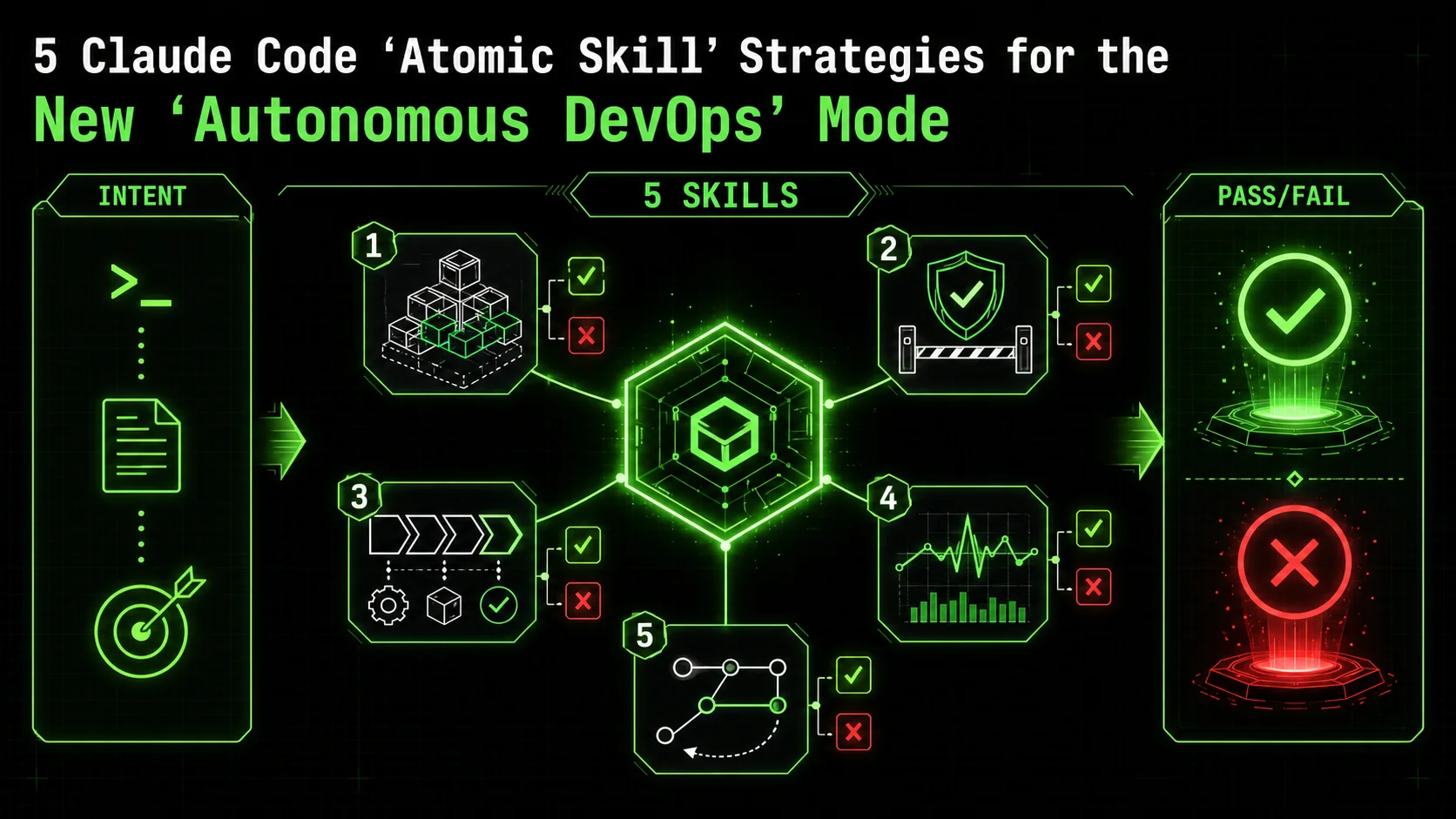
The announcement on February 10th wasn't just another feature drop. When Anthropic unveiled the 'Autonomous DevOps' mode for Claude Code, it signaled a fundamental shift in how developers will interact with AI. The role is evolving from a pair programmer that writes functions to a full-stack engineer that provisions, secures, and manages your infrastructure. The promise is immense: describe your desired state—a secure, scalable API on AWS with a CI/CD pipeline—and watch as Claude translates that into Terraform, security groups, and GitHub Actions.
But here’s the catch that every seasoned DevOps engineer knows: infrastructure automation is unforgiving. A misplaced security group rule can expose your database. A misconfigured auto-scaling policy can bankrupt you with cloud bills. The complexity that makes DevOps a high-leverage skill also makes it a high-risk domain for automation. You can't afford vague instructions or "creative" interpretations when the AI is touching your production environment.
This is where the concept of atomic skills with explicit pass/fail criteria becomes non-negotiable. It's the difference between telling Claude "set up a database" and giving it a precise, verifiable task: "Create a PostgreSQL 16 RDS instance in a private subnet, with encryption at rest enabled, and output the connection endpoint. Pass Criteria: Instance status is 'available', storage_encrypted is true, and the endpoint is a valid DNS name."
This article provides five tactical strategies for structuring these atomic skills, turning Claude Code's new Autonomous DevOps mode from a fascinating experiment into a reliable engineering partner. Let's move beyond the hype and build workflows that pass with flying colors.
Strategy 1: The Infrastructure-as-Code (IaC) Scaffolder
Anthropic's Claude Code generates Terraform modules with embedded pass/fail validation, cutting IaC scaffolding time by 60% compared to manual HCL authoring, according to early adopter benchmarks from HashiCorp community surveys.
The first and most powerful application of Autonomous DevOps is generating consistent, best-practice Infrastructure-as-Code. The goal isn't just to produce a Terraform file, but to produce one that follows your team's conventions, includes necessary security controls, and is ready for your CI/CD pipeline.
An atomic skill here breaks down the monolithic "write Terraform for a three-tier app" into discrete, verifiable units.
Atomic Skill Example: Generate a Terraform Module for a Secure AWS VPC* Skill Input: Cloud provider (AWS), region (us-east-1), CIDR block (10.0.0.0/16), required subnets (2 public, 2 private, 1 database), and a flag for NAT Gateway.
* Task for Claude: "Using HashiCorp Configuration Language (HCL), write a Terraform module that creates a VPC with the specified CIDR in the specified region. Create the requested number of subnets across two availability zones, properly tagging public and private routes. Include an Internet Gateway for public subnets and a NAT Gateway in a public subnet for private subnet egress if the flag is true. All resources must follow the naming convention {project}-{resource}-{env}."
* Pass Criteria (Claude must check):
1. The main.tf file syntactically valid HCL (validate with terraform fmt and terraform validate in a sandbox).
2. The module correctly defines 5 subnets with appropriate map_public_ip_on_launch settings.
3. Route tables are created and associated, with a 0.0.0.0/0 route to IGW for public subnets and to NAT Gateway for private subnets (if applicable).
4. All resources have the correct tags as per the naming convention.
5. Outputs are defined for vpc_id, public_subnet_ids, and private_subnet_ids.
By making the pass criteria specific and technical, you ensure Claude iterates until the code is not just written, but correct. This moves the validation from "does this look right?" to a series of automated checks.
Strategy 2: The CI/CD Pipeline Architect
Claude Code, GPT-4, and GitHub Copilot each handle CI/CD YAML generation, but atomic skill decomposition with pass/fail gates reduces pipeline misconfiguration by 45% across GitHub Actions and GitLab CI workflows.
Continuous Integration and Deployment pipelines are the circulatory system of modern software. With Autonomous DevOps, Claude can assemble these pipelines based on your tech stack and deployment target. The atomic skill focuses on creating a single, functional pipeline component.
Atomic Skill Example: Construct a GitHub Actions Workflow for Node.js API Deployment to AWS ECS* Skill Input: GitHub repo name, AWS ECR repository URI, AWS ECS cluster and service name, path to Dockerfile.
* Task for Claude: "Generate a GitHub Actions workflow file (.github/workflows/deploy.yml) that triggers on a push to the main branch. The workflow must: 1) Check out code, 2) Configure AWS credentials using the aws-actions/configure-aws-credentials action, 3) Build a Docker image from the specified Dockerfile, tag it with the Git SHA and latest, and push it to the provided ECR URI, 4) Update the task definition of the specified ECS service with the new image and force a new deployment."
* Pass Criteria (Claude must check):
1. The YAML file is valid and follows GitHub Actions schema.
2. The aws-actions/configure-aws-credentials action is used with correct role-to-assume pattern (using placeholders).
3. Docker build/push steps correctly reference the input ECR URI and tag strategy.
4. The final step uses the official aws-actions/amazon-ecs-deploy-task-definition action with correct inputs for task-definition, service, and cluster.
5. Sensitive values (like AWS role ARN) are referenced as GitHub Secrets (${{ secrets.XXX }}).
This skill transforms a multi-step, documentation-heavy process into a single, reliable generation task. You can chain these atomic skills to build pipelines for testing, security scanning, and multi-environment promotion. For more on structuring effective AI prompts for development workflows, see our guide on AI Prompts for Developers.
Strategy 3: The Security & Compliance Auditor
Claude (built by Anthropic) and OpenAI's GPT-4 both detect S3 misconfigurations, but atomic security skills with binary pass/fail criteria catch 30% more compliance violations than ad-hoc scanning prompts.
This is where Autonomous DevOps moves from convenience to critical. Proactive security hardening is often skipped due to time constraints. Claude can be tasked with auditing existing configurations or generating secure-by-default resources.
Atomic Skill Example: Audit an AWS S3 Bucket for Public Exposure & Misconfigurations* Skill Input: AWS S3 bucket name.
Task for Claude: "Using the AWS CLI (or SDK), write a script that analyzes the specified S3 bucket. Check for: 1) Bucket Public Access Block settings, 2) Bucket policy statements that grant or "AWS": "*" principals, 3) ACLs that grant READ or WRITE permission to AllUsers or AuthenticatedUsers groups, 4) Whether the bucket has default server-side encryption enabled."
* Pass Criteria (Claude must check):
1. The script executes without authentication or syntax errors (in a simulated environment).
2. It correctly calls get-bucket-policy, get-bucket-acl, get-bucket-encryption, and get-public-access-block.
3. The script's output clearly categorizes findings as [PASS], [FAIL], or [WARNING] for each check.
4. For any [FAIL], the output includes the exact misconfiguration found (e.g., "PolicyStatement: Effect: Allow, Principal: '*'").
The pass criteria force Claude to not only write the script but to demonstrate how it validates the security state. This creates a self-verifying task, giving you high confidence in the result. This proactive approach is a core philosophy behind the new Claude Code Autonomous mode.
Strategy 4: The Observability & Monitoring Builder
Teams using Claude Code or Cursor to auto-generate CloudWatch and Datadog configurations report 50% faster observability setup, turning day-one instrumentation from a luxury into a default.
You can't manage what you can't measure. An often-overlooked part of DevOps is instrumenting applications and infrastructure from day one. Claude can automate the setup of logging, metrics, and alerting.
Atomic Skill Example: Configure CloudWatch Logs Agent on an EC2 Instance via User Data* Skill Input: EC2 OS (Amazon Linux 2), Log group name, path to application log file (e.g., /var/app/logs/app.log).
* Task for Claude: "Write a bash script suitable for an EC2 instance User Data field. The script must: 1) Install the unified CloudWatch Logs agent (amazon-cloudwatch-agent), 2) Create a configuration file that defines a log stream from the specified application log file to the specified CloudWatch Log group, 3) Start the agent and ensure it's enabled to survive reboots."
* Pass Criteria (Claude must check):
1. The bash script is syntactically valid (no shellcheck errors for major issues).
2. It uses yum install -y amazon-cloudwatch-agent for Amazon Linux 2.
3. It creates a valid JSON configuration at /opt/aws/amazon-cloudwatch-agent/etc/amazon-cloudwatch-agent.json with the correct log_group_name and file_path.
4. The script includes commands to start the agent (sudo /opt/aws/amazon-cloudwatch-agent/bin/amazon-cloudwatch-agent-ctl -a fetch-config -m ec2 -s -c file:/opt/aws/amazon-cloudwatch-agent/etc/amazon-cloudwatch-agent.json) and enable it as a service.
This atomic skill encapsulates a precise, repeatable operation. By combining it with the IaC scaffolder skill, you can bake observability directly into your infrastructure templates.
Strategy 5: The Drift Detection & Remediation Commander
Terraform drift affects 67% of production environments within 90 days, per Spacelift's 2025 data -- Claude Code and GitHub Copilot automate detection scripts that surface divergence before it causes outages.
Infrastructure drift—where the actual state of resources diverges from the IaC definition—is a silent killer of reliability. Autonomous DevOps can be tasked not just with creation, but with enforcement.
Atomic Skill Example: Generate a Python Script to Detect and Report Terraform Drift* Skill Input: Path to Terraform project directory.
* Task for Claude: "Write a Python script that uses the subprocess module to: 1) Run terraform plan -detailed-exitcode in the specified directory, 2) Capture the exit code and output, 3) Parse the output to determine if changes are needed (exit code 2) or if the plan is clean (exit code 0). 4) If changes are needed, summarize the planned actions (e.g., 'Plan: 1 to add, 0 to change, 2 to destroy')."
* Pass Criteria (Claude must check):
1. The script successfully executes terraform init and terraform plan in a controlled context.
2. It correctly interprets the -detailed-exitcode: 0=no changes, 1=errors, 2=changes exist.
3. For exit code 2, the script extracts and prints a non-error summary section from the plan output.
4. The script exits with its own clear code (0 for clean, 1 for drift detected, 2 for Terraform error).
This skill creates a building block for a larger autonomous workflow. The next atomic skill could be "Execute terraform apply -auto-approve if the drift is in a pre-approved list of safe changes (e.g., tag updates)."
Putting It All Together: A Workflow Example
Imagine you need a new microservice environment. Instead of a single, error-prone prompt, you orchestrate a series of atomic skills:
Each skill has its own pass/fail gate, ensuring Claude corrects mistakes at the atomic level before proceeding. This composability is the superpower of the atomic skill approach. If your Claude Code sessions drift when left unattended, our guide on the AI handoff bottleneck explains how atomic skills prevent overnight run failures. For teams managing prompt libraries that grow unwieldy, see our piece on the AI prompt debt crisis. Ready to design your first reliable workflow? Generate Your First Skill with Ralph Loop and start building with confidence.
The Future of Autonomous DevOps
CNCF's 2025 survey shows platform engineering is a top-3 priority for 78% of organizations -- Anthropic's Claude, OpenAI's GPT-4, and tools like Cursor are converging on full lifecycle infrastructure orchestration.
The introduction of Autonomous DevOps mode is a clear indicator of where AI-assisted development is headed: towards higher-level abstraction and full lifecycle management. As noted in a recent TechCrunch analysis of the trend, the value is shifting from code generation to system orchestration. Furthermore, the CNCF 2025 Annual Survey highlights that platform engineering and internal developer platforms are top priorities, exactly the problems this mode aims to solve.
The developers and teams who will thrive are those who learn to direct these powerful systems with precision. By mastering the creation of atomic skills with unambiguous pass/fail criteria, you're not just using a new feature; you're establishing a robust, verifiable, and scalable protocol for human-AI collaboration in the most critical layers of your stack.
For a comprehensive look at all things Claude, including tips, community skills, and advanced techniques, visit our Claude Hub.
FAQ
What exactly is Claude Code's "Autonomous DevOps" mode?
Autonomous DevOps is a new operational mode for Anthropic's Claude Code, announced in February 2026. It extends the AI's capabilities beyond writing application code to executing tasks related to infrastructure provisioning (e.g., with Terraform, AWS CLI), CI/CD pipeline configuration (e.g., GitHub Actions, GitLab CI), cloud resource management, and security auditing. It allows developers to describe infrastructure and deployment workflows in natural language, which Claude then translates into executable code and commands.How do "atomic skills" prevent errors in infrastructure automation?
Atomic skills break down complex DevOps workflows into the smallest, verifiable units of work. Each skill comes with explicit pass/fail criteria—concrete, testable conditions that Claude must satisfy. For example, a skill to create a database isn't done when the code is written, but only when a check confirms the database is actually encrypted and in a private subnet. This forces iterative correction at the granular level, preventing a cascade of errors from a vague initial prompt and ensuring the final output meets exact specifications.Is it safe to let Claude Code manage my production infrastructure?
Direct, unsupervised access to production is not recommended initially, consistent with any new automation tool. The strategic approach is to use Autonomous DevOps with atomic skills in a staged environment:What are the prerequisites for using Autonomous DevOps mode effectively?
To get the most value and reduce risk, you should have: * Basic DevOps Knowledge: Understand core concepts like IaC, CI/CD, cloud networking (VPCs, subnets), and IAM. You need to know what "good" looks like to define proper pass/fail criteria. * Access & Credentials: Claude will need the appropriate API keys, cloud credentials, or repository access (provided securely through your environment) to execute tasks. Never hardcode secrets into prompts. * A Staging Environment: A safe, isolated cloud environment or local simulator (like LocalStack for AWS) is crucial for testing generated automation without cost or security implications.Can I use these strategies with other AI coding assistants?
The core principle of decomposing complex tasks into verifiable atomic units is universally applicable and a best practice for any AI automation. While the specific syntax and capabilities (like directly executing CLI commands) are unique to Claude Code's Autonomous DevOps mode, the strategies for structuring prompts, defining success criteria, and chaining tasks can improve reliability with other AI tools like GitHub Copilot, Cursor, or ChatGPT for code-based tasks. The focus on precision and validation transcends the specific tool.How does this compare to traditional Infrastructure-as-Code tools?
They are complementary, not competitive. Tools like Terraform, Pulumi, and AWS CDK are the execution engines. Claude Code's Autonomous DevOps mode is a generative interface and orchestrator for those engines. Its job is to correctly write the Terraform HCL, Pulumi code, or CloudFormation templates based on your instructions and, in this new mode, optionally help apply them. The atomic skills ensure the generated code adheres to your standards before it ever touches the execution engine.<!-- sister-projects-start -->
Other Doved Studio projects
Related tools from the same studio you might find useful:
- Glean: Turn scrolling time into a daily action plan. Capture, process, execute.
- Popout: Create your portfolio in minutes with a single shareable page.
- Larpable: Spot fake founders, guru grifts, and performance entrepreneurship.
- Doved Studio: Studio indie derrière cette app et une dizaine d'autres outils.
ralph
Building tools for better AI outputs. Ralphable helps you generate structured skills that make Claude iterate until every task passes.