Codex Mobile Review Loop: Steer Agents From Your Phone Without Rubber-Stamping Diffs
A practical workflow for reviewing, unblocking, and redirecting coding agents from mobile while keeping tests, scope, and pass-fail criteria intact.
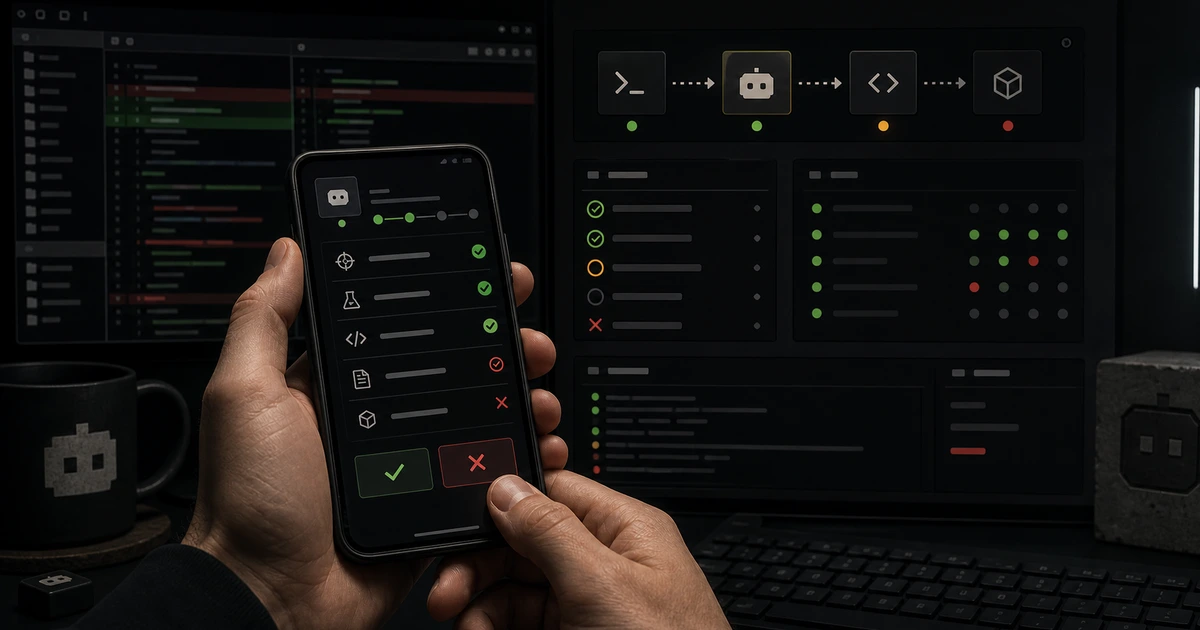
The phone is a dangerous place to review code because it compresses context. It is also useful because it keeps an agent from sitting idle for three hours over a tiny question. The trick is to design a mobile loop narrow enough to be safe.
Sources checked
- OpenAI Codex documentation
- OpenAI Codex pricing
- Anthropic Claude Code documentation
- GitHub Copilot documentation
The three jobs mobile is good at
Mobile is good for unblocking: choose between two implementation paths when the agent gives you a clean tradeoff. It is good for redirecting: "stop touching auth, focus only on the failing parser test." It is good for lightweight review: read the changed-file summary, test result, and known risk.
Mobile is bad for deep diff review, dependency changes, security-sensitive work, schema migrations, and broad refactors. If the task requires staring at five files and a failing trace, your phone is the wrong console.
The Ralph Loop mobile contract
Before a coding agent starts, the task should include a mobile-readable contract:
~~~md Task: Fix duplicate first article image rendering. Scope: blog article rendering only. Do not touch: sitemap, RSS, unrelated CSS. Pass criteria:
- no duplicated hero image on generated articles
- existing featured image still renders once
- unit or smoke test covers the duplicate case
- files changed
- command output summary
- remaining risk
This is not bureaucracy. It is what lets you review from a phone without inventing context mid-flight.
The approval table
| Agent report says | Mobile action |
|---|---|
| Tests pass, scope respected, small diff | Approve or ask for final summary |
| Tests not run | Ask the agent to run the named test |
| Scope expanded | Redirect and require revert of unrelated work |
| Dependency added | Defer to desktop review |
| Security or payment code changed | Defer to desktop review |
| Agent is unsure | Ask for options, not more code |
The five-line mobile reply
Use this when an agent asks for direction:
~~~text Choose option B. Keep the write set to lib/rendering and tests only. Do not change frontmatter parsing. Run the duplicate-image test and the blog render smoke. Report pass/fail plus remaining risk. ~~~
That is a good phone response. It makes a decision, narrows scope, names tests, and asks for a compact report.
What Ralphable adds
Ralphable turns this contract into a reusable skill. Instead of rewriting the same review discipline every time, you generate a Ralph Loop skill with pass-fail criteria. The point is not prettier prompting. The point is repeatable supervision.
Useful internal next steps: /generate, /blog/hub/claude, /blog/agents-md-skills-mcp-agent-config-stack, /blog/claude-code-limits-ai-agent-cost-control, and /blog/AGENTS.md-vs-CLAUDE.md-the-ai-coding-agent-config-war-2026.
Do not approve from mobile if
Do not approve if the agent changed files outside the contract, skipped tests, modified auth or billing, added a dependency, touched migrations, rewrote formatting across the repo, or cannot explain the remaining risk in two sentences.
The phone is for steering. The desktop is for judgment-heavy review.
FAQ
Can I actually manage coding agents from a phone?
Yes, for narrow supervision. Use mobile to unblock, redirect, and request verification.
What is the biggest risk?
Blind approval. Mobile makes weak summaries feel sufficient, so the task contract must be written before the agent starts.
Should every task use this loop?
No. Use it for background agent tasks that can wait for compact decisions.
What should a final mobile report include?
Files changed, tests run, pass/fail status, known risk, and one recommended next step.
A real before and after
Bad mobile instruction: "Looks fine, ship it." The agent hears approval without boundaries. If the summary hid a risky file, you just accepted it.
Good mobile instruction: "I approve the parser-only change if the duplicate-image regression test passes. Do not merge dependency or style changes. If any other file changed, stop and summarize why." That instruction is short enough to type on a phone and strict enough to protect the repo.
The mobile review packet
Ask the agent to return the same packet every time:
| Field | Example |
|---|---|
| Intent | Fix duplicate article image rendering |
| Changed files | 2 source files, 1 test |
| Tests | duplicate image test passed, blog render smoke passed |
| Risk | template-specific behavior may need visual check |
| Next step | run Playwright screenshot on one article |
How to encode it as a Ralph Loop skill
The reusable skill should say: require scope, require no-touch files, require exact commands, require a final packet, and block approval when tests are absent. It should also tell the agent to ask a bounded question instead of guessing when mobile context is insufficient.
That last part matters. A good agent does not keep coding through uncertainty. It pauses with options. Your phone reply can then choose a path without pretending to be a full review environment.
Cost control benefit
Mobile loops also reduce wasted agent spend. Without a contract, agents wander: broader diffs, repeated failed tests, context reloads, and speculative refactors. With a Ralph Loop, the agent has a smaller surface and a cleaner stop condition. The saved money is not only tokens. It is review attention.
ralph
Building tools for better AI outputs. Ralphable helps you generate structured skills that make Claude iterate until every task passes.