Claude Code Skills Template 2026: The Reusable Review Loop That Keeps Agents Honest
A practical SKILL.md template for coding agents: scope, evidence, tests, no-touch files, final packets, and mobile-safe approval loops.
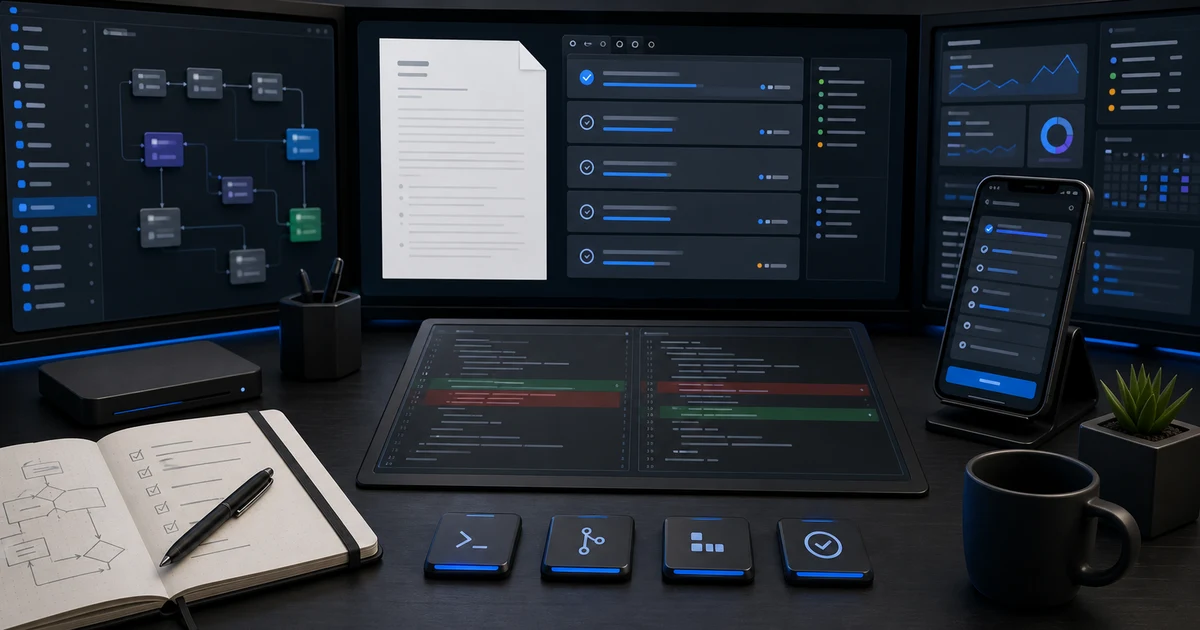
Claude Code, Codex, and other coding agents are becoming more capable. That makes reusable skills more important, not less. The better the agent, the more tempting it is to say "fix it" and let the session wander. A skill gives the agent a smaller track to run on.
Sources checked
- Claude Agent Skills documentation
- Claude Code slash commands and skills
- OpenAI Codex skills docs
- Model Context Protocol documentation
What a skill should decide
The skill should answer four questions before work begins:
If those answers are missing, the skill becomes a vibe. Vibes are how agents edit twelve files to fix one typo.
The reusable template
~~~markdown --- name: mobile-review-loop description: Use when approving or reviewing coding-agent work from a phone. ---
Mobile Review Loop
Scope
- Confirm the user's requested outcome in one sentence.
- List files that may change.
- Treat unrelated dirty files as no-touch files.
Evidence
- Read the diff before editing.
- Explain any behavior change in plain language.
- Run the narrowest relevant tests.
Stop Conditions
- Stop if tests fail twice for the same reason.
- Stop if required context is missing.
- Stop if an unrelated file must change.
Final Packet
- Intent
- Changed files
- Tests run
- Risks
- Next step
This is not fancy. That is the point. It gives the agent boundaries and gives mobile-you a predictable approval packet.
The no-touch file rule
Most agent damage starts with good intentions around adjacent code. The skill should say: if a file is unrelated to the request, do not edit it. If it appears in the diff because the repo was already dirty, mention it but do not "clean it up."
This matters because real worktrees are messy. A useful agent can operate inside mess without trying to become the repo's janitor.
The evidence rule
Every final answer should name the tests. "Looks good" is not evidence. "Ran npm test for the parser and a Playwright smoke on the article page" is evidence. If tests were not run, the skill should force the agent to say why.
The goal is not bureaucracy. It is review compression. The user should be able to approve from a phone without opening every file, because the packet has the shape they trust.
The mobile approval loop
Mobile review is different. You are not reading a 900-line diff on a train and making architectural decisions. You are deciding whether a bounded change can continue. That means the agent must return a compact packet:
| Field | Good answer |
|---|---|
| Intent | Fixed blog table rendering for article pages |
| Changed files | One parser, one page component, one test |
| Tests | Unit test passed, article route smoke passed |
| Risk | Tables with escaped pipes may need a later parser improvement |
| Next step | Deploy and verify one live article |
How Ralphable uses it
Ralphable skills should feel like reusable judgment, not generic instructions. A content skill should know brand voice. A deploy skill should know the VPS queue. A review skill should know what proof counts. A mobile loop should know that the user is approving from a tiny screen with limited patience.
The magic is not in one giant prompt. It is in many small, named workflows that activate at the right moment.
The anti-patterns
Do not write a skill that says "be careful." Say what careful means. Do not write "run tests." Name the likely tests or require the agent to discover them. Do not write "make it high quality." Describe the packet that proves quality. Do not write a skill that allows unrelated refactors because they "improve code style."
Agents respect specifics. They improvise around adjectives.
FAQ
Is this only for Claude Code?
No. The same SKILL.md pattern works for any agent environment that supports reusable workflow instructions.
How long should a skill be?
Long enough to encode decisions, short enough to be read at the moment of use.
Should a skill include commands?
Yes, when the commands are stable. Otherwise, tell the agent how to discover them.
What is the biggest mistake?
Writing a skill that describes vibes instead of stop conditions, evidence, and allowed changes.
Ralphable Editorial
Building tools for better AI outputs. Ralphable helps you generate structured skills that make Claude iterate until every task passes.