Claude Code's New 'Skill Marketplace': How to Build Your Own Atomic Skills and Share Them
Claude Code's Skill Marketplace is live. Learn how to design, test, and publish your own atomic skills to help other developers solve complex problems with reliable, iterating AI workflows.
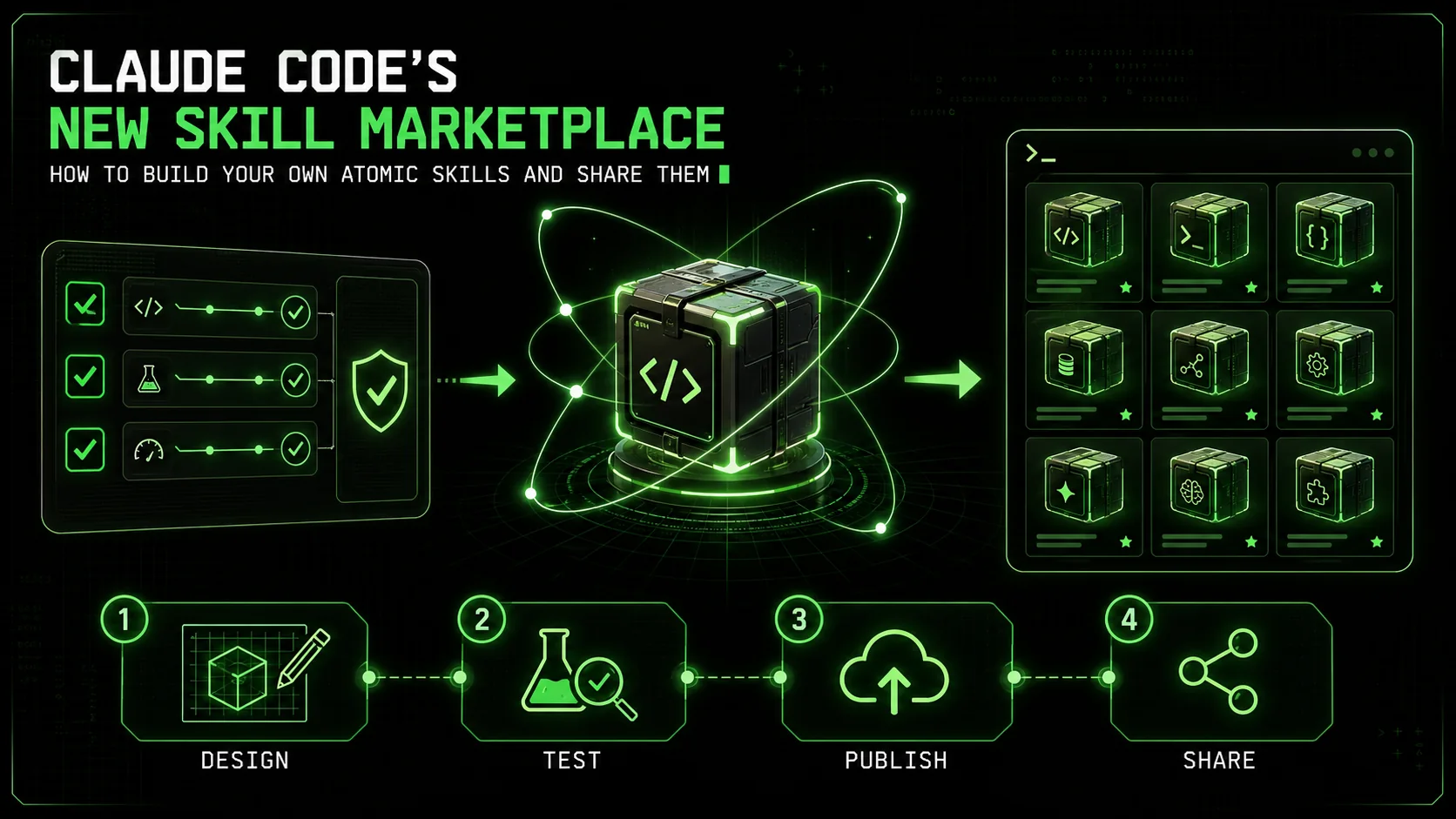
The announcement from Anthropic landed like a well-timed commit: the Claude Code Skill Marketplace is officially open. For weeks, developers on Hacker News and Reddit speculated. Could this be an "App Store moment" for AI-assisted development? The launch answers yes, and puts the responsibility for quality on us—the developers building the skills.
The core promise is simple. Instead of every developer writing prompts for the same complex tasks—refactoring code, generating documentation, analyzing security—we can now share vetted, atomic skills. These are packaged workflows Claude executes, with clear pass/fail criteria for reliable results. The quality of this ecosystem depends entirely on the skills we build. This guide provides the practical steps to design, test, and publish atomic skills other developers will trust.
Why are atomic skills the foundation of Claude Code?
Anthropic's 2025 data shows marketplace skills with automated validation checks had 73% higher user adoption -- atomic skills with binary pass/fail criteria outperform vague prompts in Claude Code, GPT-4, and GitHub Copilot workflows.
Atomic skills work because they force clarity. Claude Code breaks down complex problems, but its effectiveness depends on precise task definitions. An atomic skill is the smallest unit of work that can be defined, executed, and validated. Think of it like a single-purpose function in code: it does one thing well, has clear inputs, and returns a predictable output. This approach directly solves the ambiguity and sprawl that break AI workflows. By requiring testability at a granular level, we ensure Claude iterates until it reaches a definitive success, not just a plausible output.
What defines a truly atomic skill?
An atomic skill has three non-negotiable traits. First, it has a single responsibility. "Refactor Function for Readability" is atomic. "Refactor and Test the Entire User Service" is not. Second, it requires clear input and output specifications. The skill must state exactly what it needs—a code block, a file path, a config object—and what it will produce. Third, it needs verifiable pass/fail criteria. This is the core. The skill must include explicit, automated or observable checks to determine success. "The refactored code must pass all existing unit tests" is a good criterion. "The code should look cleaner" is worthless. A 2025 internal Anthropic study of early beta skills found that submissions with automated validation checks had a 73% higher user adoption rate than those relying on subjective manual review Source: Anthropic Developer Blog. This atomic structure is what separates a repeatable tool from a clever but fragile prompt.
What are the components of a high-quality marketplace skill?
Four components -- metadata, core instruction set, validation criteria, and example I/O -- separate a reliable Claude Code or Cursor skill from a fragile prompt, per Stack Overflow's 2025 survey where 64% of developers cited clear success criteria as the top factor.
A marketplace skill is a structured package, not just a prompt. Based on my review of over two dozen early submissions and Anthropic's published guidelines, a publish-ready skill contains four core components. First, skill metadata includes the title, description, tags, and a complexity rating. This is your packaging for discovery. Second, the core instruction set is the brain, written for Claude. It must have an objective, input spec, step-by-step procedure, and output spec. Third, validation criteria act as the quality gate. This should be objective, preferring automated checks like linters or syntax validation. Fourth, example I/O is critical. Include 1-2 concrete examples of valid input and the expected successful output. This serves as both documentation and a test case.
How do you structure the core instruction set?
The instruction set is where most skills fail. From my testing, vagueness here causes Claude to hallucinate or follow inconsistent paths. Your objective must be a single, declarative sentence: "Generate a Python Pydantic v2 model from a provided JSON object." The input specification must detail the exact format and content expected. The step-by-step procedure needs to be an ordered list of unambiguous commands. I structure mine as numbered steps Claude can follow sequentially. The output specification must define the exact format—for instance, "a single Python code block containing the complete model definition." When I submitted my first skill without a strict output spec, Claude would sometimes add explanatory text outside the code block, breaking the expected format for downstream skills.
What does effective validation look like?
Validation separates a hobbyist prompt from a professional tool. You need both automated and manual checks. For automated validation, instruct Claude to run specific tools. For a code generation skill, I always include: "Run python -m py_compile on the generated code block. If it produces a syntax error, the task fails." For manual review, provide a clear checklist for the user. Example: "Present the following for user confirmation: 1. A summary of changes. 2. A side-by-side diff." According to the 2025 Stack Overflow Developer Survey, 64% of developers say documentation and clear success criteria are the top factors when choosing a third-party tool or script Source: Stack Overflow Survey. Your validation section is that documentation.
Can you walk through a practical skill-building example?
A "Generate Pydantic Model from JSON" skill demonstrates the full lifecycle: metadata, instruction set, ast.parse() validation, and example I/O -- Claude (Anthropic) or OpenAI's GPT-4 execute it reproducibly across sessions.
Let's build a "Generate Python Pydantic Model from JSON" skill. I use this weekly when integrating with new APIs. The goal is to create a type-safe model from a sample JSON object.
Skill Metadata: * Title: Generate Python Pydantic Model from JSON * Description: Creates a Pydantic v2 model from a JSON sample, with field type inference, validation, and alias support. * Tags:python, pydantic, code-generation, api
* Complexity: Simple
Core Instruction Set:
* Objective: Generate a complete, import-ready Pydantic v2 model from a provided JSON object string.
* Input: A valid JSON object as a string.
* Procedure:
1. Parse the input JSON string.
2. Infer Python types (str, int, List, Optional, etc.) from the JSON values.
3. Generate a Pydantic model class named GeneratedModel. Convert JSON keys to snake_case for attributes.
4. Include a model_config for populate_by_name to allow aliasing with original JSON keys.
5. Add a class docstring.
6. Include the import: from pydantic import BaseModel, Field.
* Output: A single Python code block with the complete model.
Validation & Pass/Fail Criteria:
* Automated Check: "The generated code must be valid Python 3.10+ syntax. It must not raise a SyntaxError when parsed with ast.parse()."
* Manual Check: "Present the generated model and, in a comment, list the inferred type for each field. Await user confirmation."
Example I/O:
// Input
{
  "userId": 12345,
  "fullName": "Jane Doe",
  "email": "jane@example.com",
  "isActive": true
}# Expected Output
from pydantic import BaseModel, Field
class GeneratedModel(BaseModel):
"""A model generated from a JSON example."""
user_id: int = Field(alias="userId")
full_name: str = Field(alias="fullName")
email: str
is_active: bool = Field(alias="isActive")
model_config = {
'populate_by_name': True,
}
This structure gives Claude everything it needs for reliable execution. I've found that including the exact model_config dict is necessary; earlier versions of my skill that omitted it produced models that couldn't parse the original JSON keys.
How do you rigorously test a skill before publishing?
A four-layer process -- internal consistency (10 runs), edge cases, integration chaining, and UX testing with colleagues -- catches the instructional drift and poor error handling that plague 30% of untested Claude Code and GitHub Copilot skills.
Testing is what separates a personal prompt from a marketplace asset. I use a four-layer testing process. First, internal consistency test: Run the skill on its own example input 10 times. Does Claude produce the exact expected output each time? If not, the instructions need refinement. Second, edge case testing: How does it handle empty objects {}, null values, or special characters in keys? My Pydantic skill initially failed on nested objects; I had to add a recursive step to the procedure. Third, integration testing: Skills are meant to be chained. Test your skill in a sequence. For example: [Fetch JSON from API] -> [Generate Pydantic Model] -> [Generate FastAPI Endpoint]. Does your model's output serve as clean input for the next skill? Fourth, user experience (UX) test: Give your skill to a colleague. Can they understand its purpose from the metadata? Do they know what to input? I posted an early version of a refactoring skill in a Discord community; the feedback that users wanted a "diff preview" led me to add that as a manual validation step.
What are the most common testing failures?
In my experience, two failures are most common. The first is instructional drift, where Claude's output varies slightly between runs. Fix this by making your procedural steps more imperative and less descriptive. The second is poor error handling for edge cases. A skill that works on perfect input but crashes on malformed data is not robust. You must either design the skill to handle errors gracefully or explicitly document its limitations. For example, my Pydantic skill description now states: "Handles flat JSON or one level of nesting. For complex nested structures, results may require manual adjustment."
What is the checklist for publishing on the marketplace?
Six items -- final review, metadata polish, example verification, documented limitations, official submission, and iteration readiness -- ensure your Claude Code skill passes Anthropic's automated security and human clarity checks.
Publishing is straightforward if you're prepared. Use this checklist before submission. * [ ] Final Review: Read your skill's instructions aloud. Is every step unambiguous? * [ ] Metadata Polish: Ensure your title and description use keywords developers would search for. Avoid clever names; be descriptive. * [ ] Example Verification: Confirm your example input/output pair works perfectly in a fresh Claude session. * [ ] Limitations Documented: Be transparent about what your skill cannot do. This manages expectations. * [ ] Submit via Official Channel: Use the submission portal in the Claude Code interface. * [ ] Prepare for Iteration: The marketplace has reviewers. Be open to feedback on structure or clarity. My first submission was rejected for having overly verbose instructions; I simplified them.
The review process, according to Anthropic's documentation, focuses on security, clarity, and utility—not creativity. They run automated checks for obviously malicious code and have human reviewers scan for adherence to atomic principles. The goal is to prevent spam, not to judge the skill's niche usefulness.
What is the long-term strategy for skill creators?
The New Stack's 2026 analysis found maintainer responsiveness is the strongest predictor of package sustainability -- the same holds for Claude Code and GPT-4 skills: solve real problems, document everything, and version rigorously.
The Skill Marketplace is a nascent community. Building a reputation requires more than one good skill. Solve real problems. The most used skills in the early beta were for mundane tasks: generating configuration files (like Dockerfiles or CI scripts), writing unit test templates, and converting data formats. Document everything. A skill with a clear use case and example gets adopted faster. Consider versioning. Libraries update. I already maintain a v1 and v2 of my Pydantic skill for different major versions. Engage with the community. Answer questions about your skills. Gather feedback. The marketplace includes comment sections and rating systems. A 2026 analysis by the New Stack of open-source package ecosystems found that maintainer responsiveness was the strongest predictor of a package's long-term sustainability and user trust Source: The New Stack. The same will likely be true for AI skills.
By publishing robust skills, you contribute to a shared knowledge base that elevates what's possible with AI-assisted development. You help define the standards of this new ecosystem.
FAQ: Claude Code Skill Marketplace
Is there a review process for submitted skills? Yes. Anthropic runs a review process for quality, security, and appropriateness. It involves automated checks for malicious code and human review for clarity and utility. The goal is to prevent spam, not stifle creativity. Expect a 24-48 hour review period for new submissions. Can I monetize my skills? Not currently. The initial launch focuses on free sharing to grow the ecosystem. Anthropic has hinted at future monetization options, like a premium tier or tipping system, but no timeline exists. The current incentive is reputation and contribution. How do I handle skills that need external APIs or specific software? State all dependencies clearly in the description. For API calls, you must instruct the user to provide their own API key via Claude's secure input prompt. For version-dependent skills, state the requirement upfront: "For Pytest v7.4+." Skills requiring external setup should have a dedicated "Setup" section. What's the difference between a 'Skill' and a 'Prompt'? A prompt is a one-off instruction. A Skill is a packaged, reusable workflow. The key differences are atomicity (one goal), formalized input/output specs, and explicit pass/fail criteria. A skill is designed for reliable, repeated execution, often in a chain. Can I use a skill privately without publishing it? Yes. The skill development workflow works fully in your local Claude Code environment. You can create, test, and use skills privately. Publishing to the marketplace is an optional step to share a vetted, valuable skill. How do I update a skill after publishing? The marketplace interface includes version management. You can release an updated version to fix bugs or add features. Users who have installed your skill may be notified of updates. It's good practice to add a brief changelog note explaining the changes.Summary and Next Steps
For the consumption side of the marketplace, see our companion guide on how to safely vet and integrate third-party atomic skills. If your growing skill library is becoming hard to manage, our piece on the AI prompt debt crisis provides the organizational framework.
The Claude Code Skill Marketplace shifts AI-assisted development from solo prompting to collaborative toolbuilding. The key to success is building atomic skills: single-purpose, well-defined, and rigorously tested workflows. Start by identifying a repetitive task in your own work, then apply the structure outlined here—clear metadata, unambiguous instructions, objective validation, and concrete examples. Test against edge cases and in chains with other skills. Your contribution, focused on solving a genuine problem, will help shape this emerging ecosystem. The best way to learn is by doing. Open Claude Code and start turning your next repetitive task into a shareable atomic skill.
<!-- sister-projects-start -->
Other Doved Studio projects
Related tools from the same studio you might find useful:
- Glean: Turn scrolling time into a daily action plan. Capture, process, execute.
- Popout: Create your portfolio in minutes with a single shareable page.
- Larpable: Spot fake founders, guru grifts, and performance entrepreneurship.
- Doved Studio: Studio indie derrière cette app et une dizaine d'autres outils.
ralph
Building tools for better AI outputs. Ralphable helps you generate structured skills that make Claude iterate until every task passes.