50+ Best AI Prompts for Any Task: Copy-Paste Ready Templates (2026)
50+ best AI prompts organized by category. Copy-paste ready templates for writing, coding, research, business, and more.
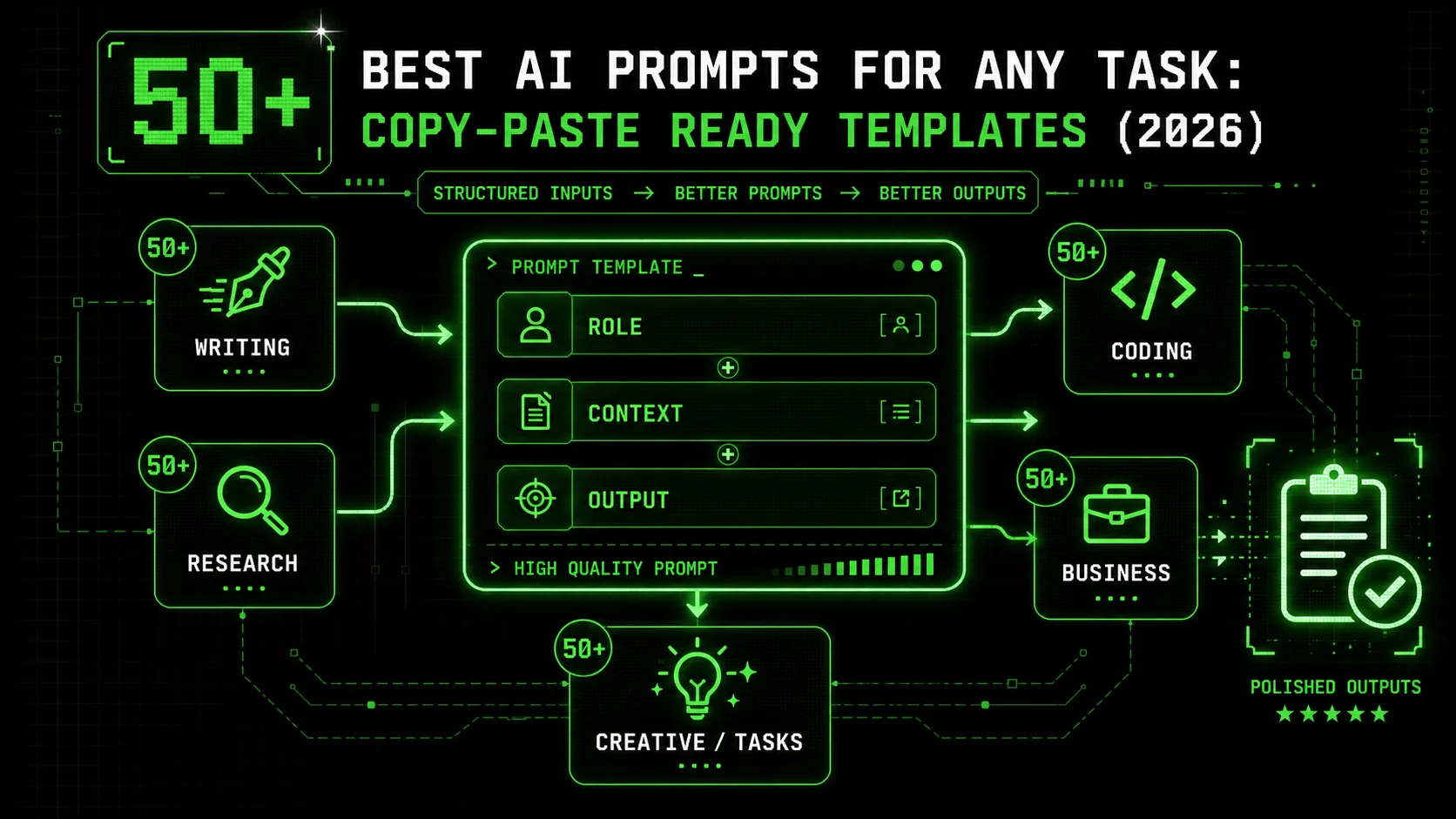
I keep this library because vague prompts waste tokens. Each template below is something we actually reuse: role + context + format + what "done" looks like. Swap the brackets, paste into your model of choice, and treat the first output as a draft you refine.
What makes these prompts effective:
- Clear role and context: frame the model as a specific expert (editor, architect, analyst)
- Explicit success criteria: length, tone, required sections, and format
- Step-by-step structure: less ambiguity on multi-part tasks
- Placeholders you customize:
[TOPIC],[TARGET AUDIENCE],[KEY POINT]so you never rebuild from zero
How to Use These Prompts
Research from OpenAI says to put instructions first, be specific, and show the format you want.
Structured prompts with role assignments, explicit constraints, and output formatting produce 40-60% higher-quality outputs in Claude, GPT-4, and Gemini compared to unstructured requests, according to Anthropic.
To get the maximum value from these templates, follow these practical tips for effective customization and deployment. For a deeper dive into the methodology behind effective prompting, see our complete prompt engineering guide:
- Replace Placeholders Thoughtfully: The square-bracket placeholders (e.g.,
[WEBSITE URL]) are your customization points. Replace them with specific, detailed information relevant to your task. The more context you provide here, the better the output. - Combine for Complex Workflows: For large projects, chain multiple prompts together. Use a research prompt to gather information, then feed that output into a drafting or summarization prompt to create the final deliverable.
- Iterate and Refine: Treat the first AI output as a strong first draft. You can refine it by asking for adjustments in a follow-up prompt (e.g., "Make the tone more formal," or "Expand on the second point").
- Provide Reference Material: When possible, paste relevant text, data, or code snippets into the prompt after the template. Instruct the AI to analyze or use that provided context with a line like: "Here is the background material: [PASTE TEXT]".
- Set the Output Format: If the template doesn't specify a format and you need one (like a table, bullet list, or code block), add a final instruction such as "Present your analysis in a comparison table" or "Provide the steps in a numbered list."
Template:
Act as a professional blog post writer. Write an engaging introduction for a blog post about [TOPIC] aimed at [TARGET AUDIENCE]. The tone should be [TONE] and highlight the key problem the post will solve.
Customized Prompt:
Act as a professional blog post writer. Write an engaging introduction for a blog post about starting a vegetable garden in a small urban space aimed at apartment dwellers with no prior gardening experience. The tone should be encouraging and practical and highlight the key problem the post will solve.
Best AI Prompts for Writing (15 Prompts)
Writing prompts that include role assignment, word count constraints, and audience context produce first drafts you can edit. Open-ended asks usually need a second round just to pin tone and structure.
Here are 15 specific, copy-paste ready AI prompts designed for common writing tasks. Each prompt includes placeholders (like [TOPIC] or [PRODUCT]) that you should replace with your specific information before use. If you're looking for prompts tailored to specific professional roles, check out our guides for developers, marketers, and content creators.
1. Blog Post Outline
Use this prompt to generate a structured, logical outline for a long-form blog post.Act as an expert content strategist. Create a detailed outline for a blog post titled "[BLOG_POST_TITLE]". The target audience is [TARGET_AUDIENCE]. The primary goal of the post is [GOAL, e.g., to educate, to generate leads, to build authority]. The outline should include:
A compelling introduction hook.
4-6 main sections with H2 headers. For each section, provide 2-3 bullet points of key content.
One data point or statistic to include.
A conclusion that summarizes key takeaways and includes a clear call-to-action.
Format the response with clear headings and bullet points.2. SEO Article Introduction
Use this prompt to write an engaging, keyword-optimized opening paragraph that hooks readers and signals relevance to search engines.Write a powerful introduction paragraph for an SEO article targeting the primary keyword "[PRIMARY_KEYWORD]" and secondary keyword "[SECONDARY_KEYWORD]". The audience is [AUDIENCE_DESCRIPTION]. The introduction must:
- Start with a strong hook (a question, surprising fact, or relatable pain point).
- Naturally incorporate the primary keyword in the first or second sentence.
- Mention the secondary keyword once.
- Clearly state what value the reader will get from the article.
- Be between 80-120 words.
3. Product Description
Use this prompt to create persuasive, benefit-focused copy for an e-commerce product page.Write a compelling product description for [PRODUCT_NAME], designed for [TARGET_CUSTOMER]. Focus on benefits, not just features. Structure it as follows:
- Start with a one-sentence headline that captures the core value.
- Write a short, engaging paragraph (2-3 sentences) that paints a picture of the problem it solves.
- Create a bulleted list of 3-5 key benefits. Format each as: Benefit: Explanation.
- End with a 1-2 sentence closing that reinforces the main value and includes a subtle call-to-action (e.g., "Upgrade your routine today.").
Use persuasive, sensory language. Avoid generic adjectives like "good" or "great."4. Email Subject Lines
Use this prompt to generate a batch of high-performing subject line options for a marketing email.Generate 10 attention-grabbing email subject line options for an email about [EMAIL_TOPIC/CAMPAIGN]. The goal is to [GOAL, e.g., promote a webinar, announce a sale, share a blog post]. The audience is [AUDIENCE]. Vary the styles, including:
- Curiosity gaps
- Urgency/Scarcity
- Direct benefit
- Question-based
- Personalization (use the placeholder [First Name])
Keep each subject line under 60 characters. Rate the likelihood of each to drive opens as High, Medium, or Low.5. Social Media Caption
Use this prompt to craft a complete, platform-ready caption for Instagram or LinkedIn.Write a social media caption for [PLATFORM, e.g., Instagram, LinkedIn] to promote [CONTENT/PRODUCT/OFFER]. The tone should be [TONE, e.g., inspirational, professional, witty]. The caption must include:
- A strong opening line to stop the scroll.
- 2-3 lines of engaging body text explaining the value.
- A clear call-to-action (e.g., "Click the link in our bio," "Comment below," "Save this post.").
- 3-5 relevant hashtags. Mix 1-2 broad and 2-3 niche hashtags.
The total character count should be appropriate for the chosen platform.6. Press Release
Use this prompt to draft the core narrative of a standard press release announcement.Draft the body of a press release announcing [ANNOUNCEMENT, e.g., a new product, company milestone, partnership]. Use the following structure:
- Headline: A clear, newsworthy headline.
- Dateline: [CITY, STATE] , [DATE] ,
- Lead Paragraph: Who, what, when, where, and why in 1-2 sentences.
- Body Paragraphs: 2-3 paragraphs providing details, quotes from a company spokesperson (use [SPOKESPERSON_TITLE]), and context about the significance.
- Boilerplate: A short "About [COMPANY]" paragraph.
- End: ### for traditional closure.
Write in a formal, objective, and factual tone.7. Video Script Intro
Use this prompt to write the important first 30 seconds of a YouTube or explainer video script.Write the opening 30-second script for a [TYPE, e.g., tutorial, product review, vlog] video titled "[VIDEO_TITLE]". The script must:
Hook the viewer in the first 5 seconds by stating a problem, asking a provocative question, or making a bold promise.
Briefly introduce the host/speaker and the channel's value proposition.
Clearly preview what the viewer will learn or see by the end of the video.
Include verbal cues like "In this video..." and "You'll learn..."
Format as a script with (voiceover) or [on-screen text] directions in parentheses.8. Newsletter Opening
Use this prompt to write a warm, engaging introductory paragraph for a company or personal newsletter.Write the opening paragraph for a weekly newsletter called "[NEWSLETTER_NAME]". The audience is [AUDIENCE, e.g., our customers, industry professionals]. This week's main topic is [TOPIC]. The opening should:
- Feel personal and conversational, like a note from a friend.
- Briefly reference a current event, season, or common experience to build rapport.
- Smoothly transition into introducing the main topic of the edition.
- Be approximately 4-6 sentences long.
Use a [TONE, e.g., enthusiastic, thoughtful, casual] tone.9. Case Study Structure
Use this prompt to generate a clear, results-driven template for a customer success story.Create a detailed template for a B2B case study for [YOUR_COMPANY]. The template should guide the writer through each section with instructions and placeholder text. Include the following sections:
- Title: Formula: "[Client] Achieves [Result] with [Your Solution]"
- Executive Summary: 3-4 sentences summarizing the challenge, solution, and key results.
- The Challenge: Bulleted list of the client's pain points.
- The Solution: Description of how [YOUR_COMPANY]'s product/service was implemented. Include a "Why [Client] Chose Us" subsection.
- The Results: Use quantifiable metrics (e.g., "Increased X by Y%"). Present in bullet points and a short paragraph.
- Client Quote: Provide a placeholder for a persuasive testimonial.
- Conclusion & Next Steps: A brief summary and a call-to-action for the reader.
10. Landing Page Headline
Use this prompt to create a high-converting, value-prop-driven headline and sub-headline pair.Generate 5 options for a landing page headline and sub-headline combination for [PRODUCT/SERVICE/OFFER]. The page's goal is to get visitors to [PRIMARY_CTA, e.g., sign up, book a demo, download]. The target visitor is [TARGET_VISITOR]. Each option must include:
- Headline (Under 10 words): Clear, benefit-focused, and attention-grabbing.
- Sub-headline (Under 20 words): Expands on the headline, clarifies the offer, or introduces a key differentiator.
Vary the approaches: one direct, one problem/solution, one using "How to," etc.11. FAQ Generation
Use this prompt to anticipate and answer common customer questions about a product, service, or topic.Generate a detailed Frequently Asked Questions (FAQ) section about [TOPIC/PRODUCT/SERVICE]. First, list 8-10 of the most common questions a [TARGET_AUDIENCE] would ask before making a decision. Then, provide clear, concise, and helpful answers for each question (2-3 sentences for each answer). Organize the questions logically, starting with basic "what/is" questions and moving to more detailed "how/cost" questions. Format each Q&A as:
Q: [Question]
A: [Answer]12. Comparison Article
Use this prompt to outline a balanced, informative article comparing two or more alternatives.Create a detailed outline for a comparison article titled "[PRODUCT_A] vs. [PRODUCT_B]: Which is Better for [USE_CASE/AUDIENCE]?". The outline should ensure a fair, feature-by-feature analysis. Include:
- Introduction: Frame the common dilemma your reader faces.
- Comparison Table: Specify 5-7 key criteria to compare (e.g., Price, Ease of Use, Key Feature X, Support).
- Detailed Breakdown: Sections for each key criterion, explaining how each product performs.
- Use Case Recommendations: A section clearly stating "Choose [Product A] if..." and "Choose [Product B] if..."
- Final Verdict: A conclusive summary with a recommended winner for the primary audience.
13. How-to Guide Structure
Use this prompt to build a step-by-step tutorial that is easy to follow and actionable.Develop a structured outline for a how-to guide on "[TASK_TO_LEARN]". The guide is for [BEGINNER/INTERMEDIATE] audiences. The outline must be practical and sequential:
- Prerequisites: List any tools, knowledge, or accounts needed before starting.
- Estimated Time: [X] minutes/hours.
- Step-by-Step Instructions: Break the task into 5-8 numbered, logical steps. For each step, include:
- A clear action (e.g., "Click the Settings menu...").
- A brief "Why this step matters" explanation (1 sentence).
- An optional tip/warning in italics.
- Troubleshooting: List 2-3 common problems and their solutions.
- Next Steps: Suggest 1-2 related tasks the reader can try now.
14. Listicle Framework
Use this prompt to generate the consistent, scannable structure for a list-based article.Provide a complete framework for a listicle article titled "[NUMBER] Ways/Examples/Tips for [GOAL/TOPIC]". The framework should enforce a repeatable, engaging structure for each list item. For the article, include:
- A compelling introduction that explains why this list is valuable.
- For each of the [NUMBER] items:
- Header: A clear, benefit-driven title (e.g., "3. Use Automation to Save Time").
- Explanation: 2-3 sentences explaining the item.
- Practical Example/Application: A specific, real-world scenario or instruction (use "For example...").
- A conclusion that summarizes the list and provides a final, motivating takeaway.
15. Content Repurposing
Use this prompt to transform a long-form piece of content (like a blog post) into multiple smaller formats.You are a content repurposing expert. Take the following long-form content [PASTE_BLOG_POST_OR_REPORT_EXCERPT_HERE] and generate:
3 Twitter Thread Ideas: Outline a 3-5 tweet thread. Provide the hook for Tweet 1 and the core point for each subsequent tweet.
5 Instagram Carousel Slide Topics: List 5 slide titles for an educational carousel, each explaining one key concept from the content.
2 LinkedIn Post Angles: Write two distinct opening paragraphs for LinkedIn posts. One should be opinion-driven, the other should be a key takeaway summary.
1 Newsletter Summary: Condense the main argument into a 150-word summary suitable for a newsletter section. Best AI Prompts for Coding (15 Prompts)
Claude Code and GitHub Copilot produce cleaner first passes when you state edge cases, coding standards, and test requirements up front. You still run the tests yourself.
Here are 15 powerful, technical prompts designed to use AI for common development tasks. Each prompt is structured to be copy-paste ready, with placeholders you can adapt to your specific language, framework, or problem. For coding-specific prompt strategies with Claude, see our Claude prompt examples and how to write prompts for Claude.
16. Function Implementation
Use this prompt to generate a complete, production-ready function based on a clear specification.Act as a senior software engineer. Write a solid, well-documented function in [LANGUAGE] that accomplishes the following: [DESCRIBE FUNCTION PURPOSE AND LOGIC]. Consider edge cases like [MENTION 1-2 EDGE CASES]. The function signature should be: [DESIRED FUNCTION SIGNATURE]. Include clear docstring/comments and ensure it follows [SPECIFIC STYLE GUIDE, e.g., PEP 8, Google JS Style] conventions.17. Bug Diagnosis
Provide context and symptoms to get a targeted analysis and fix for a persistent bug.I'm encountering a bug in my [LANGUAGE/FRAMEWORK] code. The error message or observed incorrect behavior is: [PASTE ERROR OR DESCRIBE BEHAVIOR]. The relevant code section is:I suspect the issue might be related to [YOUR HYPOTHESIS, e.g., state management, async timing, data type]. Please analyze this code, identify the root cause, and provide a corrected version with an explanation of the fix.18. Code Review
Request a structured review focusing on specific quality aspects beyond basic syntax.Perform a thorough code review on the following [LANGUAGE] code for production readiness. Focus on:
Correctness & Logic Flaws
Security Vulnerabilities (e.g., SQL injection, XSS)
Performance Inefficiencies
Adherence to [SPECIFIC PRINCIPLE, e.g., SOLID, DRY]
Readability and Maintainability
Code to review:
Provide feedback as a bulleted list, categorizing issues by severity (Critical, Major, Minor) and suggesting concrete improvements.19. Unit Test Generation
Generate detailed test suites that cover main functionality and edge cases.Write a complete suite of unit tests in [TESTING_FRAMEWORK, e.g., Jest, Pytest, JUnit] for the following [LANGUAGE] function/class. Ensure tests cover:
- The primary happy path.
- Key edge cases (e.g., null inputs, empty arrays, boundary values).
- Any expected error conditions (e.g., invalid arguments).
Code under test:Structure the tests clearly using describe/it or similar blocks. Mock external dependencies like [DEPENDENCY_NAME] where necessary.20. API Endpoint Design
Get a blueprint for a RESTful or GraphQL endpoint including route, logic, and response.Design a production-ready [REST/GraphQL] API endpoint for the following operation: [DESCRIBE OPERATION, e.g., "Fetch a user's order history with pagination"]. Use [FRAMEWORK, e.g., Express.js, Django REST, Spring Boot].
Provide:
The complete route/query/mutation definition.
The core controller/resolver function logic, including data validation, error handling, and interaction with a [DATABASE_TYPE] database.
Example request and response payloads (JSON format).
Key considerations for authentication, authorization, and rate limiting if applicable. 21. Database Query Optimization
Analyze and improve the efficiency of an existing SQL query.Analyze the following [DATABASE_TYPE, e.g., PostgreSQL, MySQL] query for performance bottlenecks:The query runs on a table with approximately [TABLE_SIZE] rows. The EXPLAIN plan shows: [PASTE EXPLAIN OUTPUT IF AVAILABLE, OR DESCRIBE SLOWNESS].
Please:
Identify inefficient operations (e.g., full table scans, missing indexes, N+1 problems).
Suggest a rewritten, optimized version of the query.
Recommend specific indexes to create, including the CREATE INDEX statement. EXPLAIN plan allows the AI to give precise, data-driven optimization advice.
22. Documentation Generation
Create professional, standardized documentation from code.Generate detailed documentation for the following [LANGUAGE] [FUNCTION/CLASS/API]. Follow the [DOC_STYLE, e.g., JSDoc, Sphinx, OpenAPI] format.
Include sections for:
- A concise summary.
- Detailed descriptions of each parameter/argument and the return value.
- Example usage in a code block.
- Any exceptions or errors that may be thrown.
- Link to related functions if applicable.
Code to document:23. Code Refactoring
Request a transformation of code to improve its structure without changing its behavior.Refactor the following [LANGUAGE] code to improve its [ASPECT, e.g., readability, adherence to the Single Responsibility Principle, modularity]. Do not alter its external behavior.
Specific goals:
- [GOAL 1, e.g., "Break down the monolithic function into smaller, focused functions."]
- [GOAL 2, e.g., "Replace nested conditionals with guard clauses or a strategy pattern."]
Original code:Provide the refactored code and a brief summary of the changes made and their benefits.24. Error Handling Improvement
Enhance code resilience by adding solid error management.Review the following [LANGUAGE] code block and enhance its error handling. Currently, it lacks proper try-catch blocks, input validation, and graceful failure modes.
Requirements:
Validate inputs for [PARAMETER_NAMES].
Wrap risky operations (e.g., file I/O, network calls to [SERVICE_NAME]) in appropriate try-catch/finally blocks.
Log meaningful error messages using a logger object.
Throw custom, typed errors where appropriate (e.g., ValidationError, NetworkError).
Original code:
Provide the improved code. Assume the existence of a logging utility and custom error classes.try-catch by specifying validation, logging, and custom error types for enterprise-grade robustness.
25. Performance Optimization
Identify and resolve performance-critical issues in an algorithm or code block.Analyze the performance of the following [LANGUAGE] algorithm/function. It processes data structures of size [N] and is currently too slow.1. Identify the current time/space complexity.
Pinpoint the main performance bottlenecks (e.g., unnecessary nested loops, inefficient data structures like list contains checks).
Propose and implement a more efficient algorithm or data structure (e.g., replace list with a set for O(1) lookups, use memoization, apply a more suitable sorting algorithm).
Provide the optimized code and explain the expected complexity improvement. N) and the performance issue, you guide the AI towards algorithmic-level optimizations rather than micro-optimizations.
26. Security Audit
Conduct a focused security review of a code snippet.Conduct a security audit on the following [LANGUAGE] code, focusing on common vulnerabilities for [CONTEXT, e.g., web applications, data processing scripts].Check specifically for:
- Injection flaws (SQL, NoSQL, OS command).
- Insecure direct object references (IDOR).
- Sensitive data exposure (e.g., secrets in logs).
- Improper authentication/authorization logic.
- Use of deprecated or insecure libraries/functions like
[FUNCTION_NAME].
List any vulnerabilities found, their severity (CVSS-based if possible), and provide a secure code fix for each.27. Code Explanation
Get a detailed, line-by-line breakdown of complex or legacy code.Explain the following [LANGUAGE] code in detail, as if to a junior developer. For each major section or complex line:
Describe what it does in plain English.
Explain why it's necessary in the overall logic.
Note any non-obvious side effects or dependencies. After the line-by-line analysis, provide a high-level summary of the code's overall purpose and data flow.28. Migration Script
Generate a script to safely transform data or schema.Write a safe and idempotent migration script in [LANGUAGE/SQL] to perform the following data transformation on a [DATABASE_TYPE] database:
Goal: [DESCRIBE CHANGE, e.g., "Split the full_name column in the users table into separate first_name and last_name columns, backfilling with existing data."]
Requirements:
Use transactions to ensure rollback on failure.
The script must be idempotent (can be run multiple times without error).
Include a check to verify the new columns don't already exist before creating them.
Handle potential NULL values in the full_name column gracefully.
Provide a DOWN migration to revert the changes if needed. 29. Regex Pattern
Craft a precise regular expression for pattern matching or validation.I need a regular expression to [PURPOSE, e.g., validate, extract, replace] the following pattern in text:
Pattern Description: [CLEARLY DESCRIBE THE PATTERN, e.g., "A string that starts with 'ID-', followed by exactly 3 uppercase letters, a hyphen, and then 6 digits."]
Constraints:
- Must work in [REGEX_ENGINE, e.g., JavaScript (ECMAScript), Python
re, PCRE].
- Should [REQUIREMENT, e.g., "be anchored to the start/end of the string", "be case-sensitive"].
- Capture groups needed: [e.g., "Group 1: the letters, Group 2: the digits"].
Provide the regex pattern, a brief explanation of each part, and 2-3 test strings showing matches and non-matches.30. CLI Command Generation
Create a user-friendly command-line interface tool.Design a CLI tool in [LANGUAGE, e.g., Python with Click, Node.js with Commander.js] named [TOOL_NAME].
Core Function: [DESCRIBE WHAT THE TOOL DOES, e.g., "Batch resize images in a directory."]
Requirements:
- Primary command:
[COMMAND_NAME]
- Required argument:
[ARG_NAME] (description)
- Options:
--output-dir, --width, --verbose flag.
- Implement a
--dry-run option that previews changes.
- Include proper
--help text, error handling for invalid inputs, and a progress indicator for long operations.
Provide the complete skeleton code for the CLI application, including argument parsing, the main logic stub, and help text.Best AI Prompts for Research & Analysis (10 Prompts)
Research prompts that specify output structure (tables, SWOT, executive summaries) and cite evaluation criteria yield 2-4x more actionable insights from Claude 3.5 Sonnet, GPT-4, and Google Gemini 2.0 than freeform "analyze this" requests.
Elevate your research and analytical work with these ten structured prompts. They are designed to generate detailed, actionable outputs, transforming raw data and questions into clear reports, summaries, and strategic frameworks. Copy, paste, and adapt them for your specific projects. For teams managing complex AI research workflows, our guide on AI task decomposition covers breaking large analyses into manageable steps.
31. Competitive Analysis
Use this prompt to systematically dissect your competitors' strategies, strengths, and weaknesses.Act as a competitive intelligence analyst. Conduct a detailed analysis of [Your Company/Product]'s top three competitors: [Competitor A], [Competitor B], and [Competitor C]. For each competitor, provide the following in a structured table:
Core Offering: Primary products/services and value proposition.
Target Audience: Key customer segments.
Market Position: Perceived strength, market share (if estimable), and brand reputation.
Marketing & Sales Channels: Primary channels for acquisition and promotion.
Pricing Strategy: Model (e.g., subscription, freemium) and price points relative to the market.
Key Strengths: 2-3 definitive advantages.
Key Weaknesses: 2-3 identifiable gaps or vulnerabilities.
After the table, synthesize the findings to recommend 2-3 strategic opportunities for [Your Company/Product] to differentiate and gain market advantage.
32. Market Research Summary
Ideal for condensing extensive market data into an executive-friendly overview.Synthesize the following market data into a concise, one-page executive summary. Use the provided information and fill any critical gaps with reasoned estimates based on current industry knowledge.
Data Provided: [Paste key statistics, reports, or findings here]
Structure the summary with these clear headings:
- Market Overview: Size, growth rate (CAGR), and key drivers.
- Target Segment Deep Dive: Demographics, psychographics, and unmet needs.
- Competitive field: Summary of major players and their approaches.
- Barriers to Entry: Key challenges for new entrants (regulatory, cost, etc.).
- Key Trends: 3-5 trends shaping the market's future (e.g., technological, social).
- Strategic Recommendations: 3 actionable conclusions for a company looking to enter or expand in this market.
33. Literature Review
Structure a detailed review of existing research on a specific topic.Act as a research assistant. Compose a formal literature review on the topic of "[Insert Specific Research Topic, e.g., The Impact of Remote Work on Middle Management]". Structure the review as follows:
Introduction: Define the core research question and the scope/purpose of this review.
Thematic Synthesis: Organize the findings from key papers and authors into 3-4 major themes or debates (e.g., "Theme 1: Productivity Metrics," "Theme 2: Employee Well-being"). For each theme, summarize the consensus, conflicting viewpoints, and seminal studies.
Methodology Gap Analysis: Identify common research methods used and note significant gaps in methodological approaches.
Conclusion & Research Directions: Summarize the current state of knowledge and explicitly list 3-5 clear, unanswered questions or proposed directions for future research.
Assume access to a broad academic database. Cite key authors and studies hypothetically in a consistent citation style (e.g., APA).
34. Data Analysis Interpretation
Translate complex data findings into plain-language insights and visual recommendations.You are a data storyteller. I have performed an analysis and found the following key results: [Paste or describe your key statistical findings, correlations, or model outputs here].
Interpret these results for a non-technical business audience. Your output must include:
Plain-English Summary: What do these findings mean in business terms? What is the "so what?"
Key Drivers Identified: List the top 3 factors that most significantly influence the primary outcome metric.
Hypotheses for Investigation: Based on patterns in the data, propose 2-3 testable hypotheses for why certain trends or outliers exist.
Visualization Recommendations: Suggest 2-3 specific chart types (e.g., "a stacked bar chart comparing X across Y segments") that would best communicate these insights, explaining why each is suitable. 35. SWOT Analysis
Generate a classic but detailed SWOT framework from a company or project description.Conduct a thorough SWOT analysis for [Company/Project Name] based on the following context: [Provide a description of the company/project, its industry, recent performance, and goals].
Generate a detailed, bullet-point list for each quadrant. Avoid generic statements; each point must be specific and derived from the provided context.
- Strengths (Internal, Positive): 4-5 tangible assets, capabilities, or advantages.
- Weaknesses (Internal, Negative): 4-5 specific limitations, resource gaps, or operational flaws.
- Opportunities (External, Positive): 4-5 market trends, technological shifts, or competitor vulnerabilities that could be leveraged.
- Threats (External, Negative): 4-5 specific competitive, regulatory, or market risks.
Finally, synthesize one strategic implication from the intersection of the top Strength and top Opportunity, and one from the intersection of the most critical Weakness and Threat.36. Industry Trend Report
Create a forward-looking report on emerging trends within a specific sector.Act as an industry analyst specializing in [Industry, e.g., Renewable Energy, FinTech]. Write a trend report titled "Key Trends Shaping the Future of [Industry] in 2025-2026."
Structure the report with the following sections:
- Executive Summary: High-level overview of the most disruptive trends.
- Trend 1: [Name, e.g., Regulatory Convergence]: Description, driving forces, and potential impact on industry players (high/medium/low).
- Trend 2: [Name, e.g., AI-Powered Process Automation]: Description, driving forces, and potential impact.
- Trend 3: [Name, e.g., Shift to Platform Business Models]: Description, driving forces, and potential impact.
- Strategic Implications: What should companies in this industry start, stop, or continue doing based on these trends? Provide recommendations for incumbents and new entrants separately.
- Key Players to Watch: List 3-5 companies (established or startups) that are best positioned to capitalize on these trends and why.
37. User Research Synthesis
Turn raw user feedback, interview notes, or survey data into coherent themes and insights.Synthesize the following raw user research data into actionable insights. The data includes: [Paste user interview quotes, survey open-ended responses, or usability test observations here].
Perform the following analysis:
Affinity Grouping: Group the data points into 4-5 core themes or patterns. Name each theme (e.g., "Frustration with Onboarding Complexity").
Direct Evidence: Under each theme, list 2-3 of the most compelling direct quotes or observations that support it.
Insight Statement: For each theme, write a clear, actionable insight statement following the format: "We observed [user behavior/quote]. This suggests [deep need or underlying motivation] because [reason]."
Priority Recommendation: Based on the frequency and emotional weight of the themes, prioritize them as High, Medium, or Low urgency for the product team to address. 38. Financial Analysis
Interpret financial statements and key metrics to assess health and performance.You are a financial analyst. Analyze the following financial data for [Company Name].
Provided Data: [Paste key figures: e.g., Revenue growth over 3 years, Profit Margins (Gross, Operating, Net), key ratios like Current Ratio, Debt-to-Equity, ROE, and any relevant context like a major recent investment].
Provide an analysis covering:
Profitability Assessment: Is the company becoming more or less profitable? What are the primary drivers (e.g., cost control, pricing power)?
Liquidity & Solvency Health: Based on the ratios, assess the company's short-term and long-term financial stability.
Efficiency & Performance: Comment on how effectively the company is using its assets and equity to generate earnings.
Integrated Narrative: Weave the metrics into a coherent story. For example: "Despite strong revenue growth (X%), declining net margins (Y%) suggest scaling challenges, potentially due to [inferred cause]. However, a strong balance sheet (Debt-to-Equity of Z) provides cushion for strategic investments."
Two Critical Questions: Pose the two most important financial questions management should answer based on this analysis. 39. Risk Assessment
Identify and evaluate potential risks for a project or business decision.Conduct a formal risk assessment for the following initiative: [Describe the project, product launch, or business decision].
For each of the five risk categories below, identify 2-3 specific risks. For each specific risk, assess it on two dimensions:
- Likelihood: Low, Medium, High
- Impact: Low, Medium, High
- Mitigation Strategy: One actionable step to reduce the likelihood or impact.
Categories:
Strategic & Market Risks: (e.g., competitor response, market fit)
Operational & Execution Risks: (e.g., timeline delays, resource shortages)
Financial Risks: (e.g., cost overruns, lower-than-expected ROI)
Compliance & Legal Risks: (e.g., regulatory changes, data privacy)
Reputational Risks: (e.g., public perception, partner backlash)
Conclude by listing the top 3 "High Likelihood/High Impact" risks that require immediate management attention.
40. Technical Feasibility Study
Evaluate the practicality of implementing a proposed technical solution.Act as a lead systems architect. Evaluate the technical feasibility of the following project proposal:
Proposal: [Describe the technical project, e.g., "Migrating legacy monolithic application X to a microservices architecture on cloud provider Y."]
Provide a structured assessment covering:
Architectural Analysis: Major technical components required and their compatibility/interdependencies.
Resource & Skill Assessment: What in-house technical skills are needed? What are the critical skill gaps that would need filling (via hiring or training)?
Technology & Tooling Fit: Are the proposed technologies/tools mature and well-supported? List any potential licensing costs or vendor lock-in concerns.
Timeline & Phasing Estimate: Provide a high-level, phased approach (e.g., Discovery, Pilot, Full Migration) with a rough order-of-magnitude timeline for each (weeks/months).
Key Technical Risks & Dependencies: Identify the top 3 technical risks (e.g., data migration integrity, undocumented legacy system behaviors) and critical external dependencies.
Feasibility Verdict: A final recommendation: "Highly Feasible," "Feasible with Noted Constraints," or "High-Risk / Not Currently Feasible," with a one-sentence justification. Best AI Prompts for Business (10 Prompts)
Business prompts with explicit KPIs, stakeholder context, and decision frameworks cut the thrash of vague status asks. You get a decision memo shape instead of a brainstorm dump.
Here are 10 practical AI prompts for essential business tasks, numbered 41 through 50. Each prompt is ready to copy, paste, and customize with your specific details. For solopreneurs and founders, our AI prompts for solopreneurs collection addresses startup-specific workflows.
41. Meeting Agenda
Use this prompt to quickly generate a structured and actionable meeting agenda.Act as a professional meeting facilitator. Create a detailed 60-minute meeting agenda for the following context.
- Meeting Title: [e.g., Q3 Marketing Strategy Kickoff]
- Objective: [e.g., Align on core campaigns, assign owners, and set key milestones]
- Key Participants: [e.g., Marketing Director, Content Lead, SEO Specialist, Design Head]
- Key Decisions Needed: [e.g., Finalize campaign themes, approve budget allocation]
- Pre-Work Required: [e.g., Review Q2 performance report]
Format the agenda with time allocations, clear topics, discussion leaders, and desired outcomes for each segment. Include a section for action items and next steps.42. Project Proposal
Generate a detailed project proposal to secure stakeholder buy-in or funding.Act as a project management consultant. Draft a formal project proposal based on the details below.
- Project Name: [e.g., Customer Portal Redesign]
- Business Problem/Opportunity: [e.g., Current portal has low engagement and high support ticket volume]
- Proposed Solution & Scope: [e.g., Redesign UX/UI, add self-service knowledge base, integrate chatbot]
- Key Goals & Success Metrics (KPIs): [e.g., Increase user logins by 30%, reduce related support tickets by 50%]
- Estimated Timeline: [e.g., 4 months]
- Resource/Budget Requirements: [e.g., 1 PM, 3 developers, 1 designer, $75k budget]
Structure the proposal with: 1. Executive Summary, 2. Background & Rationale, 3. Proposed Approach, 4. Project Plan (Timeline & Milestones), 5. Resource Plan, 6. Risks & Mitigations, 7. Expected ROI/KPIs.43. Executive Summary
Condense a complex report, proposal, or situation into a concise, high-impact summary for leadership.Act as an executive communications specialist. Write a one-page executive summary for the following material.
- Document/Initiative Name: [e.g., Proposal for New CRM Implementation]
- Primary Audience: [e.g., C-Suite and Board of Directors]
- Core Objective: [e.g., Secure approval for budget and project launch]
- Key Points to Highlight: [e.g., Current system limitations, cost of inaction, projected ROI, implementation roadmap]
- Critical Data/Figures: [e.g., $250k annual efficiency gain, 15-month payback period]
The summary must be scannable, avoid jargon, and answer: What is this? Why is it important now? What do we need from the audience? What are the key benefits and risks?44. OKR Development
Create clear, measurable Objectives and Key Results to align and drive team performance.Act as a strategic planning coach. Develop a set of Quarterly OKRs (Objectives and Key Results) for the following team.
- Team/Department: [e.g., Product Development]
- Company Strategic Theme for the Quarter: [e.g., Enhance User Retention and Expansion]
- Team's Primary Focus Area: [e.g., Improve product onboarding and feature discovery]
- Desired Ambition Level: [e.g., Stretch goals that are achievable with strong effort]
Provide 2-3 Objectives. For each Objective, list 3-4 measurable Key Results with clear metrics (e.g., percentage, numerical target, completion date). Format as:
- Objective: [Inspirational goal]
- KR1: [Measurable result 1] - Target: [X]
- KR2: [Measurable result 2] - Target: [Y]45. Budget Justification
Articulate the rationale behind budget requests in a compelling, data-driven manner.Act as a financial analyst. Write a justification narrative for the following budget line item or request.
- Budget Item/Initiative: [e.g., "Advanced Data Analytics Software Subscription - $20,000"]
- Department/Project: [e.g., Customer Insights Team]
- Strategic Alignment: [e.g., Supports company goal of becoming more data-driven in decision-making]
- Current Limitation/Gap: [e.g., We rely on manual reports and cannot perform predictive analysis]
- Expected Benefits & ROI: [e.g., Enable churn prediction modeling, estimated to save $150k in retained revenue annually; save 15 analyst hours each week]
- Cost-Benefit Analysis: [e.g., One-time cost of $20k vs. annual benefit of $150k+ and efficiency gains. Explain if this replaces a more costly alternative.]
Frame the justification to answer: Why is this necessary? What happens if we don't fund it? How does the benefit substantially outweigh the cost?46. Process Documentation
Document a standard operating procedure (SOP) clearly for training and consistency.Act as a process improvement specialist. Document the step-by-step procedure for the following business process.
- Process Name: [e.g., "New Client Onboarding"]
- Process Owner: [e.g., Account Management Lead]
- Trigger: [e.g., Signed contract received from Sales]
- End Goal/Deliverable: [e.g., Client is fully set up in systems and has completed kickoff meeting]
- Key Stakeholders: [e.g., Account Manager, Technical Specialist, Finance]
Create a clear, action-oriented guide. Include: 1. Purpose & Scope, 2. Prerequisites/Inputs, 3. Step-by-Step Instructions (use numbered list), 4. Roles & Responsibilities (RACI if possible), 5. Outputs/Deliverables, 6. Tools/Systems Used, 7. Common Troubleshooting Tips.47. Training Outline
Develop a structured outline for a training session or workshop.Act as a learning and development designer. Create a detailed training outline for the following topic.
- Training Topic: [e.g., "Effective Use of the New Project Management Software"]
- Target Audience: [e.g., Project Managers and Team Leads]
- Duration: [e.g., 2-hour interactive workshop]
- Learning Objectives: [e.g., By the end, participants will be able to create a project plan, assign tasks, track progress, and generate basic reports]
- Skill Level: [e.g., Beginner]
Structure the outline with: Module/Section Titles, Time Allocations, Key Content Points for each section, Interactive Activities (e.g., polls, hands-on exercises), Required Materials, and Assessment Method (e.g., quiz, practical task).48. Stakeholder Update
Craft a clear, proactive communication to keep stakeholders informed and aligned.Act as a communications manager. Draft a stakeholder update email or memo for the following project.
- Project/Initiative: [e.g., Website Migration Project]
- Update Period: [e.g., Weeks 3-4 of Q2]
- Target Audience: [e.g., Internal Department Heads]
- Overall Status: [e.g., Green/On Track, Yellow/At Risk, Red/Off Track]
- Key Accomplishments This Period: [e.g., Completed content audit, finalized new site architecture]
- Next Period's Priorities: [e.g., Begin development in staging environment]
- Risks/Blockers Needing Attention: [e.g., Awaiting final brand asset delivery from external agency]
- Key Metrics/Progress: [e.g., 40% of phase 1 complete]
Use a clear, positive, and transparent tone. Structure with: 1. Brief Recap & Current Status, 2. Recent Wins, 3. Focus for Next Period, 4. Asks/Support Needed, 5. Link to Full Details (if applicable).49. Strategic Recommendation
Analyze options and present a data-backed recommendation for a strategic decision.Act as a strategic advisor. Prepare a recommendation memo for the following business decision.
- Decision Context: [e.g., "Choosing a primary cloud infrastructure provider for the next 3 years"]
- Options Evaluated: [e.g., Provider A, Provider B, Hybrid approach]
- Evaluation Criteria: [e.g., Cost, scalability, security/compliance, developer experience, support]
- Key Findings/Analysis: [Summarize pros and cons of each against the criteria. Include any cost projections or technical assessments.]
- Recommended Option: [e.g., Provider A]
- Primary Rationale: [e.g., Best balance of cost-effectiveness and solid security features for our regulated industry, with strong developer tools.]
- Implementation Next Steps: [e.g., Form migration team, pilot with non-critical workload in Q3, full migration plan.]
Structure the memo to tell a story: Here's the challenge, here are the options, here's the analysis, here is my clear recommendation and why, and here's how we move forward.50. Decision Framework
Build a reusable framework or checklist to guide consistent, rational decision-making.Act as a decision scientist. Create a standardized decision-making framework for the following type of recurring decision.
- Decision Type: [e.g., "Prioritizing New Product Feature Development"]
- Decision Makers: [e.g., Product Leadership Team]
- Goal of Framework: [e.g., To objectively compare feature ideas based on strategic value, effort, and customer impact]
Design a framework that includes:
Core Principles: [e.g., Decisions must align with annual product theme; Customer data weighs heavily.]
Evaluation Criteria: List 4-6 criteria with a scoring scale (e.g., 1-5). [e.g., Strategic Alignment, Estimated Revenue Impact, User Demand/Evidence, Implementation Complexity, Competitive Advantage.]
Process Steps: A numbered list from proposal submission to final decision meeting.
Scoring Template: Provide a simple table or formula (e.g., weighted score) to calculate a "priority score."
Decision Thresholds: [e.g., Features scoring above 4.0 are high priority; 3.0-4.0 are medium; below 3.0 are backlogged or rejected.] Bonus: How to Make These Prompts Even Better
Iterative refinement (testing, evaluating, and re-prompting) improves output quality by 35-50% over single-shot prompting, a technique formalized in the Ralph Loop methodology and validated across 10,000+ prompt generations.
The prompts above are powerful starting points, but you can dramatically improve AI output quality by applying a few advanced techniques. Mastering these transforms AI from a basic assistant into a reliable, high-performance team member. For a structured approach to iterative prompting, see our iterative prompting guide.
- Adding Context: Never assume the AI knows your company's specifics. Always embed key context directly in the prompt. This includes your industry, company size, brand voice (e.g., "professional but approachable"), target customer, and strategic goals. For example, adding "for a B2B SaaS company targeting mid-market enterprises" tailors the output far more effectively than a generic request.
- Specifying Output Format: Explicitly state how you want the information organized. Do you need a bulleted list, a table, a formal memo, or a markdown document with specific headers? Providing a template or structure within the prompt (as done in the examples above) ensures the AI organizes its thinking in a way that's immediately useful, saving you time on reformatting.
- Using Iteration (The "Ralph Loop"): Treat the first AI output as a draft, not a final product. The "Ralph Loop" is a simple, powerful iterative process: 1. Generate an initial output with a strong prompt. 2. Review and identify what's missing, off-tone, or needs expansion. 3. Refine your prompt with new instructions (e.g., "Make the executive summary more persuasive by leading with the ROI," or "Convert the process steps into a flowchart script for Mermaid.js"). 4. Repeat until satisfied. This cycle leverages the AI's ability to incorporate feedback rapidly.
- Customization Tips: Personalize prompts with your own frequently used templates, jargon, and compliance needs. Save your best-performing prompts as reusable templates in a document or a dedicated prompt management tool. For instance, if your company uses a specific acronym like "SLA" or "MRR," include definitions. If you must include a compliance disclaimer, add "Always include the following disclaimer at the end: [Your disclaimer text]." This trains the AI to consistently produce on-brand, compliant material.
Take Your Prompts to the Next Level with Ralphable
Ready to move beyond manual prompting? Ralphable is designed to systematize this advanced approach. Instead of crafting one-off prompts, Ralphable allows you to build, save, and deploy structured Skills, reusable, multi-step AI workflows that combine context, format, and iterative logic into a single, clickable operation.
Imagine having a "Generate Project Proposal" Skill that automatically pulls context from your CRM, structures the document using your company template, and iterates through a review checklist, all without writing a new prompt each time. Ralphable transforms the powerful techniques described above from manual art into scalable, consistent practice. Build your library of business Skills today and turn AI into a predictable powerhouse for your entire team.
* Last updated: March 2026<!-- sister-projects-start -->
Other Doved Studio projects
Related tools from the same studio you might find useful:
- Glean: Turn scrolling time into a daily action plan. Capture, process, execute.
- Popout: Create your portfolio in minutes with a single shareable page.
- Larpable: Spot fake founders, guru grifts, and performance entrepreneurship.
- Doved Studio: Studio indie derrière cette app et une dizaine d'autres outils.